
RecombiMAb human IgG4 S228P L235E P329G (SPLEPG) isotype control, anti-hen egg lysozyme
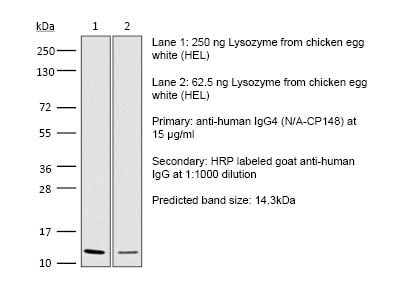
Product Description
Specifications
| Isotype | Human IgG4 |
|---|---|
| Recommended Dilution Buffer | InVivoPure pH 7.0 Dilution Buffer |
| Conjugation | This product is unconjugated. Conjugation is available via our Antibody Conjugation Services. |
| Mutations | S228P, L235E, P329G (SPLEPG) |
| Immunogen | Hen egg lysozyme (HEL) |
| Formulation |
PBS, pH 7.0 Contains no stabilizers or preservatives |
| Endotoxin |
≤0.5EU/mg (≤0.0005EU/μg) Determined by LAL assay |
| Aggregation |
<5% Determined by SEC |
| Purity |
≥95% Determined by SDS-PAGE |
| Sterility | 0.2 µm filtration |
| Production | Purified from CHO cell supernatant in an animal-free facility |
| Purification | Protein A |
| RRID | AB_2927522 |
| Molecular Weight | 150 kDa |
| Murine Pathogen Tests |
Ectromelia/Mousepox Virus: Negative Hantavirus: Negative K Virus: Negative Lactate Dehydrogenase-Elevating Virus: Negative Lymphocytic Choriomeningitis virus: Negative Mouse Adenovirus: Negative Mouse Cytomegalovirus: Negative Mouse Hepatitis Virus: Negative Mouse Minute Virus: Negative Mouse Norovirus: Negative Mouse Parvovirus: Negative Mouse Rotavirus: Negative Mycoplasma Pulmonis: Negative Pneumonia Virus of Mice: Negative Polyoma Virus: Negative Reovirus Screen: Negative Sendai Virus: Negative Theiler’s Murine Encephalomyelitis: Negative |
| Storage | The antibody solution should be stored at the stock concentration at 4°C. Do not freeze. |
| Need a Custom Formulation? | See All Antibody Customization Options |
Product Citations
-
PD-1 protects expanding human T cells from premature restimulation-induced cell death by modulating TCR and CD28 signaling.
In Cell Death Dis on 26 February 2026 by Lee, K. P., Elster, S., et al.
PubMed
Programmed cell death-1 (PD-1) is a co-inhibitory receptor expressed on T cells that dampens TCR and CD28 signaling in the immunological synapse. PD-1 is significantly upregulated on T cells in the tumor microenvironment, where it promotes exhaustion in the context of chronic antigen restimulation. Exhaustion renders T cells hyporesponsive and ineffectual, but potentially resistant to restimulation-induced cell death (RICD). Restimulation-induced cell death (RICD) is a critical propriocidal apoptosis program triggered in activated T cells upon robust TCR re-engagement, which serves to constrain effector T cell expansion and longevity to prevent collateral tissue damage. While the checkpoint function of PD-1 has profound implications for cancer immunotherapy, the role of PD-1 in regulating newly activated T cells remains unclear. We hypothesized that PD-1 attenuates RICD sensitivity in human effector T cells by modulating TCR signal strength. Here we show that transient upregulation of PD-1 helps to protect clonally expanding human CD4+ and CD8 + T cells from premature RICD, with only moderate protection noted in terminally-differentiated, PD-1lo effector CD8 + T cells. Restimulation of T cells with beads containing PD-L1 results in significant apoptosis resistance, dependent on PD-L1 dosage and the proximity of PD-L1 to the TCR and CD28. Interestingly, PD-L1 demonstrated a more significant RICD rescue with CD28 co-ligation as opposed to TCR engagement alone, suggesting PD-1 signaling targets both signaling pathways in this context. Furthermore, biochemical/proteomic data suggest PD-1 modulates proximal signaling downstream of both TCR and CD28 and influences the expression of specific pro/anti-apoptotic proteins that govern RICD sensitivity. Despite the original assumption of PD-1 as a programmed death-inducing protein, our research reveals that homeostatic expression of PD-1 in clonally expanding T cells confers RICD resistance that promotes T cell survival and persistence. These findings present significant implications for understanding how blocking or engaging the PD-L1:PD-1 signaling axis may influence apoptosis sensitivity in both normal and exhausted T cells to alter adaptive immune responses.