
RecombiMAb human IgG1 (N297A) isotype control, anti-hen egg lysozyme
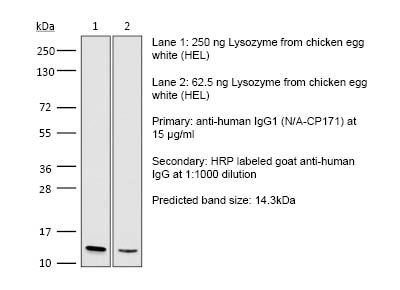
Product Description
Specifications
| Isotype | Human IgG1, κ |
|---|---|
| Recommended Dilution Buffer | InVivoPure pH 7.0 Dilution Buffer |
| Conjugation | This product is unconjugated. Conjugation is available via our Antibody Conjugation Services. |
| Mutations | N297A |
| Immunogen | Hen egg lysozyme (HEL) |
| Formulation |
PBS, pH 7.0 Contains no stabilizers or preservatives |
| Endotoxin |
≤0.5EU/mg (≤0.0005EU/μg) Determined by LAL assay |
| Aggregation |
<5% Determined by SEC |
| Purity |
≥95% Determined by SDS-PAGE |
| Sterility | 0.2 µm filtration |
| Production | Purified from CHO cell supernatant in an animal-free facility |
| Purification | Protein G |
| RRID | AB_3696244 |
| Molecular Weight | 150 kDa |
| Murine Pathogen Tests |
Ectromelia/Mousepox Virus: Negative Hantavirus: Negative K Virus: Negative Lactate Dehydrogenase-Elevating Virus: Negative Lymphocytic Choriomeningitis virus: Negative Mouse Adenovirus: Negative Mouse Cytomegalovirus: Negative Mouse Hepatitis Virus: Negative Mouse Minute Virus: Negative Mouse Norovirus: Negative Mouse Parvovirus: Negative Mouse Rotavirus: Negative Mycoplasma Pulmonis: Negative Pneumonia Virus of Mice: Negative Polyoma Virus: Negative Reovirus Screen: Negative Sendai Virus: Negative Theiler’s Murine Encephalomyelitis: Negative |
| Storage | The antibody solution should be stored at the stock concentration at 4°C. Do not freeze. |
| Need a Custom Formulation? | See All Antibody Customization Options |
Product Citations
-
Development and first-in-human CAR T therapy against the pathognomonic MiT-fusion driven protein GPNMB
In medRxiv on 27 February 2025 by Zemp, F. J., Breckenridge, Z., et al.
-
A Critical Role of Intracellular PD-L1 in Promoting Ovarian Cancer Progression.
In Cells on 19 February 2025 by Huang, R., Nakamura, B., et al.
PubMed
Disrupting the interaction between tumor-cell surface PD-L1 and T cell membrane PD-1 can elicit durable clinical responses. However, only about 10% of ovarian cancer patients respond to PD-1/PD-L1 blockade. Here, we show that PD-L1 expression in ovarian cancer-patient tumors is predominantly intracellular. Notably, PARP inhibitor treatment highly increased intracellular PD-L1 accumulation in both ovarian cancer-patient tumor samples and cell lines. We investigated whether intracellular PD-L1 might play a critical role in ovarian cancer progression. Mutating the PD-L1 acetylation site in PEO1 and ID8Brca1-/- ovarian cancer cells significantly decreased PD-L1 levels and impaired colony formation, which was accompanied by cell cycle G2/M arrest and apoptosis induction. PEO1 and ID8Brca1-/- tumors with PD-L1 acetylation site mutation also exhibited significantly reduced growth in mice. Furthermore, targeting intracellular PD-L1 with a cell-penetrating antibody effectively decreased ovarian tumor-cell intracellular PD-L1 level and induced tumor-cell growth arrest and apoptosis, as well as enhanced DNA damage and STING activation, both in vitro and in vivo. In conclusion, we have shown the critical role of intracellular PD-L1 in ovarian cancer progression.