
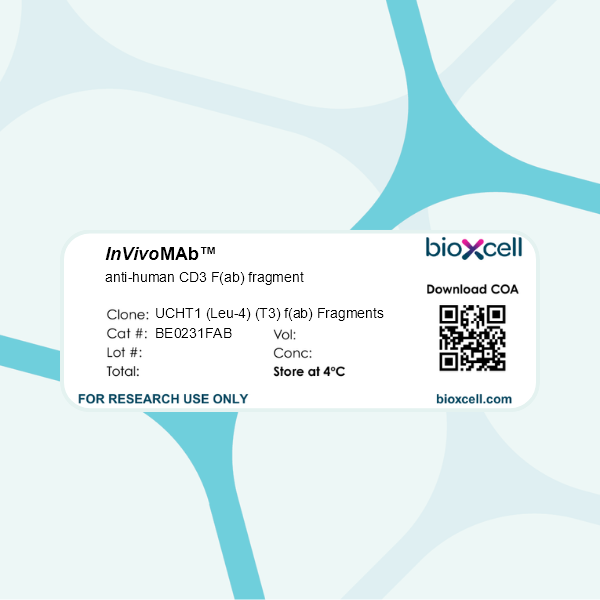
Catalog #BE0231FAB
InVivoMAb anti-human CD3 F(ab) fragment
Clone
UCHT1 (Leu-4) (T3) f(ab) Fragments
Reactivities
Human
Isotype
Mouse IgG1, κ
Product Description
This product is an F(ab) fragment derived from the anti-human CD3 antibody clone UCHT1 (Leu-4) (T3). The UCHT1 (Leu-4) (T3) monoclonal antibody reacts with human CD3ε, a 20 kDa transmembrane cell-surface protein and member of the immunoglobulin superfamily. CD3ε is one of the polypeptide chains that associates with the T cell receptor (TCR) to form the TCR/CD3 complex. CD3ε is expressed on T lymphocytes, NK-T cells, and to varying degrees on developing thymocytes, where it plays a central role in TCR signaling, T cell activation, and antigen recognition. Unlike a full-length antibody, this F(ab) fragment contains only the antigen-binding region and lacks the Fc domain. As a result, the fragment retains specific binding to human CD3ε while eliminating Fc-mediated effector functions such as complement activation and Fc receptor engagement. Because the Fc region is absent, this format is useful in experiments where CD3 engagement or T cell targeting is desired without Fc-dependent immune effects, including antibody-mediated cytotoxicity, Fc receptor–driven cross-linking by accessory cells, or complement activation. Immobilized full-length UCHT1 (Leu-4) (T3) antibody is commonly used to activate human T cells in vitro through crosslinking of the TCR/CD3 complex. In contrast, the F(ab) fragment format may provide a more controlled approach for studies focused on CD3 binding, receptor engagement, or T cell targeting while minimizing secondary Fc-mediated mechanisms that can complicate interpretation of results. This can be particularly useful when researchers want to examine CD3-associated biology without introducing Fc-dependent immune activation. F(ab) fragments targeting CD3 may also be useful in emerging targeted delivery and cell-engineering strategies. For example, CD3-binding fragments can be used to coat nanoparticles, viral vectors, or other delivery systems to selectively target T cells and deliver genetic payloads such as CAR constructs or gene-editing components directly in vivo. By avoiding Fc-mediated immune interactions, F(ab) fragments help preserve target cells while enabling receptor-specific targeting and delivery. This anti-human CD3 F(ab) fragment therefore provides a useful reagent for studies focused on human T cell targeting, CD3 engagement without Fc-mediated effects, and receptor-directed delivery approaches.
Specifications
| Isotype | Mouse IgG1, κ |
|---|---|
| Recommended Dilution Buffer | InVivoPure pH 7.0 Dilution Buffer |
| Immunogen | Human CD3ε |
| Formulation |
PBS, pH 7.0 Contains no stabilizers or preservatives |
| Endotoxin |
≤1EU/mg (≤0.001EU/μg) Determined by LAL assay |
| Aggregation |
<5% Determined by SEC |
| Purity |
≥95% Determined by SDS-PAGE and SEC |
| Sterility | 0.2 µm filtration |
| Production | Papain Digest |
| Purification | Protein G |
| RRID | AB_3751620 |
| Storage | This product should be stored at the stock concentration at 4°C. Do not freeze. |
| Need a Custom Formulation? | See All Antibody Customization Options |