
InVivoPlus anti-mouse IFNγ
in vitro IFNγ neutralization
ELISPOT
Flow cytometry
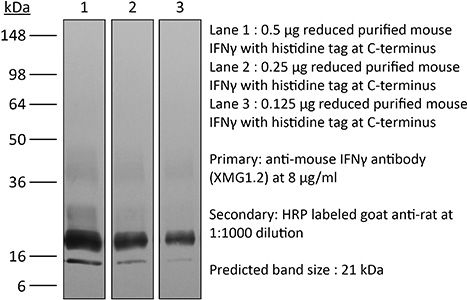
Western blotin vitro Organoids/Organ-on-Chip
Product Description
Bio X Cell is pleased to offer XMG1.2-CP058. XMG1.2-CP058 is a recombinant, chimeric version of the original XMG1.2 with identical variable domain sequences and constant region sequences converted from Rat IgG1, κ to mouse IgG1, κ for use in murine models. Species-matched chimeric antibodies exhibit regulated effector functions—including Fc receptor binding and complement activation—and cause less immunogenicity and formation of anti-drug antibodies (ADAs) than xenogenic antibodies in animal models. The highly controlled sequence and lack of genetic drift in recombinant antibodies provide more reliable and reproducible results over hybridoma derived antibodies.
Specifications
| Isotype | Rat IgG1, κ |
|---|---|
| Recommended Isotype Control(s) | InVivoPlus rat IgG1 isotype control, anti-horseradish peroxidase |
| Recommended Dilution Buffer | InVivoPure pH 8.0T Dilution Buffer |
| Conjugation | This product is unconjugated. Conjugation is available via our Antibody Conjugation Services. |
| Immunogen | Recombinant mouse IFNγ |
| Reported Applications |
in vivo IFNγ neutralization in vitro IFNγ neutralization ELISPOT Flow cytometry Western blotin vitro Organoids/Organ-on-Chip |
| Formulation |
PBS + 0.01% Tween, pH 8.0 Contains no stabilizers or preservatives |
| Endotoxin* |
≤0.5EU/mg (≤0.0005EU/μg) Determined by LAL assay |
| Aggregation* |
<5% Determined by SEC |
| Purity |
≥95% Determined by SDS-PAGE |
| Sterility | 0.2 µm filtration |
| Production | Purified from cell culture supernatant in an animal-free facility |
| Purification | Protein G |
| RRID | AB_1107694 |
| Molecular Weight | 150 kDa |
| Murine Pathogen Tests* |
Ectromelia/Mousepox Virus: Negative Hantavirus: Negative K Virus: Negative Lactate Dehydrogenase-Elevating Virus: Negative Lymphocytic Choriomeningitis virus: Negative Mouse Adenovirus: Negative Mouse Cytomegalovirus: Negative Mouse Hepatitis Virus: Negative Mouse Minute Virus: Negative Mouse Norovirus: Negative Mouse Parvovirus: Negative Mouse Rotavirus: Negative Mycoplasma Pulmonis: Negative Pneumonia Virus of Mice: Negative Polyoma Virus: Negative Reovirus Screen: Negative Sendai Virus: Negative Theiler’s Murine Encephalomyelitis: Negative |
| Storage | The antibody solution should be stored at the stock concentration at 4°C. Do not freeze. |
| Need a Custom Formulation? | See All Antibody Customization Options |
Application References
-
Deng, L., et al (2014). "Irradiation and anti-PD-L1 treatment synergistically promote antitumor immunity in mice" J Clin Invest 124(2): 687-695.
PubMed
High-dose ionizing irradiation (IR) results in direct tumor cell death and augments tumor-specific immunity, which enhances tumor control both locally and distantly. Unfortunately, local relapses often occur following IR treatment, indicating that IR-induced responses are inadequate to maintain antitumor immunity. Therapeutic blockade of the T cell negative regulator programmed death-ligand 1 (PD-L1, also called B7-H1) can enhance T cell effector function when PD-L1 is expressed in chronically inflamed tissues and tumors. Here, we demonstrate that PD-L1 was upregulated in the tumor microenvironment after IR. Administration of anti-PD-L1 enhanced the efficacy of IR through a cytotoxic T cell-dependent mechanism. Concomitant with IR-mediated tumor regression, we observed that IR and anti-PD-L1 synergistically reduced the local accumulation of tumor-infiltrating myeloid-derived suppressor cells (MDSCs), which suppress T cells and alter the tumor immune microenvironment. Furthermore, activation of cytotoxic T cells with combination therapy mediated the reduction of MDSCs in tumors through the cytotoxic actions of TNF. Our data provide evidence for a close interaction between IR, T cells, and the PD-L1/PD-1 axis and establish a basis for the rational design of combination therapy with immune modulators and radiotherapy.
-
Sell, S., et al (2015). "Control of murine cytomegalovirus infection by gammadelta T cells" PLoS Pathog 11(2): e1004481.
PubMed
Infections with cytomegalovirus (CMV) can cause severe disease in immunosuppressed patients and infected newborns. Innate as well as cellular and humoral adaptive immune effector functions contribute to the control of CMV in immunocompetent individuals. None of the innate or adaptive immune functions are essential for virus control, however. Expansion of gammadelta T cells has been observed during human CMV (HCMV) infection in the fetus and in transplant patients with HCMV reactivation but the protective function of gammadelta T cells under these conditions remains unclear. Here we show for murine CMV (MCMV) infections that mice that lack CD8 and CD4 alphabeta-T cells as well as B lymphocytes can control a MCMV infection that is lethal in RAG-1(-/-) mice lacking any T- and B-cells. gammadelta T cells, isolated from infected mice can kill MCMV infected target cells in vitro and, importantly, provide long-term protection in infected RAG-1(-/-) mice after adoptive transfer. gammadelta T cells in MCMV infected hosts undergo a prominent and long-lasting phenotypic change most compatible with the view that the majority of the gammadelta T cell population persists in an effector/memory state even after resolution of the acute phase of the infection. A clonotypically focused Vgamma1 and Vgamma2 repertoire was observed at later stages of the infection in the organs where MCMV persists. These findings add gammadelta T cells as yet another protective component to the anti-CMV immune response. Our data provide clear evidence that gammadelta T cells can provide an effective control mechanism of acute CMV infections, particularly when conventional adaptive immune mechanisms are insufficient or absent, like in transplant patient or in the developing immune system in utero. The findings have implications in the stem cell transplant setting, as antigen recognition by gammadelta T cells is not MHC-restricted and dual reactivity against CMV and tumors has been described.
-
Uddin, M. N., et al (2014). "TNF-alpha-dependent hematopoiesis following Bcl11b deletion in T cells restricts metastatic melanoma" J Immunol 192(4): 1946-1953.
PubMed
Using several tumor models, we demonstrate that mice deficient in Bcl11b in T cells, although having reduced numbers of T cells in the peripheral lymphoid organs, developed significantly less tumors compared with wild-type mice. Bcl11b(-/-) CD4(+) T cells, with elevated TNF-alpha levels, but not the Bcl11b(-/-) CD8(+) T cells, were required for the reduced tumor burden, as were NK1.1(+) cells, found in increased numbers in Bcl11b(F/F)/CD4-Cre mice. Among NK1.1(+) cells, the NK cell population was predominant in number and was the only population displaying elevated granzyme B levels and increased degranulation, although not increased proliferation. Although the number of myeloid-derived suppressor cells was increased in the lungs with metastatic tumors of Bcl11b(F/F)/CD4-Cre mice, their arginase-1 levels were severely reduced. The increase in NK cell and myeloid-derived suppressor cell numbers was associated with increased bone marrow and splenic hematopoiesis. Finally, the reduced tumor burden, increased numbers of NK cells in the lung, and increased hematopoiesis in Bcl11b(F/F)/CD4-Cre mice were all dependent on TNF-alpha. Moreover, TNF-alpha treatment of wild-type mice also reduced the tumor burden and increased hematopoiesis and the numbers and activity of NK cells in the lung. In vitro treatment with TNF-alpha of lineage-negative hematopoietic progenitors increased NK and myeloid differentiation, further supporting a role of TNF-alpha in promoting hematopoiesis. These studies reveal a novel role for TNF-alpha in the antitumor immune response, specifically in stimulating hematopoiesis and increasing the numbers and activity of NK cells.
-
Zander, R. A., et al (2015). "PD-1 Co-inhibitory and OX40 Co-stimulatory Crosstalk Regulates Helper T Cell Differentiation and Anti-Plasmodium Humoral Immunity" Cell Host Microbe 17(5): 628-641.
PubMed
The differentiation and protective capacity of Plasmodium-specific T cells are regulated by both positive and negative signals during malaria, but the molecular and cellular details remain poorly defined. Here we show that malaria patients and Plasmodium-infected rodents exhibit atypical expression of the co-stimulatory receptor OX40 on CD4 T cells and that therapeutic enhancement of OX40 signaling enhances helper CD4 T cell activity, humoral immunity, and parasite clearance in rodents. However, these beneficial effects of OX40 signaling are abrogated following coordinate blockade of PD-1 co-inhibitory pathways, which are also upregulated during malaria and associated with elevated parasitemia. Co-administration of biologics blocking PD-1 and promoting OX40 signaling induces excessive interferon-gamma that directly limits helper T cell-mediated support of humoral immunity and decreases parasite control. Our results show that targeting OX40 can enhance Plasmodium control and that crosstalk between co-inhibitory and co-stimulatory pathways in pathogen-specific CD4 T cells can impact pathogen clearance.
Product Citations
-
Loss of Arginase 2 Promotes Lung Metastasis in immune-competent hosts via Nitric Oxide Synthase 2-Dependent Th17 Response
In bioRxiv on 8 June 2026 by Chou, S., Wang, X., et al.
-
Cardiolipin preserves Treg metabolic fitness and immune homeostasis in the gut.
In Nat Metab on 1 June 2026 by Regina, A., Solagna, F., et al.
PubMed
Loss of host-microbiota balance promotes gut inflammation, colitis and inflammatory bowel disease. Yet, whether host or microbial factors are the critical driver of the pathology remains unclear. Here, we investigate how cardiolipin maintains metabolic fitness of regulatory T (Treg) cells to preserve gut-immune homeostasis. We discover that deleting the cardiolipin-synthesizing enzyme protein tyrosine phosphatase mitochondrial 1 (PTPMT1) in T cells predisposes mice to colitis due to impaired Treg cell function in the absence of dysbiosis. Subsequent pathobiont infections accelerate the progression and severity of gut inflammation. Mechanistically, the absence of cardiolipin impairs Treg cell metabolic fitness and triggers a maladaptive integrated stress response, which can be reversed pharmacologically or genetically, restoring gut homeostasis and extending lifespan in PTPMT1 ΔT mice. Barth syndrome, a genetic disorder marked by severe cardiolipin deficiency, also exhibits gastrointestinal symptoms and inflammation associated with helper T cell imbalance and an active integrated stress response signature. Overall, these results suggest that a cardiolipin-mediated mitonuclear axis in T cells preserves gut-immune homeostasis and dictates outcome in pathobiont infections.
-
IL1R2 Deficiency Unleashes Neutrophil-Mediated Antitumor Potential in Sarcoma.
In Cancer Immunol Res on 4 May 2026 by Mariancini, A., Supino, D., et al.
PubMed
Interleukin 1 (IL1) plays dual functions in cancer. It promotes cancer-related inflammation and progression but also influences leukocyte functional activation. IL1 receptor 2 (IL1R2) functions as an IL1 decoy receptor, inhibiting IL1 activity. In this study, we investigated the contribution of IL1R2 in tuning IL1-dependent effects in mouse models of cancer, including colorectal cancer, lung cancer, and primary and metastatic transplantable and chemically induced sarcoma. Even though the prominent role of IL1 is protumoral, IL1R2 deficiency was selectively associated with reduced sarcoma growth, whereas it was irrelevant in other preclinical models investigated. IL1R2 deficiency was associated with a massive infiltration of neutrophils in the tumor, neutrophilia, and increased extramedullary emergency granulopoiesis. Neutrophils were crucial for tumor control in IL1R2-deficient mice. Immunophenotypic and transcriptional profiling of sarcoma-infiltrating neutrophils revealed that IL1R2 deficiency was associated with higher expression of activation or maturation markers and gene expression reprogramming, with downregulation of pathways associated with protumoral functions. In patients with sarcoma, the IL1R2 deficiency gene signature correlated with better clinical outcomes. Thus, this study shows that IL1R2 tunes IL1-driven cancer-associated emergency granulopoiesis and neutrophil functional activation to an antitumor mode in sarcomas and reveals the antitumor potential of neutrophils in this tumor.
-
The RORγt ligand-binding domain controls the pathogenicity of IL-17A+ T cells differently in autoimmune diseases of the skin and CNS.
In Cell Rep on 23 December 2025 by Miyako, K., Kanno, T., et al.
PubMed
The transcription factor RORγt orchestrates Th17 lineage differentiation, thymic T cell development, and the pathogenesis of several autoimmune disorders. Lipid ligands are required for appropriate regulation of RORγt activity, but it is unclear to what extent lipid recognition controls RORγt function in vivo. Here, we show that the mutation of RORγt alanine-304 in the ligand-binding domain (LBD) to isoleucine (A304I) abrogates lipid-dependent Th17 differentiation and selectively ameliorates γδT17 cell-mediated psoriatic skin inflammation. In contrast, there is no improvement in experimental autoimmune encephalomyelitis in RORγtA304I mice. Consistent with this, the expression of genes characteristic of Th17 cells decreases in RORγtA304I mice, along with a compensatory increase of genes characteristic of Th1-like Th17 cells with pathogenic signatures. Thus, RORγt alanine-304 in the LBD is indispensable for generating γδT17 and conventional Th17 cells and for the suppression of the Th1-like Th17 pathogenic population, which decouples the pathogenicity of skin and CNS autoimmune diseases.