
InVivoMAb anti-rat CD4
in vitro neutralization of CD4
Flow cytometry
Immunohistochemistry (paraffin)
Immunohistochemistry (frozen)
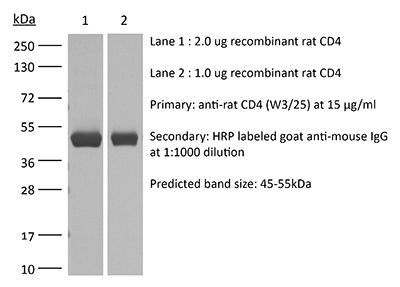
Product Description
Specifications
| Isotype | Mouse IgG1, κ |
|---|---|
| Recommended Isotype Control(s) | InVivoMAb rat IgG2b isotype control, anti-keyhole limpet hemocyanin |
| Recommended Dilution Buffer | InVivoPure pH 7.0 Dilution Buffer |
| Reported Applications |
in vivo down-regulation of surface CD4 in vitro neutralization of CD4 Flow cytometry Immunohistochemistry (paraffin) Immunohistochemistry (frozen) |
| Formulation |
PBS, pH 7.0 Contains no stabilizers or preservatives |
| Endotoxin |
≤1EU/mg (≤0.001EU/μg) Determined by LAL assay |
| Purity |
≥95% Determined by SDS-PAGE |
| Sterility | 0.2 µm filtration |
| Production | Purified from cell culture supernatant in an animal-free facility |
| Purification | Protein G |
| Molecular Weight | 150 kDa |
| Storage | The antibody solution should be stored at the stock concentration at 4°C. Do not freeze. |
| Need a Custom Formulation? | See All Antibody Customization Options |
Application References
-
Williams AF, Galfrè G, Milstein C (1977). "Analysis of cell surfaces by xenogeneic myeloma-hybrid antibodies: differentiation antigens of rat lymphocytes" Cell 10.1016/0092-8674(77)90266-5.
PubMed
-
Thullen TD, Ashbaugh AD, Daly KR, Linke MJ, Steele PE, Walzer PD (2003). "New rat model of Pneumocystis pneumonia induced by anti-CD4(+) T-lymphocyte antibodies" Infect Immun 10.1128/IAI.71.11.6292-6297.2003.
PubMed
The CD4(+) T lymphocyte plays a central role in host defense against Pneumocystis pneumonia but has received only limited attention in rats. CD4(+) T-cell-depleting (OX-38) and nondepleting (W3/25) monoclonal antibodies, which recognize an identical or adjacent epitope, were administered for up to 14 weeks to Lewis rats that had been exposed to PNEUMOCYSTIS: While OX-38 produced a greater decrease in circulating CD4(+) cells than W3/25, both antibody treatments resulted in similar effects on the health of the rats and the levels of Pneumocystis pneumonia, which were milder than those found with corticosteroids. W3/25 also did not enhance the severity of Pneumocystis pneumonia achieved with corticosteroids alone. We conclude that CD4(+) cell function is more important than CD4(+) cell number in host defense against Pneumocystis in the rat and that this new model permits study of opportunistic infections in the rat without the confounding effects of corticosteroids.
-
Acroute DV, Lafitte S, Dive D, Khalife J, Pierrot C (2010). "A role for CD4+ and CD8+ cells and not for CD25+ cells in the control of Plasmodium berghei Anka blood stage parasites in rats" Parasite 10.1051/parasite/2010171053.
PubMed
In previous studies of the infection of rats by P. berghei Anka, we have shown that primary blood stage infection induced the expansion of CD4+ T cells and CD8+ T cells in adult resistant rats while the number of CD4+CD25+ cells was found to be higher in young susceptible rats. In this work, the respective contribution of each cell population was determined in young and adult rats treated with monoclonal antibodies. Down-regulation of surface CD25 molecules, including those expressed by CD4+ cells did not significantly enhance the capacity of young rats to control the development of erythrocytic stages or modify the course of infection in adult infected rats. However, we observed a significant loss of protection when adult rats were treated with anti-CD4 mAb (W3/25) with higher blood parasitemia levels and approximately 50% of rats succumbed to infection. More importantly and in contrast to earlier studies performed in mice, we found a significant increase in blood parasite levels and a significant delay in parasite clearance in adult rats treated with anti-CD8 mAb OX8, known to deplete CD8+ cells. These results suggest that CD8+ cells play a critical role in the development of immune responses in rats to control the replication of blood stage parasites.
-
Pelegrí C, Paz Morante M, Castellote C, Castell M, Franch A (1995). "Administration of a nondepleting anti-CD4 monoclonal antibody (W3/25) prevents adjuvant arthritis, even upon rechallenge: parallel administration of a depleting anti-CD8 monoclonal
PubMed
The aim of this study was to determine the effects of the anti-CD4 monoclonal antibody (mAb) W3/25, found to be nondepleting, on the onset of rat adjuvant arthritis (AA), and, in addition, to ascertain whether depletion of CD8+ cells during the same period could interfere with those effects. Female Wistar rats in which AA had been induced were treated with W3/25 and/or OX8 (anti-rat CD8) mAb during the latency period of arthritis. W3/25 alone or in combination with OX8 prevented the inflammatory process of AA. When the protected groups were rechallenged with a second dose of Mycobacterium butyricum no arthritis was observed. Protected and nonprotected arthritic animals developed the same anti-mycobacteria antibody levels as the arthritic control group. This study indicates that a nondepleting anti-CD4 mAb can prevent AA, while CD8+ lymphocytes do not appear relevant for the development of AA and do not seem to have a regulatory role for CD4+ cells.