
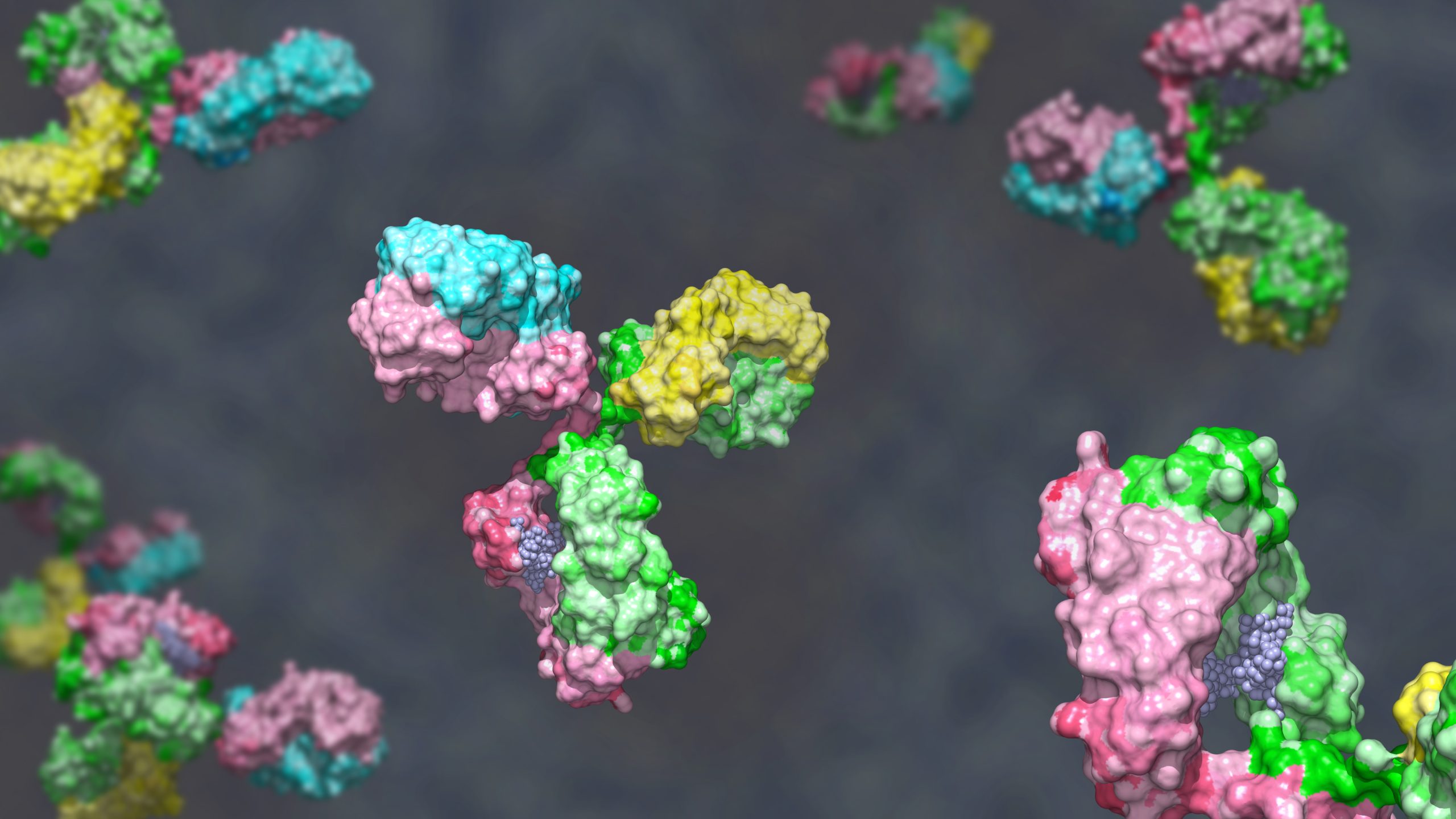

Early Dual-Target Insights in Standard Models Strengthen Translational Research
As dual-target mechanisms gain prominence in oncology and immunology research, drug discovery and translational teams are increasingly asking more complex biological questions earlier in discovery to better inform downstream therapeutic strategy and candidate prioritization.1 Pathways that were once studied independently are now understood as components of dynamic, interdependent networks. This shift naturally moves dual-target interrogation upstream into discovery and early preclinical work, long before humanized systems or therapeutic candidates are in play.
For many programs, the challenge is not recognizing the relevance of dual-target biology, but determining how to interrogate those mechanisms early enough to influence downstream strategy. This is where research-use-only (RUO) bispecific antibodies, and particularly anti-mouse bispecifics, have become valuable tools. They allow researchers to evaluate two pathways within the same biological context, using the standard mouse models already central to early in vivo research. In drug discovery settings, these tools are particularly valuable for early proof-of-concept studies in syngeneic mouse models, where intact biology enables comparison against therapeutic-like benchmark mechanisms.
The result? Earlier mechanistic grounding and a clearer foundation for translational decisions.
Why Dual-Target Questions Are Emerging Earlier
Biology rarely behaves like a single pathway system. Immune checkpoints interact, stromal and tumor signals co-regulate, and co-stimulatory mechanisms often depend on a second receptor being engaged.
As a result, translational teams are increasingly asking:
- What happens when two pathways are modulated together?
- Do these pathways converge, oppose one another, or reshape downstream signaling?
Answering these questions earlier in the program strengthens the logic behind target selection and can help improve the rationale guiding later decisions. RUO bispecific antibodies provide a controlled, modular way to test these questions without relying on clinical-grade materials. Anti-mouse bispecific formats give researchers the ability to investigate dual-target mechanisms in standard mouse systems, enabling earlier insight before moving into more specialized human-relevant platforms. While exploratory systems biology studies may require custom bispecific formats, translational discovery programs often rely on ready-to-use murine bispecifics modeled after known therapeutic architectures to inform early development decisions.
The Value of Early Dual-Target Interrogation in Standard Mouse Models
Mouse models remain the most accessible and widely used systems for early mechanistic work.2 Researchers are familiar with the disease models, immune context, endpoints, and sources of variability in mouse systems. Bringing dual-target tools into this environment offers several benefits.
Anti-mouse bispecific antibodies make it possible to:
- Evaluate signaling convergence in a familiar immune context
- Study immune co-regulation under controlled activation or inhibition conditions
- Assess tumor–immune interactions when two pathways are perturbed simultaneously
This clarity allows teams to test hypotheses earlier, make more informed go/no-go decisions, and reduce uncertainty when evaluating whether a dual-target mechanism warrants further investigation.
Why Mechanistic Readouts Matter Before Using More Specialized Systems
Human-relevant systems such as organoids, 3D co-cultures, and humanized mouse models answer essential translational questions, but they also introduce cost, complexity, and throughput limitations.3 Teams want to enter these systems with well-defined hypotheses, not exploratory questions.
Early readouts from well-established mouse models serve several critical functions:
- Refining the biological rationale behind a target pair
- Selecting the appropriate bispecific format or architecture for later work
- Identifying which mechanistic interactions are worth benchmarking in human-relevant systems
A structured progression, mouse model first, then human-relevant, protects resources while ensuring that each experiment is positioned to deliver meaningful insight.
Building Continuity Across Model Systems Strengthens Translational Reliability
Continuity is often overlooked in translational research. When early mouse studies and later human-relevant assays use bispecific constructs modeled after known therapeutic architectures, researchers can compare pathway behavior across systems with fewer confounding variables.
This consistency helps teams evaluate:
- Whether dual-target functional readouts align across models
- How immune activation or suppression changes in human-relevant systems
- Whether pathway synergy or opposition persists across species
Ready-to-Use Bispecifics as Enablers of Faster, More Continuous Discovery
A practical barrier in dual-target research is simply waiting for the right tools. Traditional bispecific production timelines can delay early investigation, push mechanistic questions further downstream, or constrain the number of constructs a team can feasibly test.4
Ready-to-ship bispecific antibodies modeled after known therapeutic architectures help overcome this bottleneck. By providing immediate access to in vivo-ready constructs designed for mechanistic evaluation, researchers can initiate dual-target studies earlier and maintain continuity as programs progress across model systems.
This earlier access supports clearer mechanistic insight, smoother transitions between mouse and human-relevant platforms, and sustained study momentum, particularly for discovery and translational teams managing multiple programs in parallel.
How Bispecific Format Choice Shapes the Mechanistic Questions You Can Answer
Different bispecific architectures (KIH, H&T, BiTE-style, and others) have different biological properties.5 They influence:
- Target proximity or crosslinking
- Receptor geometry and spatial orientation
- The degree and nature of immune engagement
Matching the format to the mechanistic question helps reduce the risk of redesigning studies later and helps ensure that early insights remain relevant as research progresses into more advanced systems.
Case Scenarios: How Early Dual-Target Insight Can Support De-Risking Downstream Work
These scenarios illustrate the type of clarity early anti-mouse bispecific work can provide:
- Determining whether two immune checkpoints modulate each other in vivo before investing in organoid models
- Testing tumor–stromal crosstalk under dual perturbation to prioritize downstream assays
- Comparing pathway behavior in mouse versus human-relevant systems to refine translational strategy
Practical Considerations for Designing a Dual-Target Workflow
Researchers planning dual-target studies often consider:
- When to begin with anti-mouse formats
- How to maintain construct continuity across model transitions
- When to introduce human or human-relevant systems
- How to standardize assay design to reduce variability
- How to ensure Fc behavior, construct architecture, and reagent quality remain consistent
These decisions directly influence data coherence and reproducibility.
How Bio X Cell Bispecifics Support This Workflow
Bio X Cell’s bispecific antibodies are designed to align with this structured, translationally relevant workflow:
- Derived from in vivo-validated clones for therapeutic-like benchmarking, or from custom provided targets when program requirements extend beyond catalog offering
- Modeled after known therapeutic architectures to support mechanistic continuity
- Ultrapure, low-endotoxin formulations suitable for sensitive in vivo and in vitro organoid/organ-on-chip systems
- Ready-to-ship availability to help reduce delays and enable earlier evaluation
- Custom bispecifics engineered to mirror program-specific targets, formats, and study requirements when catalog tools are not sufficient
These attributes help teams maintain consistency and reduce technical barriers during exploratory and translational stages.
Conclusion:
Mechanistic Insight + Workflow Continuity = Stronger Translational Grounding
Early dual-target studies in accessible mouse systems provide a more confident foundation for translational decisions. By maintaining construct continuity across platforms and removing barriers to early evaluation, researchers gain clearer biological understanding and more reliable data for downstream planning.
Ready-to-use bispecific antibodies strengthen this progression by offering immediate access to tools aligned with the expectations of preclinical and translational workflows.

References
- Marin-Acevedo JA et al. (2018) Next generation of immune checkpoint therapy in cancer. Journal of Hematology & Oncology. Full text
- Mak IWY et al. (2014) Lost in translation: animal models and clinical trials in cancer treatment. Full text
- Kim J et al. (2020) Human organoids: model systems for human biology and medicine. Full text
- Brinkmann U, Kontermann RE. (2017) The making of bispecific antibodies. Full text
- Nie S et al. (2020) Biology drives the discovery of bispecific antibodies as innovative therapeutics. Full text