
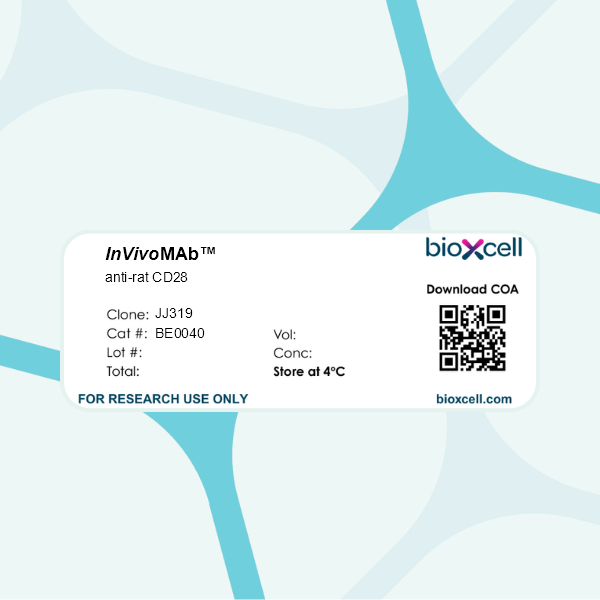
InVivoMAb anti-rat CD28
Flow cytometry
Product Description
Specifications
| Isotype | Mouse IgG1, κ |
|---|---|
| Recommended Isotype Control(s) | InVivoMAb mouse IgG1 isotype control, unknown specificity |
| Recommended Dilution Buffer | InVivoPure pH 7.0 Dilution Buffer |
| Conjugation | This product is unconjugated. Conjugation is available via our Antibody Conjugation Services. |
| Immunogen | Rat CD28-transfected BALB/c mouse A2OJ cell line |
| Reported Applications |
in vitro T cell stimulation/activation Flow cytometry |
| Formulation |
PBS, pH 7.0 Contains no stabilizers or preservatives |
| Endotoxin |
≤1EU/mg (≤0.001EU/μg) Determined by LAL assay |
| Purity |
≥95% Determined by SDS-PAGE |
| Sterility | 0.2 µm filtration |
| Production | Purified from cell culture supernatant in an animal-free facility |
| Purification | Protein G |
| RRID | AB_1107626 |
| Molecular Weight | 150 kDa |
| Storage | The antibody solution should be stored at the stock concentration at 4°C. Do not freeze. |
| Need a Custom Formulation? | See All Antibody Customization Options |
Application References
-
Guendisch, U., et al (2017). "Pharmacological inhibition of RORγt suppresses the Th17 pathway and alleviates arthritis in vivo" PLoS One 12(11): e0188391.
PubMed
Retinoic acid receptor-related-orphan-receptor-C (RORγt) is the key transcription factor that is driving the differentiation of IL-17 producing T-helper 17 (Th17) cells that are implicated in the pathology of various autoimmune and inflammatory diseases. Based on the importance of RORγt in promoting Th17-driven pathology, there is considerable interest to develop low-molecular-weight compounds with the aim of inhibiting the transcriptional activity of this nuclear hormone receptor. In this article, we describe the in vitro and in vivo pharmacology of a potent and selective small-molecular-weight RORγt inverse agonist. The compound binds to the ligand binding domain (LBD) of RORγt leading to displacement of a co-activator peptide. We show for the first time that a RORγt inverse agonist down-regulates permissive histone H3 acetylation and methylation at the IL17A and IL23R promoter regions, thereby providing insight into the transcriptional inhibition of RORγt-dependent genes. Consistent with this, the compound effectively reduced IL-17A production by polarized human T-cells and γδT-cells and attenuated transcription of RORγt target genes. The inhibitor showed good in vivo efficacy in an antigen-induced arthritis model in rats and reduced the frequencies of IL-17A producing cells in ex vivo recall assays. In summary, we demonstrate that inhibiting RORγt by a low-molecular-weight inhibitor results in efficient and selective blockade of the pro-inflammatory Th17/IL-17A pathway making it an attractive target for Th17-mediated disorders.
-
Guntermann, C., et al (2017). "Retinoic-acid-orphan-receptor-C inhibition suppresses Th17 cells and induces thymic aberrations" JCI Insight 2(5): e91127.
PubMed
Retinoic-acid-orphan-receptor-C (RORC) is a master regulator of Th17 cells, which are pathogenic in several autoimmune diseases. Genetic Rorc deficiency in mice, while preventing autoimmunity, causes early lethality due to metastatic thymic T cell lymphomas. We sought to determine whether pharmacological RORC inhibition could be an effective and safe therapy for autoimmune diseases by evaluating its effects on Th17 cell functions and intrathymic T cell development. RORC inhibitors effectively inhibited Th17 differentiation and IL-17A production, and delayed-type hypersensitivity reactions. In vitro, RORC inhibitors induced apoptosis, as well as Bcl2l1 and BCL2L1 mRNA downregulation, in mouse and nonhuman primate thymocytes, respectively. Chronic, 13-week RORC inhibitor treatment in rats caused progressive thymic alterations in all analyzed rats similar to those in Rorc-deficient mice prior to T cell lymphoma development. One rat developed thymic cortical hyperplasia with preneoplastic features, including increased mitosis and reduced IKAROS expression, albeit without skewed T cell clonality. In summary, pharmacological inhibition of RORC not only blocks Th17 cell development and related cytokine production, but also recapitulates thymic aberrations seen in Rorc-deficient mice. While RORC inhibition may offer an effective therapeutic principle for Th17-mediated diseases, T cell lymphoma with chronic therapy remains an apparent risk.
-
Chen, X. L., et al (2015). "GIMAP5 Deficiency Is Associated with Increased AKT Activity in T Lymphocytes" PLoS One 10(10): e0139019.
PubMed
Long-term survival of T lymphocytes in quiescent state is essential to maintain their cell numbers in secondary lymphoid organs. In mice and in rats, the loss of functional GTPase of the immune associated nucleotide binding protein 5 (GIMAP5) causes peripheral T lymphopenia due to spontaneous death of T cells. The underlying mechanism responsible for the disruption of quiescence in Gimap5 deficient T cells remains largely unknown. In this study, we show that loss of functional Gimap5 results in increased basal activation of mammalian target of rapamycin (mTOR), independent of protein phosphatase 2A (PP2A) or AMP-activated protein kinase (AMPK). Our results suggest that the constitutive activation of the phosphoinositide 3-kinase (PI3K) pathway may be one of the consequences of the absence of functional GIMAP5.
-
Fichtner, A. S., et al (2015). "Function and expression of CD1d and invariant natural killer T-cell receptor in the cotton rat (Sigmodon hispidus)" Immunology .
PubMed
The cotton rat (Sigmodon hispidus) belongs to the rodent family of Cricetidae and provides a powerful model to study the pathogenesis of human respiratory viruses and measles virus. Recent studies in other rodent models have suggested a role for invariant natural killer T (iNKT) cells in antiviral immunity and vaccination against respiratory virus infections. Using new experimental tools, we provide the first evidence for a functional CD1d cell molecule (crCD1d) and iNKT T-cell receptor in cotton rats. The crCD1d cDNA sequence was identified and crCD1d transductants showed that monoclonal antibody WTH-2 stains crCD1d as efficiently as mouse or rat CD1d. The expression of crCD1d was clearly weaker for thymocytes and B cells, and higher for T cells, which is different to what is found in murine species. The antigen-presenting capacity of crCD1d was demonstrated with crCD1d-immunoglobulin dimers loaded with the glycolipid PBS57, which bound iNKT T-cell receptors. Evidence for functional cotton rat iNKT cells was provided by detection of interferon-gamma and interleukin-4 in cultures of splenocytes stimulated with PBS57 and alpha-galactosylceramide and by specific staining of about 0.2% of splenocytes with PBS57-loaded crCD1d dimers. Canonical AV14/AJ18 rearrangements were identified and found to contain multiple members of the AV14 (AV11) family. One of them was expressed and found to bind CD1d dimers. In summary, these data provide the first evidence for functional CD1d molecules and iNKT T-cell receptors in cotton rats and provide the tools to analyse them both in the cotton rat model of infectious diseases.
Product Citations
-
Pharmacological inhibition of RORγt suppresses the Th17 pathway and alleviates arthritis in vivo.
In PLoS ONE on 21 November 2017 by Guendisch, U., Weiss, J., et al.
PubMed
Retinoic acid receptor-related-orphan-receptor-C (RORγt) is the key transcription factor that is driving the differentiation of IL-17 producing T-helper 17 (Th17) cells that are implicated in the pathology of various autoimmune and inflammatory diseases. Based on the importance of RORγt in promoting Th17-driven pathology, there is considerable interest to develop low-molecular-weight compounds with the aim of inhibiting the transcriptional activity of this nuclear hormone receptor. In this article, we describe the in vitro and in vivo pharmacology of a potent and selective small-molecular-weight RORγt inverse agonist. The compound binds to the ligand binding domain (LBD) of RORγt leading to displacement of a co-activator peptide. We show for the first time that a RORγt inverse agonist down-regulates permissive histone H3 acetylation and methylation at the IL17A and IL23R promoter regions, thereby providing insight into the transcriptional inhibition of RORγt-dependent genes. Consistent with this, the compound effectively reduced IL-17A production by polarized human T-cells and γδT-cells and attenuated transcription of RORγt target genes. The inhibitor showed good in vivo efficacy in an antigen-induced arthritis model in rats and reduced the frequencies of IL-17A producing cells in ex vivo recall assays. In summary, we demonstrate that inhibiting RORγt by a low-molecular-weight inhibitor results in efficient and selective blockade of the pro-inflammatory Th17/IL-17A pathway making it an attractive target for Th17-mediated disorders.
-
BATF2 is a glutamine-responsive tumour suppressor required for type-I interferon-dependent anti-tumour immunity.
In Nat Commun on 29 December 2025 by Gong, W., Taner, H. F., et al.
PubMed
Recent evidence highlights the significance of a new type of tumour suppressors, which are not frequently mutated but inhibited by metabolic cues in cancers. Here, we identify BATF2 as a tumour suppressor whose expression is epigenetically silenced by glutamine in Head and Neck Squamous Cell Carcinomas (HNSCC). BATF2 correlates with type-I interferon and Th1 signatures in human HNSCC, with correlation coefficients even stronger than those of the positive control, STING. The phosphorylation of BATF2 at serine 227 promotes the oligomerization of STING. BATF2 deficiency or high glutamine levels result in higher oxygen consumption rates and metabolic profiles unfavorable for type-I interferon production. An isocaloric glutamine-rich diet abolishes STING-mediated effector cell expansion in tumours, weakening STING agonist-induced tumour control. Cancer cell-specific BATF2 expression promotes an Id2-centered T-cell effector signature, reduces T-cell exhaustion, and triggers spontaneous HNSCC rejection in a type-I interferon-dependent fashion. Utilizing syngeneic subcutaneous, orthotopic, and 24-week-long cigarette smoke carcinogen-induced HNSCC models, we demonstrate that host Batf2 deficiency results in increased infiltration of CD206+ myeloid cells and reduced effector CD8+ T-cells, accelerating the initiation of cancers. Overall, we reveal a tumour suppressor BATF2 whose loss is mediated by unique metabolic cues in the TME and drives cancer immune escape.
-
Retinoic-acid-orphan-receptor-C inhibition suppresses Th17 cells and induces thymic aberrations.
In JCI Insight on 9 March 2017 by Guntermann, C., Piaia, A., et al.
PubMed
Retinoic-acid-orphan-receptor-C (RORC) is a master regulator of Th17 cells, which are pathogenic in several autoimmune diseases. Genetic Rorc deficiency in mice, while preventing autoimmunity, causes early lethality due to metastatic thymic T cell lymphomas. We sought to determine whether pharmacological RORC inhibition could be an effective and safe therapy for autoimmune diseases by evaluating its effects on Th17 cell functions and intrathymic T cell development. RORC inhibitors effectively inhibited Th17 differentiation and IL-17A production, and delayed-type hypersensitivity reactions. In vitro, RORC inhibitors induced apoptosis, as well as Bcl2l1 and BCL2L1 mRNA downregulation, in mouse and nonhuman primate thymocytes, respectively. Chronic, 13-week RORC inhibitor treatment in rats caused progressive thymic alterations in all analyzed rats similar to those in Rorc-deficient mice prior to T cell lymphoma development. One rat developed thymic cortical hyperplasia with preneoplastic features, including increased mitosis and reduced IKAROS expression, albeit without skewed T cell clonality. In summary, pharmacological inhibition of RORC not only blocks Th17 cell development and related cytokine production, but also recapitulates thymic aberrations seen in Rorc-deficient mice. While RORC inhibition may offer an effective therapeutic principle for Th17-mediated diseases, T cell lymphoma with chronic therapy remains an apparent risk.