
RecombiMAb anti-mouse Ly6G
in vivo MDSC depletion
Western Blot
Immunofluorescence*
Immunohistochemistry (paraffin)*
Immunohistochemistry (frozen)*
Flow cytometry*
*Reported for the original rat IgG2a 1A8 antibody
(switched from rat IgG2a)
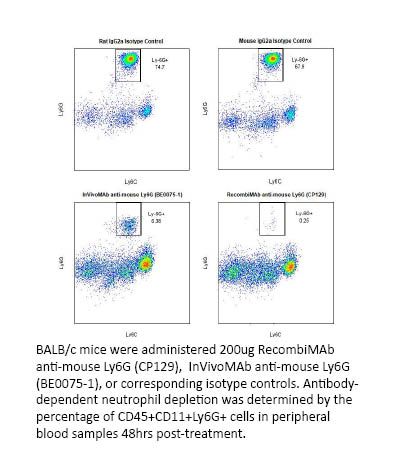
Product Description
Specifications
| Isotype | Mouse IgG2a, κ |
|---|---|
| Recommended Isotype Control(s) | RecombiMAb mouse IgG2a isotype control, anti-hen egg lysozyme |
| Recommended Dilution Buffer | InVivoPure pH 7.0 Dilution Buffer |
| Conjugation | This product is unconjugated. Conjugation is available via our Antibody Conjugation Services. |
| Immunogen | EL4J cells transfected with Ly6G |
| Reported Applications |
in vivo neutrophil depletion in vivo MDSC depletion Western Blot Immunofluorescence* Immunohistochemistry (paraffin)* Immunohistochemistry (frozen)* Flow cytometry* *Reported for the original rat IgG2a 1A8 antibody |
| Formulation |
PBS, pH 7.0 Contains no stabilizers or preservatives |
| Endotoxin |
≤0.5EU/mg (≤0.0005EU/μg) Determined by LAL assay |
| Aggregation |
<5% Determined by SEC |
| Purity |
≥95% Determined by SDS-PAGE |
| Sterility | 0.2 µm filtration |
| Production | Purified from CHO cell supernatant in an animal-free facility |
| Purification | Protein G |
| RRID | AB_3696227 |
| Molecular Weight | 150 kDa |
| Murine Pathogen Tests |
Ectromelia/Mousepox Virus: Negative Hantavirus: Negative K Virus: Negative Lactate Dehydrogenase-Elevating Virus: Negative Lymphocytic Choriomeningitis virus: Negative Mouse Adenovirus: Negative Mouse Cytomegalovirus: Negative Mouse Hepatitis Virus: Negative Mouse Minute Virus: Negative Mouse Norovirus: Negative Mouse Parvovirus: Negative Mouse Rotavirus: Negative Mycoplasma Pulmonis: Negative Pneumonia Virus of Mice: Negative Polyoma Virus: Negative Reovirus Screen: Negative Sendai Virus: Negative Theiler’s Murine Encephalomyelitis: Negative |
| Storage | The antibody solution should be stored at the stock concentration at 4°C. Do not freeze. |
| Need a Custom Formulation? | See All Antibody Customization Options |
Application References
-
Mackin SR, Liang C-Y, Karl CE, Kleverov M, Khan MZ, Selvam T, Mack M, Alter G, Guarino B, Corti D, Schmid MA, Diamond MS (2026). "Fc-engineered antibodies enhance protection against SARS-CoV-2 lung infection and inflammation" mBio 17(5):e0055726.
PubMed
As the SARS-CoV-2 pandemic progressed, many monoclonal antibodies (mAbs) that neutralized infection against initial strains lost potency against later variants due to the accumulation of mutations in the spike protein. Nonetheless, some mAbs, including the parent of the therapeutically used sotrovimab, S309, remained protective in animals against Omicron variants despite reduced neutralizing potential, with inhibitory activity likely sustained by Fc-mediated effector functions. Here, we identify Fc variants of S309 that confer enhanced protection against SARS-CoV-2 infection in a humanized Fcγ receptor transgenic (Hu-FcγR Tg) mouse model of infection. Versions of S309 that are afucosylated (AFUC) and contain a G236A (GA) mutation in the Fc region showed increased binding to FcγRs IIA, IIIA, and IIIB and enhanced phagocytic activity in cell culture-based assays. Treatment with S309-GA-AFUC resulted in less viral burden, inflammation, and pulmonary ventilatory dysfunction in the lungs of Hu-FcγR Tg mice challenged with SARS-CoV-2 strains compared to the parental S309 mAb or a variant lacking Fc effector functions (S309-GRLR). The enhanced protection in the lung conferred by S309-GA-AFUC required trafficking of CCR2-expressing monocytes to reduce SARS-CoV-2 viral burden and lung injury. Flow cytometry and RNA sequencing analyses showed that compared to the parental S309 mAb, S309-GA-AFUC treatment reduced the inflammatory state and induced a reparative transcriptional signature in monocytes and interstitial macrophages. Overall, our findings demonstrate that Fc engineering to increase antibody binding to activating FcγRs can strengthen effector functions, shape myeloid transcriptional profiles, and enhance protection against SARS-CoV-2 infection in vivo. Importance: Although therapeutic antibodies had success in protecting vulnerable individuals from severe COVID-19 during the early stages of the pandemic, many lost effectiveness as SARS-CoV-2 accumulated mutations that compromised neutralizing activity. Our experiments show that antibody protection against SARS-CoV-2 strains can be enhanced by genetically engineering the Fc region or altering its N-linked glycosylation to improve interactions with FcγRs on host immune cells. Modified versions of S309, the parent of the clinically used sotrovimab antibody, more effectively reduce viral burden and inflammation in the lung and shape protective transcriptional responses, which, together, result in improved lung ventilatory function and outcome after SARS-CoV-2 infection. Thus, antibody engineering can serve as a strategy to enhance therapeutic activity against rapidly evolving viruses with the potential to escape neutralization.
-
Janova H, Zhao FR, Akgul A, Schatz M, Alligood DM, Alvarado DM, Thackray LB, Stappenbeck TS, Diamond MS (2026). "Macrophage-glia interactions regulate immune damage to enteric neurons during West Nile virus infection" Proc Natl Acad Sci U S A 123(11)
PubMed
Functional gastrointestinal (GI) tract disorders affect a substantial proportion of the global population and are often preceded by intestinal infections that cause injury to enteric neurons and glia through unrestrained immune responses. However, the mechanisms that limit infection-induced inflammation and protect the enteric nervous system remain poorly understood. Here, we defined such neuron-glia-macrophage interactions after West Nile virus (WNV) infection; this model neurotropic virus causes GI tract dysmotility in mice via injury of enteric neurons through a T cell-mediated cytolytic mechanism. In response to WNV infection, RNA sequencing analysis showed that resident muscularis macrophages upregulate antiviral, proinflammatory, and immunomodulatory genes. Whereas pharmacological depletion of resident macrophages did not affect the viral burden in the GI tract, it instead reshaped the enteric glial response to WNV, resulting in excessive production of T cell and neutrophil chemoattractants. The amplified recruitment of these immune cell types worsened enteric neuronal injury. Together, our findings identify resident muscularis macrophages as key regulators of glia-driven inflammation during enteric viral infection and reveal their role in protecting enteric neurons from immune-mediated damage.