
Catalog #CP091
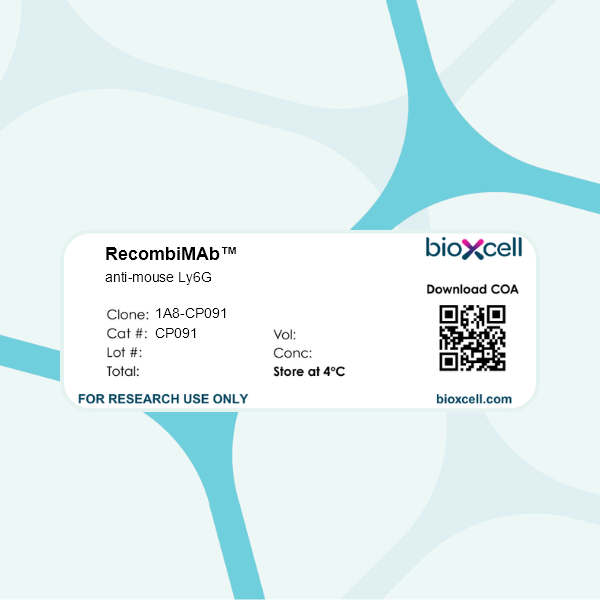
RecombiMAb anti-mouse Ly6G
Clone
1A8-CP091
Reactivities
Mouse
Applications
in vivo neutrophil depletion
in vivo MDSC depletion
Western Blot
Immunofluorescence*
Immunohistochemistry (paraffin)*
Immunohistochemistry (frozen)*
Flow cytometry*
*Reported for the original rat IgG2a 1A8 antibody
in vivo MDSC depletion
Western Blot
Immunofluorescence*
Immunohistochemistry (paraffin)*
Immunohistochemistry (frozen)*
Flow cytometry*
*Reported for the original rat IgG2a 1A8 antibody
Isotype
Mouse IgG2c
(switched from rat IgG2a)
(switched from rat IgG2a)
You may also be interested in:
Product Description
The 1A8-CP091 monoclonal antibody is a recombinant Fc-engineered chimeric version of the original 1A8 antibody. The variable domain sequences are identical to the original 1A8 hybridoma-derived antibody, but the constant region sequences have been switched from rat IgG2a to mouse IgG2c. Recombinant versions of clone 1A8 have demonstrated superior Ly6+ cell depletion in peripheral blood, spleen and bone marrow compared to the hybridoma-derived material. Studies have also shown mouse strain-specific differences in the efficiency of anti-Ly6G 1A8 neutrophil depletion with C57/BL mice showing significant reduction in Ly6+ cell depletion compared to BALB/c mice. Mouse strains such as C57Bl/6, C57Bl/10, SJL, and NOD mice possess the Igh1-b allele resulting in only the expression of the IgG2c isotype. Mouse strains such as BALB/c and Swiss Webster mice possess the Igh1-a allele which results in only the expression of the IgG2a isotype. It is important to consider matching the Ig-haplotype of the receiving mice to the isotype of the injected antibody to avoid eliciting undesired immune responses. 1A9-CP091 has an effector function competent Fc domain allowing for activation of FcγRs to trigger antibody‑dependent cellular cytotoxicity (ADCC), antibody‑dependent cellular phagocytosis (ADCP), complement‑dependent cytotoxicity (CDC) and opsonization to promote target cell depletion. Additionally, species matched chimeric antibodies result in less immunogenicity and formation of anti-drug antibodies (ADAs) than xenogenic antibodies in animal models.
The 1A8-CP091 monoclonal antibody reacts with mouse Ly6G, a 21-25 kDa member of the Ly-6 superfamily of GPI-anchored cell surface proteins with roles in cell signaling and cell adhesion. Ly6G is expressed differentially during development by cells in the myeloid lineage including monocytes, macrophages, granulocytes, and neutrophils. Monocytes typically express Ly6G transiently during development while mature granulocytes and peripheral neutrophils retain expression making Ly6G a good cell surface marker for these populations. Unlike the RB6-8C5 antibody, the 1A8-CP091 antibody reacts specifically with mouse Ly6G with no reported cross reactivity with mouse Ly6C.
References:
Pollenus, Emilie et al. “Limitations of neutrophil depletion by anti-Ly6G antibodies in two heterogenic immunological models.” Immunology letters vol. 212 (2019): 30-36. doi:10.1016/j.imlet.2019.06.006
The 1A8-CP091 monoclonal antibody reacts with mouse Ly6G, a 21-25 kDa member of the Ly-6 superfamily of GPI-anchored cell surface proteins with roles in cell signaling and cell adhesion. Ly6G is expressed differentially during development by cells in the myeloid lineage including monocytes, macrophages, granulocytes, and neutrophils. Monocytes typically express Ly6G transiently during development while mature granulocytes and peripheral neutrophils retain expression making Ly6G a good cell surface marker for these populations. Unlike the RB6-8C5 antibody, the 1A8-CP091 antibody reacts specifically with mouse Ly6G with no reported cross reactivity with mouse Ly6C.
References:
Pollenus, Emilie et al. “Limitations of neutrophil depletion by anti-Ly6G antibodies in two heterogenic immunological models.” Immunology letters vol. 212 (2019): 30-36. doi:10.1016/j.imlet.2019.06.006
Specifications
| Isotype | Mouse IgG2c, κ |
|---|---|
| Recommended Isotype Control(s) | InVivoMAb mouse IgG2c isotype control, anti-dengue virus |
| Recommended Dilution Buffer | InVivoPure pH 7.0 Dilution Buffer |
| Immunogen | EL4J cells transfected with Ly6G |
| Reported Applications |
in vivo neutrophil depletion in vivo MDSC depletion Western Blot Immunofluorescence* Immunohistochemistry (paraffin)* Immunohistochemistry (frozen)* Flow cytometry* *Reported for the original rat IgG2a 1A8 antibody |
| Formulation |
PBS, pH 7.0 Contains no stabilizers or preservatives |
| Endotoxin |
≤0.5EU/mg (≤0.0005EU/μg) Determined by LAL assay |
| Aggregation |
<5% Determined by SEC |
| Purity |
≥95% Determined by SDS-PAGE |
| Sterility | 0.2 µm filtration |
| Production | Purified from CHO cell supernatant in an animal-free facility |
| Purification | Protein G |
| RRID | AB_3751660 |
| Molecular Weight | 150 kDa |
| Murine Pathogen Tests |
Ectromelia/Mousepox Virus: Negative Hantavirus: Negative K Virus: Negative Lactate Dehydrogenase-Elevating Virus: Negative Lymphocytic Choriomeningitis virus: Negative Mouse Adenovirus: Negative Mouse Cytomegalovirus: Negative Mouse Hepatitis Virus: Negative Mouse Minute Virus: Negative Mouse Norovirus: Negative Mouse Parvovirus: Negative Mouse Rotavirus: Negative Mycoplasma Pulmonis: Negative Pneumonia Virus of Mice: Negative Polyoma Virus: Negative Reovirus Screen: Negative Sendai Virus: Negative Theiler’s Murine Encephalomyelitis: Negative |
| Storage | This product should be stored at the stock concentration at 4°C. Do not freeze. |
| Need a Custom Formulation? | See All Antibody Customization Options |