
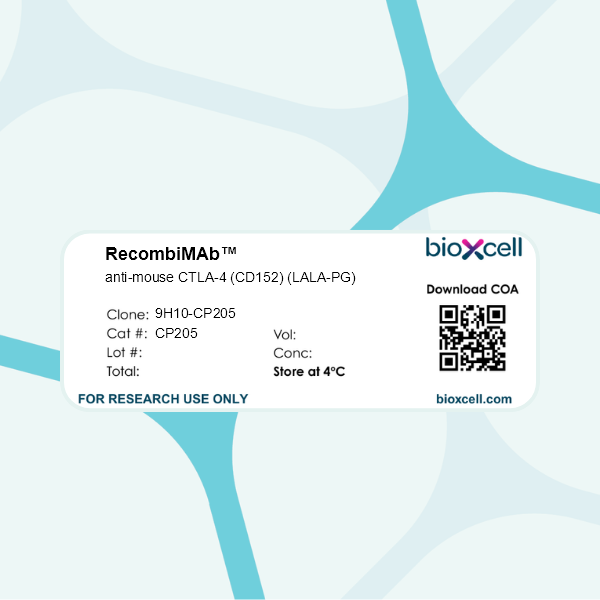
Catalog #CP205
RecombiMAb anti-mouse CTLA-4 (CD152) (LALA-PG)
Clone
9H10-CP205
Reactivities
Mouse
Applications
in vivo CTLA-4 neutralization*
in vitro CTLA-4 neutralization*
Western blot
*Reported for the original Syrian hamster IgG 9H10 antibody
in vitro CTLA-4 neutralization*
Western blot
*Reported for the original Syrian hamster IgG 9H10 antibody
Isotype
Mouse IgG2a (LALA-PG), κ
(switched from Syrian hamster IgG)
(switched from Syrian hamster IgG)
You may also be interested in:
Product Description
The 9H10-CP205 monoclonal antibody is a chimeric version of the original 9H10 antibody. The variable domain sequences are identical but the constant region sequences have been switched from Syrian hamster IgG1 to mouse IgG2a, κ. The constant region includes the Fc silencing mutation variants LALA-PG, rendering it unable to bind endogenous murine Fcγ receptors or C1q to induce antibody-dependent cell-mediated cytotoxicity (ADCC) or complement-dependent cytotoxicity (CDC). 9H10-CP205 is useful to evaluate pure CTLA-4 blockade (antagonism) without Fc-dependent depletion of regulatory T cells (Tregs) or other effector functions. Species-matched chimeric antibodies result in less immunogenicity and formation of anti-drug antibodies (ADAs) than xenogenic antibodies in animal models. The highly controlled sequence and lack of genetic drift in recombinant antibodies provide more reliable and reproducible results over hybridoma derived antibodies.
9H10-CP205 reacts with mouse CTLA-4 (cytotoxic T lymphocyte antigen-4) also known as CD152. CTLA-4 is a 33 kDa cell surface receptor encoded by the Ctla4 gene that belongs to the CD28 family of the Ig superfamily. CTLA-4 is expressed on activated T and B lymphocytes. CTLA-4 is structurally similar to the T-cell co-stimulatory protein, CD28, and both molecules bind to the B7 family members B7-1 (CD80) and B7-2 (CD86). Upon ligand binding, CTLA-4 negatively regulates cell-mediated immune responses. CTLA-4 plays roles in induction and/or maintenance of immunological tolerance, thymocyte development, and regulation of protective immunity. CTLA-4 is among a group of inhibitory receptors being explored as cancer treatment targets through immune checkpoint blockade.
9H10-CP205 reacts with mouse CTLA-4 (cytotoxic T lymphocyte antigen-4) also known as CD152. CTLA-4 is a 33 kDa cell surface receptor encoded by the Ctla4 gene that belongs to the CD28 family of the Ig superfamily. CTLA-4 is expressed on activated T and B lymphocytes. CTLA-4 is structurally similar to the T-cell co-stimulatory protein, CD28, and both molecules bind to the B7 family members B7-1 (CD80) and B7-2 (CD86). Upon ligand binding, CTLA-4 negatively regulates cell-mediated immune responses. CTLA-4 plays roles in induction and/or maintenance of immunological tolerance, thymocyte development, and regulation of protective immunity. CTLA-4 is among a group of inhibitory receptors being explored as cancer treatment targets through immune checkpoint blockade.
Specifications
| Isotype | Mouse IgG2a (LALA-PG), κ |
|---|---|
| Recommended Isotype Control(s) | RecombiMAb mouse IgG2a (LALA-PG) isotype control, anti-hen egg lysozyme |
| Recommended Dilution Buffer | InVivoPure pH 7.0 Dilution Buffer |
| Conjugation | This product is unconjugated. Conjugation is available via our Antibody Conjugation Services. |
| Mutations | LALA-PG |
| Immunogen | Mouse CTLA-4-human IgG1 fusion protein |
| Reported Applications |
in vivo CTLA-4 neutralization* in vitro CTLA-4 neutralization* Western blot *Reported for the original Syrian hamster IgG 9H10 antibody |
| Formulation |
PBS, pH 7.0 Contains no stabilizers or preservatives |
| Endotoxin |
≤0.5EU/mg (≤0.0005EU/μg) Determined by LAL assay |
| Aggregation |
<5% Determined by SEC |
| Purity |
≥95% Determined by SDS-PAGE |
| Sterility | 0.2 µm filtration |
| Production | Purified from mammalian cell supernatant in an animal-free facility |
| Purification | Protein A |
| Molecular Weight | 150 kDa |
| Murine Pathogen Tests |
Ectromelia/Mousepox Virus: Negative Hantavirus: Negative K Virus: Negative Lactate Dehydrogenase-Elevating Virus: Negative Lymphocytic Choriomeningitis virus: Negative Mouse Adenovirus: Negative Mouse Cytomegalovirus: Negative Mouse Hepatitis Virus: Negative Mouse Minute Virus: Negative Mouse Norovirus: Negative Mouse Parvovirus: Negative Mouse Rotavirus: Negative Mycoplasma Pulmonis: Negative Pneumonia Virus of Mice: Negative Polyoma Virus: Negative Reovirus Screen: Negative Sendai Virus: Negative Theiler’s Murine Encephalomyelitis: Negative |
| Storage | The antibody solution should be stored at the stock concentration at 4°C. Do not freeze. |
| Need a Custom Formulation? | See All Antibody Customization Options |