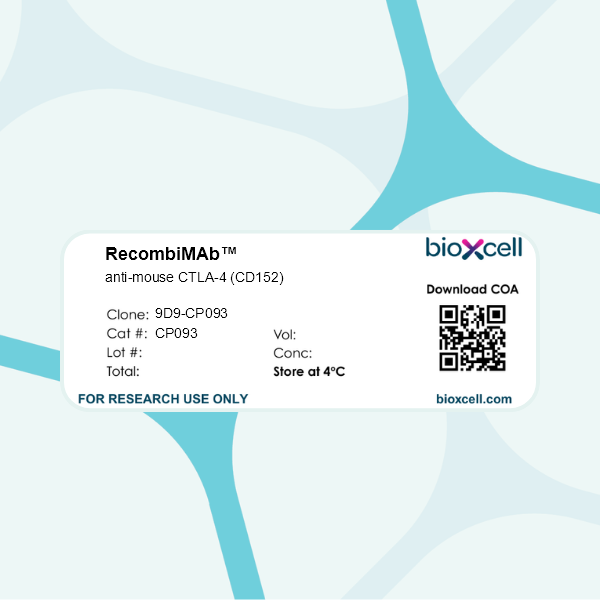
Catalog #CP093

RecombiMAb anti-mouse CTLA-4 (CD152)

Clone 9D9-CP093
Reactivities Mouse
Isotype Mouse IgG2c, κ
(switched from Mouse IgG2b, κ)

$560.00 - $7,581.50

$560.00 - $7.00

Choose an Option...
  • 25 mg - $7,581.50
  • 5 mg - $2,170.50
  • 1 mg - $560.00
  • Custom Amount (Quotes Only)
In stock
Only %1 left

Product Description

The 9D9-CP093 monoclonal antibody is a recombinant, Fc-engineered chimeric version of the original 9D9 antibody. The variable domain sequences are identical but the constant region sequences have been switched from mouse IgG2b to mouse IgG2c. Recombinant 9D9 that has been isotype switched to either mouse IgG2a or IgG2c has demonstrated improved Fc effector function resulting in potent depletion of intratumoral Tregs, increased activation of CD8+ T cells, increased tumor-associated high endothelial venules (TA-HEVs), and increased tumor-draining lymph node priming resulting in superior antitumor efficacy through Fc-dependent mechanisms compared to the original IgG2b antibody. Isotype switching amplified ADCC/ADCP via high-affinity binding to activating FcγRs, combining CTLA-4 blockade with Treg elimination for robust antitumor immunity. Mouse IgG2a and IgG2c are allelic variants of the same isotype, differing by strain-specific genetics, and are indistinguishable in their specificities to murine FcγR. Both mouse IgG2a and IgG2c have broader and higher-affinity interactions with activating FcγRs than mouse IgG2b. Mouse strains such as C57Bl/6, C57Bl/10, SJL, and NOD mice possess the Igh1-b allele resulting in only the expression of IgG2c. However, mouse strains such as BALB/c and Swiss Webster mice possess the Igh1-a allele which results in only the expression of IgG2a. It is important to consider matching the Ig-haplotype of the receiving mice to the isotype of the injected antibody to avoid eliciting an undesired immune response and ensure better antibody tolerance, pharmacokinetics, and efficacy. The highly controlled sequence and lack of genetic drift in recombinant antibodies provide more reliable and reproducible results over hybridoma derived antibodies. The 9D9 monoclonal antibody is a commonly used surrogate for CTLA-4 checkpoint blockade studies in mouse cancer models. It reacts with mouse CTLA-4 (cytotoxic T lymphocyte antigen-4) also known as CD152.

Bates, Amber M et al. “Combination of Bempegaldesleukin and Anti-CTLA-4 Prevents Metastatic Dissemination After Primary Resection or Radiotherapy in a Preclinical Model of Non-Small Cell Lung Cancer.” Frontiers in oncology vol. 11 645352. 15 Apr. 2021, doi:10.3389/fonc.2021.645352
Blanchard, Lucas et al. “Fc-optimized anti-CTLA-4 antibodies increase tumor-associated high endothelial venules and sensitize refractory tumors to PD-1 blockade.” Cell reports. Medicine vol. 6,6 (2025): 102141. doi:10.1016/j.xcrm.2025.102141
Kerr, Caroline P et al. “Priming versus propagating: distinct immune effects of an alpha- versus beta-particle emitting radiopharmaceutical when combined with immune checkpoint inhibition.” bioRxiv : the preprint server for biology 2024.12.26.630430. 26 Dec. 2024, doi:10.1101/2024.12.26.630430. Preprint.
Rakhmilevich, Alexander L et al. “A combined radio-immunotherapy regimen eradicates late-stage tumors in mice.” Frontiers in immunology vol. 15 1419773. 15 Jul. 2024, doi:10.3389/fimmu.2024.1419773
Selby, Mark J et al. “Anti-CTLA-4 antibodies of IgG2a isotype enhance antitumor activity through reduction of intratumoral regulatory T cells.” Cancer immunology research vol. 1,1 (2013): 32-42. doi:10.1158/2326-6066.CIR-13-0013

Specifications

Isotype Mouse IgG2c, κ
Recommended Isotype Control(s) InVivoPlus mouse IgG2c isotype control, anti-dengue virus
Recommended Dilution Buffer InVivoPure pH 7.0 Dilution Buffer
Immunogen Not available or unknown
Reported Applications in vivo CTLA-4 neutralization
in vivo intra-tumoral regulatory T cell depletion
ELISA
Formulation PBS, pH 7.0
Contains no stabilizers or preservatives
Endotoxin ≤0.5EU/mg (≤0.0005EU/μg)
Determined by LAL assay
Aggregation* <5%
Determined by SEC
Purity ≥95%
Determined by SDS-PAGE
Sterility 0.2 µm filtration
Production Purified from mammalian cell supernatant in an animal-free facility
Purification Protein A
Molecular Weight 150 kDa
Murine Pathogen Tests Ectromelia/Mousepox Virus: Negative
Hantavirus: Negative
K Virus: Negative
Lactate Dehydrogenase-Elevating Virus: Negative
Lymphocytic Choriomeningitis virus: Negative
Mouse Adenovirus: Negative
Mouse Cytomegalovirus: Negative
Mouse Hepatitis Virus: Negative
Mouse Minute Virus: Negative
Mouse Norovirus: Negative
Mouse Parvovirus: Negative
Mouse Rotavirus: Negative
Mycoplasma Pulmonis: Negative
Pneumonia Virus of Mice: Negative
Polyoma Virus: Negative
Reovirus Screen: Negative
Sendai Virus: Negative
Theiler’s Murine Encephalomyelitis: Negative
Storage The antibody solution should be stored at the stock concentration at 4°C. Do not freeze.
Need a Custom Formulation? See All Antibody Customization Options
* Additional quality control measures for our InVivoPlus™ products include advanced binding validation, murine pathogen screening, protein aggregation screening, and ultra-low endotoxin levels. The superior quality of our InVivoPlus™ products will meet and exceed the strict demands and rigorous standards required for in vivo research. Learn more about the InVivoPlus™ difference here.

Application References

in-vivo CTLA-4 neutralization
in vivo intra-tumoral regulatory T cell depletion
Rakhmilevich AL, Tsarovsky NW, Felder M, Zaborek J, Moram S, Erbe AK, Pieper AA, Spiegelman DV, Cheng EM, Witt CM, Overwijk WW, Morris ZS, Sondel PM (2024). "A combined radio-immunotherapy regimen eradicates late-stage tumors in mice" Front Immunol .
PubMed

Background: The majority of experimental approaches for cancer immunotherapy are tested against relatively small tumors in tumor-bearing mice, because in most cases advanced cancers are resistant to the treatments. In this study, we asked if even late-stage mouse tumors can be eradicated by a rationally designed combined radio-immunotherapy (CRI) regimen. Methods: CRI consisted of local radiotherapy, intratumoral IL-12, slow-release systemic IL-2 and anti- CTLA-4 antibody. Therapeutic effects of CRI against several weakly immunogenic and immunogenic mouse tumors including B78 melanoma, MC38 and CT26 colon carcinomas and 9464D neuroblastoma were evaluated. Immune cell depletion and flow cytometric analysis were performed to determine the mechanisms of the antitumor effects. Results: Tumors with volumes of 2,000 mm3 or larger were eradicated by CRI. Flow analyses of the tumors revealed reduction of T regulatory (Treg) cells and increase of CD8/Treg ratios following CRI. Rapid shrinkage of the treated tumors did not require T cells, whereas T cells were involved in the systemic effect against the distant tumors. Cured mice developed immunological memory. Conclusions: These findings underscore that rationally designed combination immunotherapy regimens can be effective even against large, late-stage tumors.

in-vivo CTLA-4 neutralization
in vivo intra-tumoral regulatory T cell depletion
Kerr CP, Jin WJ, Liu P, Grudzinski JJ, Ferreira CA, Rojas HC, Oñate AJ, Kwon O, Hyun M, Idrissou MB, Schwartz RW, Vera JM, Clark PA, Takashima M, Erbe AK, Shea AG, Powers M, Pinchuk AN, Massey CF, Choi C, Hernandez R, Bednarz BP, Ong IM, Weichert JP,
PubMed

Radiopharmaceutical therapy (RPT) enhances tumor response to immune checkpoint inhibitors (ICI) in preclinical models, but the effects of different radioisotopes have not been thoroughly compared. To evaluate mechanisms of response to RPT+ICI, we used NM600, an alkylphosphocholine selectively taken up by most tumors. Effects of 90 Y-, 177 Lu-, and 225 Ac-NM600 + ICIs were compared in syngeneic murine models, B78 melanoma (poorly immunogenic) and MC38 colorectal cancer (immunogenic). 90 Y-/ 177 Lu-/or 225 Ac-NM600 delivering 2 Gy mean tumor dose promoted tumor regression and improved survival when combined with ICIs in syngeneic mice bearing B78 or MC38 tumors. Regardless of the administered isotope, this combination was optimized with early ICI administration (days -3/0/3) relative to day 1 RPT. 90 Y-NM600+ICI produced the greatest anti-tumor response for MC38, whereas high linear energy transfer (LET) alpha particle radiation from 225 Ac-NM600+ICI was most effective against poorly immunogenic B78 tumors. Flow cytometry and single cell RNA and T cell receptor (TCR) sequencing illuminated distinct mechanisms of 90 Y- or 177 Lu-NM600 in promoting expansion of existing adaptive immunity and of 225 Ac-NM600 in promoting immune priming when combined with ICI. Antitumor immune response can be achieved with appropriate application of α- or β- emitting RPT in combination with ICIs in diverse murine tumor models.

in-vivo CTLA-4 neutralization
in vivo intra-tumoral regulatory T cell depletion
Rakhmilevich AL, Tsarovsky NW, Felder M, Zaborek J, Moram S, Erbe AK, Pieper AA, Spiegelman DV, Cheng EM, Witt CM, Overwijk WW, Morris ZS, Sondel PM (2024). "A combined radio-immunotherapy regimen eradicates late-stage tumors in mice" Front Immunol .
PubMed

Background: The majority of experimental approaches for cancer immunotherapy are tested against relatively small tumors in tumor-bearing mice, because in most cases advanced cancers are resistant to the treatments. In this study, we asked if even late-stage mouse tumors can be eradicated by a rationally designed combined radio-immunotherapy (CRI) regimen. Methods: CRI consisted of local radiotherapy, intratumoral IL-12, slow-release systemic IL-2 and anti- CTLA-4 antibody. Therapeutic effects of CRI against several weakly immunogenic and immunogenic mouse tumors including B78 melanoma, MC38 and CT26 colon carcinomas and 9464D neuroblastoma were evaluated. Immune cell depletion and flow cytometric analysis were performed to determine the mechanisms of the antitumor effects. Results: Tumors with volumes of 2,000 mm3 or larger were eradicated by CRI. Flow analyses of the tumors revealed reduction of T regulatory (Treg) cells and increase of CD8/Treg ratios following CRI. Rapid shrinkage of the treated tumors did not require T cells, whereas T cells were involved in the systemic effect against the distant tumors. Cured mice developed immunological memory. Conclusions: These findings underscore that rationally designed combination immunotherapy regimens can be effective even against large, late-stage tumors.

in-vivo CTLA-4 neutralization
in vivo intra-tumoral regulatory T cell depletion
Kerr CP, Jin WJ, Liu P, Grudzinski JJ, Ferreira CA, Rojas HC, Oñate AJ, Kwon O, Hyun M, Idrissou MB, Schwartz RW, Vera JM, Clark PA, Takashima M, Erbe AK, Shea AG, Powers M, Pinchuk AN, Massey CF, Choi C, Hernandez R, Bednarz BP, Ong IM, Weichert JP,
PubMed

Radiopharmaceutical therapy (RPT) enhances tumor response to immune checkpoint inhibitors (ICI) in preclinical models, but the effects of different radioisotopes have not been thoroughly compared. To evaluate mechanisms of response to RPT+ICI, we used NM600, an alkylphosphocholine selectively taken up by most tumors. Effects of 90 Y-, 177 Lu-, and 225 Ac-NM600 + ICIs were compared in syngeneic murine models, B78 melanoma (poorly immunogenic) and MC38 colorectal cancer (immunogenic). 90 Y-/ 177 Lu-/or 225 Ac-NM600 delivering 2 Gy mean tumor dose promoted tumor regression and improved survival when combined with ICIs in syngeneic mice bearing B78 or MC38 tumors. Regardless of the administered isotope, this combination was optimized with early ICI administration (days -3/0/3) relative to day 1 RPT. 90 Y-NM600+ICI produced the greatest anti-tumor response for MC38, whereas high linear energy transfer (LET) alpha particle radiation from 225 Ac-NM600+ICI was most effective against poorly immunogenic B78 tumors. Flow cytometry and single cell RNA and T cell receptor (TCR) sequencing illuminated distinct mechanisms of 90 Y- or 177 Lu-NM600 in promoting expansion of existing adaptive immunity and of 225 Ac-NM600 in promoting immune priming when combined with ICI. Antitumor immune response can be achieved with appropriate application of α- or β- emitting RPT in combination with ICIs in diverse murine tumor models.

in-vivo CTLA-4 neutralization
in vivo intra-tumoral regulatory T cell depletion
Rakhmilevich AL, Tsarovsky NW, Felder M, Zaborek J, Moram S, Erbe AK, Pieper AA, Spiegelman DV, Cheng EM, Witt CM, Overwijk WW, Morris ZS, Sondel PM (2024). "A combined radio-immunotherapy regimen eradicates late-stage tumors in mice" Front Immunol .
PubMed

Background: The majority of experimental approaches for cancer immunotherapy are tested against relatively small tumors in tumor-bearing mice, because in most cases advanced cancers are resistant to the treatments. In this study, we asked if even late-stage mouse tumors can be eradicated by a rationally designed combined radio-immunotherapy (CRI) regimen. Methods: CRI consisted of local radiotherapy, intratumoral IL-12, slow-release systemic IL-2 and anti- CTLA-4 antibody. Therapeutic effects of CRI against several weakly immunogenic and immunogenic mouse tumors including B78 melanoma, MC38 and CT26 colon carcinomas and 9464D neuroblastoma were evaluated. Immune cell depletion and flow cytometric analysis were performed to determine the mechanisms of the antitumor effects. Results: Tumors with volumes of 2,000 mm3 or larger were eradicated by CRI. Flow analyses of the tumors revealed reduction of T regulatory (Treg) cells and increase of CD8/Treg ratios following CRI. Rapid shrinkage of the treated tumors did not require T cells, whereas T cells were involved in the systemic effect against the distant tumors. Cured mice developed immunological memory. Conclusions: These findings underscore that rationally designed combination immunotherapy regimens can be effective even against large, late-stage tumors.

in-vivo CTLA-4 neutralization
in vivo intra-tumoral regulatory T cell depletion
Kerr CP, Jin WJ, Liu P, Grudzinski JJ, Ferreira CA, Rojas HC, Oñate AJ, Kwon O, Hyun M, Idrissou MB, Schwartz RW, Vera JM, Clark PA, Takashima M, Erbe AK, Shea AG, Powers M, Pinchuk AN, Massey CF, Choi C, Hernandez R, Bednarz BP, Ong IM, Weichert JP,
PubMed

Radiopharmaceutical therapy (RPT) enhances tumor response to immune checkpoint inhibitors (ICI) in preclinical models, but the effects of different radioisotopes have not been thoroughly compared. To evaluate mechanisms of response to RPT+ICI, we used NM600, an alkylphosphocholine selectively taken up by most tumors. Effects of 90 Y-, 177 Lu-, and 225 Ac-NM600 + ICIs were compared in syngeneic murine models, B78 melanoma (poorly immunogenic) and MC38 colorectal cancer (immunogenic). 90 Y-/ 177 Lu-/or 225 Ac-NM600 delivering 2 Gy mean tumor dose promoted tumor regression and improved survival when combined with ICIs in syngeneic mice bearing B78 or MC38 tumors. Regardless of the administered isotope, this combination was optimized with early ICI administration (days -3/0/3) relative to day 1 RPT. 90 Y-NM600+ICI produced the greatest anti-tumor response for MC38, whereas high linear energy transfer (LET) alpha particle radiation from 225 Ac-NM600+ICI was most effective against poorly immunogenic B78 tumors. Flow cytometry and single cell RNA and T cell receptor (TCR) sequencing illuminated distinct mechanisms of 90 Y- or 177 Lu-NM600 in promoting expansion of existing adaptive immunity and of 225 Ac-NM600 in promoting immune priming when combined with ICI. Antitumor immune response can be achieved with appropriate application of α- or β- emitting RPT in combination with ICIs in diverse murine tumor models.

in-vivo CTLA-4 neutralization
in vivo intra-tumoral regulatory T cell depletion
Rakhmilevich AL, Tsarovsky NW, Felder M, Zaborek J, Moram S, Erbe AK, Pieper AA, Spiegelman DV, Cheng EM, Witt CM, Overwijk WW, Morris ZS, Sondel PM (2024). "A combined radio-immunotherapy regimen eradicates late-stage tumors in mice" Front Immunol .
PubMed

Background: The majority of experimental approaches for cancer immunotherapy are tested against relatively small tumors in tumor-bearing mice, because in most cases advanced cancers are resistant to the treatments. In this study, we asked if even late-stage mouse tumors can be eradicated by a rationally designed combined radio-immunotherapy (CRI) regimen. Methods: CRI consisted of local radiotherapy, intratumoral IL-12, slow-release systemic IL-2 and anti- CTLA-4 antibody. Therapeutic effects of CRI against several weakly immunogenic and immunogenic mouse tumors including B78 melanoma, MC38 and CT26 colon carcinomas and 9464D neuroblastoma were evaluated. Immune cell depletion and flow cytometric analysis were performed to determine the mechanisms of the antitumor effects. Results: Tumors with volumes of 2,000 mm3 or larger were eradicated by CRI. Flow analyses of the tumors revealed reduction of T regulatory (Treg) cells and increase of CD8/Treg ratios following CRI. Rapid shrinkage of the treated tumors did not require T cells, whereas T cells were involved in the systemic effect against the distant tumors. Cured mice developed immunological memory. Conclusions: These findings underscore that rationally designed combination immunotherapy regimens can be effective even against large, late-stage tumors.

in-vivo CTLA-4 neutralization
in vivo intra-tumoral regulatory T cell depletion
Kerr CP, Jin WJ, Liu P, Grudzinski JJ, Ferreira CA, Rojas HC, Oñate AJ, Kwon O, Hyun M, Idrissou MB, Schwartz RW, Vera JM, Clark PA, Takashima M, Erbe AK, Shea AG, Powers M, Pinchuk AN, Massey CF, Choi C, Hernandez R, Bednarz BP, Ong IM, Weichert JP,
PubMed

Radiopharmaceutical therapy (RPT) enhances tumor response to immune checkpoint inhibitors (ICI) in preclinical models, but the effects of different radioisotopes have not been thoroughly compared. To evaluate mechanisms of response to RPT+ICI, we used NM600, an alkylphosphocholine selectively taken up by most tumors. Effects of 90 Y-, 177 Lu-, and 225 Ac-NM600 + ICIs were compared in syngeneic murine models, B78 melanoma (poorly immunogenic) and MC38 colorectal cancer (immunogenic). 90 Y-/ 177 Lu-/or 225 Ac-NM600 delivering 2 Gy mean tumor dose promoted tumor regression and improved survival when combined with ICIs in syngeneic mice bearing B78 or MC38 tumors. Regardless of the administered isotope, this combination was optimized with early ICI administration (days -3/0/3) relative to day 1 RPT. 90 Y-NM600+ICI produced the greatest anti-tumor response for MC38, whereas high linear energy transfer (LET) alpha particle radiation from 225 Ac-NM600+ICI was most effective against poorly immunogenic B78 tumors. Flow cytometry and single cell RNA and T cell receptor (TCR) sequencing illuminated distinct mechanisms of 90 Y- or 177 Lu-NM600 in promoting expansion of existing adaptive immunity and of 225 Ac-NM600 in promoting immune priming when combined with ICI. Antitumor immune response can be achieved with appropriate application of α- or β- emitting RPT in combination with ICIs in diverse murine tumor models.

in-vivo CTLA-4 neutralization
in vivo intra-tumoral regulatory T cell depletion
Rakhmilevich AL, Tsarovsky NW, Felder M, Zaborek J, Moram S, Erbe AK, Pieper AA, Spiegelman DV, Cheng EM, Witt CM, Overwijk WW, Morris ZS, Sondel PM (2024). "A combined radio-immunotherapy regimen eradicates late-stage tumors in mice" Front Immunol .
PubMed

Background: The majority of experimental approaches for cancer immunotherapy are tested against relatively small tumors in tumor-bearing mice, because in most cases advanced cancers are resistant to the treatments. In this study, we asked if even late-stage mouse tumors can be eradicated by a rationally designed combined radio-immunotherapy (CRI) regimen. Methods: CRI consisted of local radiotherapy, intratumoral IL-12, slow-release systemic IL-2 and anti- CTLA-4 antibody. Therapeutic effects of CRI against several weakly immunogenic and immunogenic mouse tumors including B78 melanoma, MC38 and CT26 colon carcinomas and 9464D neuroblastoma were evaluated. Immune cell depletion and flow cytometric analysis were performed to determine the mechanisms of the antitumor effects. Results: Tumors with volumes of 2,000 mm3 or larger were eradicated by CRI. Flow analyses of the tumors revealed reduction of T regulatory (Treg) cells and increase of CD8/Treg ratios following CRI. Rapid shrinkage of the treated tumors did not require T cells, whereas T cells were involved in the systemic effect against the distant tumors. Cured mice developed immunological memory. Conclusions: These findings underscore that rationally designed combination immunotherapy regimens can be effective even against large, late-stage tumors.

in-vivo CTLA-4 neutralization
in vivo intra-tumoral regulatory T cell depletion
Kerr CP, Jin WJ, Liu P, Grudzinski JJ, Ferreira CA, Rojas HC, Oñate AJ, Kwon O, Hyun M, Idrissou MB, Schwartz RW, Vera JM, Clark PA, Takashima M, Erbe AK, Shea AG, Powers M, Pinchuk AN, Massey CF, Choi C, Hernandez R, Bednarz BP, Ong IM, Weichert JP,
PubMed

Radiopharmaceutical therapy (RPT) enhances tumor response to immune checkpoint inhibitors (ICI) in preclinical models, but the effects of different radioisotopes have not been thoroughly compared. To evaluate mechanisms of response to RPT+ICI, we used NM600, an alkylphosphocholine selectively taken up by most tumors. Effects of 90 Y-, 177 Lu-, and 225 Ac-NM600 + ICIs were compared in syngeneic murine models, B78 melanoma (poorly immunogenic) and MC38 colorectal cancer (immunogenic). 90 Y-/ 177 Lu-/or 225 Ac-NM600 delivering 2 Gy mean tumor dose promoted tumor regression and improved survival when combined with ICIs in syngeneic mice bearing B78 or MC38 tumors. Regardless of the administered isotope, this combination was optimized with early ICI administration (days -3/0/3) relative to day 1 RPT. 90 Y-NM600+ICI produced the greatest anti-tumor response for MC38, whereas high linear energy transfer (LET) alpha particle radiation from 225 Ac-NM600+ICI was most effective against poorly immunogenic B78 tumors. Flow cytometry and single cell RNA and T cell receptor (TCR) sequencing illuminated distinct mechanisms of 90 Y- or 177 Lu-NM600 in promoting expansion of existing adaptive immunity and of 225 Ac-NM600 in promoting immune priming when combined with ICI. Antitumor immune response can be achieved with appropriate application of α- or β- emitting RPT in combination with ICIs in diverse murine tumor models.

in-vivo CTLA-4 neutralization
in vivo intra-tumoral regulatory T cell depletion
Rakhmilevich AL, Tsarovsky NW, Felder M, Zaborek J, Moram S, Erbe AK, Pieper AA, Spiegelman DV, Cheng EM, Witt CM, Overwijk WW, Morris ZS, Sondel PM (2024). "A combined radio-immunotherapy regimen eradicates late-stage tumors in mice" Front Immunol .
PubMed

Background: The majority of experimental approaches for cancer immunotherapy are tested against relatively small tumors in tumor-bearing mice, because in most cases advanced cancers are resistant to the treatments. In this study, we asked if even late-stage mouse tumors can be eradicated by a rationally designed combined radio-immunotherapy (CRI) regimen. Methods: CRI consisted of local radiotherapy, intratumoral IL-12, slow-release systemic IL-2 and anti- CTLA-4 antibody. Therapeutic effects of CRI against several weakly immunogenic and immunogenic mouse tumors including B78 melanoma, MC38 and CT26 colon carcinomas and 9464D neuroblastoma were evaluated. Immune cell depletion and flow cytometric analysis were performed to determine the mechanisms of the antitumor effects. Results: Tumors with volumes of 2,000 mm3 or larger were eradicated by CRI. Flow analyses of the tumors revealed reduction of T regulatory (Treg) cells and increase of CD8/Treg ratios following CRI. Rapid shrinkage of the treated tumors did not require T cells, whereas T cells were involved in the systemic effect against the distant tumors. Cured mice developed immunological memory. Conclusions: These findings underscore that rationally designed combination immunotherapy regimens can be effective even against large, late-stage tumors.

in-vivo CTLA-4 neutralization
in vivo intra-tumoral regulatory T cell depletion
Kerr CP, Jin WJ, Liu P, Grudzinski JJ, Ferreira CA, Rojas HC, Oñate AJ, Kwon O, Hyun M, Idrissou MB, Schwartz RW, Vera JM, Clark PA, Takashima M, Erbe AK, Shea AG, Powers M, Pinchuk AN, Massey CF, Choi C, Hernandez R, Bednarz BP, Ong IM, Weichert JP,
PubMed

Radiopharmaceutical therapy (RPT) enhances tumor response to immune checkpoint inhibitors (ICI) in preclinical models, but the effects of different radioisotopes have not been thoroughly compared. To evaluate mechanisms of response to RPT+ICI, we used NM600, an alkylphosphocholine selectively taken up by most tumors. Effects of 90 Y-, 177 Lu-, and 225 Ac-NM600 + ICIs were compared in syngeneic murine models, B78 melanoma (poorly immunogenic) and MC38 colorectal cancer (immunogenic). 90 Y-/ 177 Lu-/or 225 Ac-NM600 delivering 2 Gy mean tumor dose promoted tumor regression and improved survival when combined with ICIs in syngeneic mice bearing B78 or MC38 tumors. Regardless of the administered isotope, this combination was optimized with early ICI administration (days -3/0/3) relative to day 1 RPT. 90 Y-NM600+ICI produced the greatest anti-tumor response for MC38, whereas high linear energy transfer (LET) alpha particle radiation from 225 Ac-NM600+ICI was most effective against poorly immunogenic B78 tumors. Flow cytometry and single cell RNA and T cell receptor (TCR) sequencing illuminated distinct mechanisms of 90 Y- or 177 Lu-NM600 in promoting expansion of existing adaptive immunity and of 225 Ac-NM600 in promoting immune priming when combined with ICI. Antitumor immune response can be achieved with appropriate application of α- or β- emitting RPT in combination with ICIs in diverse murine tumor models.

in-vivo CTLA-4 neutralization
in vivo intra-tumoral regulatory T cell depletion
Rakhmilevich AL, Tsarovsky NW, Felder M, Zaborek J, Moram S, Erbe AK, Pieper AA, Spiegelman DV, Cheng EM, Witt CM, Overwijk WW, Morris ZS, Sondel PM (2024). "A combined radio-immunotherapy regimen eradicates late-stage tumors in mice" Front Immunol .
PubMed

Background: The majority of experimental approaches for cancer immunotherapy are tested against relatively small tumors in tumor-bearing mice, because in most cases advanced cancers are resistant to the treatments. In this study, we asked if even late-stage mouse tumors can be eradicated by a rationally designed combined radio-immunotherapy (CRI) regimen. Methods: CRI consisted of local radiotherapy, intratumoral IL-12, slow-release systemic IL-2 and anti- CTLA-4 antibody. Therapeutic effects of CRI against several weakly immunogenic and immunogenic mouse tumors including B78 melanoma, MC38 and CT26 colon carcinomas and 9464D neuroblastoma were evaluated. Immune cell depletion and flow cytometric analysis were performed to determine the mechanisms of the antitumor effects. Results: Tumors with volumes of 2,000 mm3 or larger were eradicated by CRI. Flow analyses of the tumors revealed reduction of T regulatory (Treg) cells and increase of CD8/Treg ratios following CRI. Rapid shrinkage of the treated tumors did not require T cells, whereas T cells were involved in the systemic effect against the distant tumors. Cured mice developed immunological memory. Conclusions: These findings underscore that rationally designed combination immunotherapy regimens can be effective even against large, late-stage tumors.

in-vivo CTLA-4 neutralization
in vivo intra-tumoral regulatory T cell depletion
Kerr CP, Jin WJ, Liu P, Grudzinski JJ, Ferreira CA, Rojas HC, Oñate AJ, Kwon O, Hyun M, Idrissou MB, Schwartz RW, Vera JM, Clark PA, Takashima M, Erbe AK, Shea AG, Powers M, Pinchuk AN, Massey CF, Choi C, Hernandez R, Bednarz BP, Ong IM, Weichert JP,
PubMed

Radiopharmaceutical therapy (RPT) enhances tumor response to immune checkpoint inhibitors (ICI) in preclinical models, but the effects of different radioisotopes have not been thoroughly compared. To evaluate mechanisms of response to RPT+ICI, we used NM600, an alkylphosphocholine selectively taken up by most tumors. Effects of 90 Y-, 177 Lu-, and 225 Ac-NM600 + ICIs were compared in syngeneic murine models, B78 melanoma (poorly immunogenic) and MC38 colorectal cancer (immunogenic). 90 Y-/ 177 Lu-/or 225 Ac-NM600 delivering 2 Gy mean tumor dose promoted tumor regression and improved survival when combined with ICIs in syngeneic mice bearing B78 or MC38 tumors. Regardless of the administered isotope, this combination was optimized with early ICI administration (days -3/0/3) relative to day 1 RPT. 90 Y-NM600+ICI produced the greatest anti-tumor response for MC38, whereas high linear energy transfer (LET) alpha particle radiation from 225 Ac-NM600+ICI was most effective against poorly immunogenic B78 tumors. Flow cytometry and single cell RNA and T cell receptor (TCR) sequencing illuminated distinct mechanisms of 90 Y- or 177 Lu-NM600 in promoting expansion of existing adaptive immunity and of 225 Ac-NM600 in promoting immune priming when combined with ICI. Antitumor immune response can be achieved with appropriate application of α- or β- emitting RPT in combination with ICIs in diverse murine tumor models.

in-vivo CTLA-4 neutralization
in vivo intra-tumoral regulatory T cell depletion
Rakhmilevich AL, Tsarovsky NW, Felder M, Zaborek J, Moram S, Erbe AK, Pieper AA, Spiegelman DV, Cheng EM, Witt CM, Overwijk WW, Morris ZS, Sondel PM (2024). "A combined radio-immunotherapy regimen eradicates late-stage tumors in mice" Front Immunol .
PubMed

Background: The majority of experimental approaches for cancer immunotherapy are tested against relatively small tumors in tumor-bearing mice, because in most cases advanced cancers are resistant to the treatments. In this study, we asked if even late-stage mouse tumors can be eradicated by a rationally designed combined radio-immunotherapy (CRI) regimen. Methods: CRI consisted of local radiotherapy, intratumoral IL-12, slow-release systemic IL-2 and anti- CTLA-4 antibody. Therapeutic effects of CRI against several weakly immunogenic and immunogenic mouse tumors including B78 melanoma, MC38 and CT26 colon carcinomas and 9464D neuroblastoma were evaluated. Immune cell depletion and flow cytometric analysis were performed to determine the mechanisms of the antitumor effects. Results: Tumors with volumes of 2,000 mm3 or larger were eradicated by CRI. Flow analyses of the tumors revealed reduction of T regulatory (Treg) cells and increase of CD8/Treg ratios following CRI. Rapid shrinkage of the treated tumors did not require T cells, whereas T cells were involved in the systemic effect against the distant tumors. Cured mice developed immunological memory. Conclusions: These findings underscore that rationally designed combination immunotherapy regimens can be effective even against large, late-stage tumors.

in-vivo CTLA-4 neutralization
in vivo intra-tumoral regulatory T cell depletion
Kerr CP, Jin WJ, Liu P, Grudzinski JJ, Ferreira CA, Rojas HC, Oñate AJ, Kwon O, Hyun M, Idrissou MB, Schwartz RW, Vera JM, Clark PA, Takashima M, Erbe AK, Shea AG, Powers M, Pinchuk AN, Massey CF, Choi C, Hernandez R, Bednarz BP, Ong IM, Weichert JP,
PubMed

Radiopharmaceutical therapy (RPT) enhances tumor response to immune checkpoint inhibitors (ICI) in preclinical models, but the effects of different radioisotopes have not been thoroughly compared. To evaluate mechanisms of response to RPT+ICI, we used NM600, an alkylphosphocholine selectively taken up by most tumors. Effects of 90 Y-, 177 Lu-, and 225 Ac-NM600 + ICIs were compared in syngeneic murine models, B78 melanoma (poorly immunogenic) and MC38 colorectal cancer (immunogenic). 90 Y-/ 177 Lu-/or 225 Ac-NM600 delivering 2 Gy mean tumor dose promoted tumor regression and improved survival when combined with ICIs in syngeneic mice bearing B78 or MC38 tumors. Regardless of the administered isotope, this combination was optimized with early ICI administration (days -3/0/3) relative to day 1 RPT. 90 Y-NM600+ICI produced the greatest anti-tumor response for MC38, whereas high linear energy transfer (LET) alpha particle radiation from 225 Ac-NM600+ICI was most effective against poorly immunogenic B78 tumors. Flow cytometry and single cell RNA and T cell receptor (TCR) sequencing illuminated distinct mechanisms of 90 Y- or 177 Lu-NM600 in promoting expansion of existing adaptive immunity and of 225 Ac-NM600 in promoting immune priming when combined with ICI. Antitumor immune response can be achieved with appropriate application of α- or β- emitting RPT in combination with ICIs in diverse murine tumor models.

in-vivo CTLA-4 neutralization
in vivo intra-tumoral regulatory T cell depletion
Kerr CP, Jin WJ, Liu P, Grudzinski JJ, Ferreira CA, Rojas HC, Oñate AJ, Kwon O, Hyun M, Idrissou MB, Schwartz RW, Vera JM, Clark PA, Takashima M, Erbe AK, Shea AG, Powers M, Pinchuk AN, Massey CF, Choi C, Hernandez R, Bednarz BP, Ong IM, Weichert JP,
PubMed

Radiopharmaceutical therapy (RPT) enhances tumor response to immune checkpoint inhibitors (ICI) in preclinical models, but the effects of different radioisotopes have not been thoroughly compared. To evaluate mechanisms of response to RPT+ICI, we used NM600, an alkylphosphocholine selectively taken up by most tumors. Effects of 90 Y-, 177 Lu-, and 225 Ac-NM600 + ICIs were compared in syngeneic murine models, B78 melanoma (poorly immunogenic) and MC38 colorectal cancer (immunogenic). 90 Y-/ 177 Lu-/or 225 Ac-NM600 delivering 2 Gy mean tumor dose promoted tumor regression and improved survival when combined with ICIs in syngeneic mice bearing B78 or MC38 tumors. Regardless of the administered isotope, this combination was optimized with early ICI administration (days -3/0/3) relative to day 1 RPT. 90 Y-NM600+ICI produced the greatest anti-tumor response for MC38, whereas high linear energy transfer (LET) alpha particle radiation from 225 Ac-NM600+ICI was most effective against poorly immunogenic B78 tumors. Flow cytometry and single cell RNA and T cell receptor (TCR) sequencing illuminated distinct mechanisms of 90 Y- or 177 Lu-NM600 in promoting expansion of existing adaptive immunity and of 225 Ac-NM600 in promoting immune priming when combined with ICI. Antitumor immune response can be achieved with appropriate application of α- or β- emitting RPT in combination with ICIs in diverse murine tumor models.

in-vivo CTLA-4 neutralization
in vivo intra-tumoral regulatory T cell depletion
Rakhmilevich AL, Tsarovsky NW, Felder M, Zaborek J, Moram S, Erbe AK, Pieper AA, Spiegelman DV, Cheng EM, Witt CM, Overwijk WW, Morris ZS, Sondel PM (2024). "A combined radio-immunotherapy regimen eradicates late-stage tumors in mice" Front Immunol .
PubMed

Background: The majority of experimental approaches for cancer immunotherapy are tested against relatively small tumors in tumor-bearing mice, because in most cases advanced cancers are resistant to the treatments. In this study, we asked if even late-stage mouse tumors can be eradicated by a rationally designed combined radio-immunotherapy (CRI) regimen. Methods: CRI consisted of local radiotherapy, intratumoral IL-12, slow-release systemic IL-2 and anti- CTLA-4 antibody. Therapeutic effects of CRI against several weakly immunogenic and immunogenic mouse tumors including B78 melanoma, MC38 and CT26 colon carcinomas and 9464D neuroblastoma were evaluated. Immune cell depletion and flow cytometric analysis were performed to determine the mechanisms of the antitumor effects. Results: Tumors with volumes of 2,000 mm3 or larger were eradicated by CRI. Flow analyses of the tumors revealed reduction of T regulatory (Treg) cells and increase of CD8/Treg ratios following CRI. Rapid shrinkage of the treated tumors did not require T cells, whereas T cells were involved in the systemic effect against the distant tumors. Cured mice developed immunological memory. Conclusions: These findings underscore that rationally designed combination immunotherapy regimens can be effective even against large, late-stage tumors.

in-vivo CTLA-4 neutralization
in vivo intra-tumoral regulatory T cell depletion
Rakhmilevich AL, Tsarovsky NW, Felder M, Zaborek J, Moram S, Erbe AK, Pieper AA, Spiegelman DV, Cheng EM, Witt CM, Overwijk WW, Morris ZS, Sondel PM (2024). "A combined radio-immunotherapy regimen eradicates late-stage tumors in mice" Front Immunol .
PubMed

Background: The majority of experimental approaches for cancer immunotherapy are tested against relatively small tumors in tumor-bearing mice, because in most cases advanced cancers are resistant to the treatments. In this study, we asked if even late-stage mouse tumors can be eradicated by a rationally designed combined radio-immunotherapy (CRI) regimen. Methods: CRI consisted of local radiotherapy, intratumoral IL-12, slow-release systemic IL-2 and anti- CTLA-4 antibody. Therapeutic effects of CRI against several weakly immunogenic and immunogenic mouse tumors including B78 melanoma, MC38 and CT26 colon carcinomas and 9464D neuroblastoma were evaluated. Immune cell depletion and flow cytometric analysis were performed to determine the mechanisms of the antitumor effects. Results: Tumors with volumes of 2,000 mm3 or larger were eradicated by CRI. Flow analyses of the tumors revealed reduction of T regulatory (Treg) cells and increase of CD8/Treg ratios following CRI. Rapid shrinkage of the treated tumors did not require T cells, whereas T cells were involved in the systemic effect against the distant tumors. Cured mice developed immunological memory. Conclusions: These findings underscore that rationally designed combination immunotherapy regimens can be effective even against large, late-stage tumors.

in-vivo CTLA-4 neutralization
in vivo intra-tumoral regulatory T cell depletion
Kerr CP, Jin WJ, Liu P, Grudzinski JJ, Ferreira CA, Rojas HC, Oñate AJ, Kwon O, Hyun M, Idrissou MB, Schwartz RW, Vera JM, Clark PA, Takashima M, Erbe AK, Shea AG, Powers M, Pinchuk AN, Massey CF, Choi C, Hernandez R, Bednarz BP, Ong IM, Weichert JP,
PubMed

Radiopharmaceutical therapy (RPT) enhances tumor response to immune checkpoint inhibitors (ICI) in preclinical models, but the effects of different radioisotopes have not been thoroughly compared. To evaluate mechanisms of response to RPT+ICI, we used NM600, an alkylphosphocholine selectively taken up by most tumors. Effects of 90 Y-, 177 Lu-, and 225 Ac-NM600 + ICIs were compared in syngeneic murine models, B78 melanoma (poorly immunogenic) and MC38 colorectal cancer (immunogenic). 90 Y-/ 177 Lu-/or 225 Ac-NM600 delivering 2 Gy mean tumor dose promoted tumor regression and improved survival when combined with ICIs in syngeneic mice bearing B78 or MC38 tumors. Regardless of the administered isotope, this combination was optimized with early ICI administration (days -3/0/3) relative to day 1 RPT. 90 Y-NM600+ICI produced the greatest anti-tumor response for MC38, whereas high linear energy transfer (LET) alpha particle radiation from 225 Ac-NM600+ICI was most effective against poorly immunogenic B78 tumors. Flow cytometry and single cell RNA and T cell receptor (TCR) sequencing illuminated distinct mechanisms of 90 Y- or 177 Lu-NM600 in promoting expansion of existing adaptive immunity and of 225 Ac-NM600 in promoting immune priming when combined with ICI. Antitumor immune response can be achieved with appropriate application of α- or β- emitting RPT in combination with ICIs in diverse murine tumor models.

in-vivo CTLA-4 neutralization
in vivo intra-tumoral regulatory T cell depletion
Bates AM, Brown RJ, Pieper AA, Zangl LM, Arthur I, Carlson PM, Le T, Sosa GA, Clark PA, Sriramaneni RN, Kim K, Patel RB, Morris ZS (2021). "Combination of Bempegaldesleukin and Anti-CTLA-4 Prevents Metastatic Dissemination After Primary Resection or
PubMed

Surgical resection or hypo-fractionated radiation therapy (RT) in early-stage non-small cell lung cancer (NSCLC) achieves local tumor control, but metastatic relapse remains a challenge. We hypothesized that immunotherapy with anti-CTLA-4 and bempegaldesleukin (BEMPEG; NKTR-214), a CD122-preferential IL2 pathway agonist, after primary tumor RT or resection would reduce metastases in a syngeneic murine NSCLC model. Mice bearing Lewis Lung Carcinoma (LLC) tumors were treated with combinations of BEMPEG, anti-CTLA-4, and primary tumor treatment (surgical resection or RT). Primary tumor size, mouse survival, and metastatic disease at the time of death were assessed. Flow cytometry, qRT-PCR, and cytokine analyses were performed on tumor specimens. All mice treated with RT or surgical resection of primary tumor alone succumbed to metastatic disease, and all mice treated with BEMPEG and/or anti-CTLA-4 succumbed to primary tumor local progression. The combination of primary tumor RT or resection and BEMPEG and anti-CTLA-4 reduced spontaneous metastasis and improved survival without any noted toxicity. Flow cytometric immunoprofiling of primary tumors revealed increased CD8 T and NK cells and decreased T-regulatory cells with the combination of BEMPEG, anti-CTLA-4, and RT compared to RT alone. Increased expression of genes associated with tumor cell immune susceptibility, immune cell recruitment, and cytotoxic T lymphocyte activation were observed in tumors of mice treated with BEMPEG, anti-CTLA-4, and RT. The combination of BEMPEG and anti-CTLA-4 with primary tumor RT or resection enabled effective control of local and metastatic disease in a preclinical murine NSCLC model. This therapeutic combination has important translational potential for patients with early-stage NSCLC and other cancers.

in-vivo CTLA-4 neutralization
in vivo intra-tumoral regulatory T cell depletion
Bates AM, Brown RJ, Pieper AA, Zangl LM, Arthur I, Carlson PM, Le T, Sosa GA, Clark PA, Sriramaneni RN, Kim K, Patel RB, Morris ZS (2021). "Combination of Bempegaldesleukin and Anti-CTLA-4 Prevents Metastatic Dissemination After Primary Resection or
PubMed

Surgical resection or hypo-fractionated radiation therapy (RT) in early-stage non-small cell lung cancer (NSCLC) achieves local tumor control, but metastatic relapse remains a challenge. We hypothesized that immunotherapy with anti-CTLA-4 and bempegaldesleukin (BEMPEG; NKTR-214), a CD122-preferential IL2 pathway agonist, after primary tumor RT or resection would reduce metastases in a syngeneic murine NSCLC model. Mice bearing Lewis Lung Carcinoma (LLC) tumors were treated with combinations of BEMPEG, anti-CTLA-4, and primary tumor treatment (surgical resection or RT). Primary tumor size, mouse survival, and metastatic disease at the time of death were assessed. Flow cytometry, qRT-PCR, and cytokine analyses were performed on tumor specimens. All mice treated with RT or surgical resection of primary tumor alone succumbed to metastatic disease, and all mice treated with BEMPEG and/or anti-CTLA-4 succumbed to primary tumor local progression. The combination of primary tumor RT or resection and BEMPEG and anti-CTLA-4 reduced spontaneous metastasis and improved survival without any noted toxicity. Flow cytometric immunoprofiling of primary tumors revealed increased CD8 T and NK cells and decreased T-regulatory cells with the combination of BEMPEG, anti-CTLA-4, and RT compared to RT alone. Increased expression of genes associated with tumor cell immune susceptibility, immune cell recruitment, and cytotoxic T lymphocyte activation were observed in tumors of mice treated with BEMPEG, anti-CTLA-4, and RT. The combination of BEMPEG and anti-CTLA-4 with primary tumor RT or resection enabled effective control of local and metastatic disease in a preclinical murine NSCLC model. This therapeutic combination has important translational potential for patients with early-stage NSCLC and other cancers.

in-vivo CTLA-4 neutralization
in vivo intra-tumoral regulatory T cell depletion
Bates AM, Brown RJ, Pieper AA, Zangl LM, Arthur I, Carlson PM, Le T, Sosa GA, Clark PA, Sriramaneni RN, Kim K, Patel RB, Morris ZS (2021). "Combination of Bempegaldesleukin and Anti-CTLA-4 Prevents Metastatic Dissemination After Primary Resection or
PubMed

Surgical resection or hypo-fractionated radiation therapy (RT) in early-stage non-small cell lung cancer (NSCLC) achieves local tumor control, but metastatic relapse remains a challenge. We hypothesized that immunotherapy with anti-CTLA-4 and bempegaldesleukin (BEMPEG; NKTR-214), a CD122-preferential IL2 pathway agonist, after primary tumor RT or resection would reduce metastases in a syngeneic murine NSCLC model. Mice bearing Lewis Lung Carcinoma (LLC) tumors were treated with combinations of BEMPEG, anti-CTLA-4, and primary tumor treatment (surgical resection or RT). Primary tumor size, mouse survival, and metastatic disease at the time of death were assessed. Flow cytometry, qRT-PCR, and cytokine analyses were performed on tumor specimens. All mice treated with RT or surgical resection of primary tumor alone succumbed to metastatic disease, and all mice treated with BEMPEG and/or anti-CTLA-4 succumbed to primary tumor local progression. The combination of primary tumor RT or resection and BEMPEG and anti-CTLA-4 reduced spontaneous metastasis and improved survival without any noted toxicity. Flow cytometric immunoprofiling of primary tumors revealed increased CD8 T and NK cells and decreased T-regulatory cells with the combination of BEMPEG, anti-CTLA-4, and RT compared to RT alone. Increased expression of genes associated with tumor cell immune susceptibility, immune cell recruitment, and cytotoxic T lymphocyte activation were observed in tumors of mice treated with BEMPEG, anti-CTLA-4, and RT. The combination of BEMPEG and anti-CTLA-4 with primary tumor RT or resection enabled effective control of local and metastatic disease in a preclinical murine NSCLC model. This therapeutic combination has important translational potential for patients with early-stage NSCLC and other cancers.

in-vivo CTLA-4 neutralization
in vivo intra-tumoral regulatory T cell depletion
Bates AM, Brown RJ, Pieper AA, Zangl LM, Arthur I, Carlson PM, Le T, Sosa GA, Clark PA, Sriramaneni RN, Kim K, Patel RB, Morris ZS (2021). "Combination of Bempegaldesleukin and Anti-CTLA-4 Prevents Metastatic Dissemination After Primary Resection or
PubMed

Surgical resection or hypo-fractionated radiation therapy (RT) in early-stage non-small cell lung cancer (NSCLC) achieves local tumor control, but metastatic relapse remains a challenge. We hypothesized that immunotherapy with anti-CTLA-4 and bempegaldesleukin (BEMPEG; NKTR-214), a CD122-preferential IL2 pathway agonist, after primary tumor RT or resection would reduce metastases in a syngeneic murine NSCLC model. Mice bearing Lewis Lung Carcinoma (LLC) tumors were treated with combinations of BEMPEG, anti-CTLA-4, and primary tumor treatment (surgical resection or RT). Primary tumor size, mouse survival, and metastatic disease at the time of death were assessed. Flow cytometry, qRT-PCR, and cytokine analyses were performed on tumor specimens. All mice treated with RT or surgical resection of primary tumor alone succumbed to metastatic disease, and all mice treated with BEMPEG and/or anti-CTLA-4 succumbed to primary tumor local progression. The combination of primary tumor RT or resection and BEMPEG and anti-CTLA-4 reduced spontaneous metastasis and improved survival without any noted toxicity. Flow cytometric immunoprofiling of primary tumors revealed increased CD8 T and NK cells and decreased T-regulatory cells with the combination of BEMPEG, anti-CTLA-4, and RT compared to RT alone. Increased expression of genes associated with tumor cell immune susceptibility, immune cell recruitment, and cytotoxic T lymphocyte activation were observed in tumors of mice treated with BEMPEG, anti-CTLA-4, and RT. The combination of BEMPEG and anti-CTLA-4 with primary tumor RT or resection enabled effective control of local and metastatic disease in a preclinical murine NSCLC model. This therapeutic combination has important translational potential for patients with early-stage NSCLC and other cancers.

in-vivo CTLA-4 neutralization
in vivo intra-tumoral regulatory T cell depletion
Bates AM, Brown RJ, Pieper AA, Zangl LM, Arthur I, Carlson PM, Le T, Sosa GA, Clark PA, Sriramaneni RN, Kim K, Patel RB, Morris ZS (2021). "Combination of Bempegaldesleukin and Anti-CTLA-4 Prevents Metastatic Dissemination After Primary Resection or
PubMed

Surgical resection or hypo-fractionated radiation therapy (RT) in early-stage non-small cell lung cancer (NSCLC) achieves local tumor control, but metastatic relapse remains a challenge. We hypothesized that immunotherapy with anti-CTLA-4 and bempegaldesleukin (BEMPEG; NKTR-214), a CD122-preferential IL2 pathway agonist, after primary tumor RT or resection would reduce metastases in a syngeneic murine NSCLC model. Mice bearing Lewis Lung Carcinoma (LLC) tumors were treated with combinations of BEMPEG, anti-CTLA-4, and primary tumor treatment (surgical resection or RT). Primary tumor size, mouse survival, and metastatic disease at the time of death were assessed. Flow cytometry, qRT-PCR, and cytokine analyses were performed on tumor specimens. All mice treated with RT or surgical resection of primary tumor alone succumbed to metastatic disease, and all mice treated with BEMPEG and/or anti-CTLA-4 succumbed to primary tumor local progression. The combination of primary tumor RT or resection and BEMPEG and anti-CTLA-4 reduced spontaneous metastasis and improved survival without any noted toxicity. Flow cytometric immunoprofiling of primary tumors revealed increased CD8 T and NK cells and decreased T-regulatory cells with the combination of BEMPEG, anti-CTLA-4, and RT compared to RT alone. Increased expression of genes associated with tumor cell immune susceptibility, immune cell recruitment, and cytotoxic T lymphocyte activation were observed in tumors of mice treated with BEMPEG, anti-CTLA-4, and RT. The combination of BEMPEG and anti-CTLA-4 with primary tumor RT or resection enabled effective control of local and metastatic disease in a preclinical murine NSCLC model. This therapeutic combination has important translational potential for patients with early-stage NSCLC and other cancers.

in-vivo CTLA-4 neutralization
in vivo intra-tumoral regulatory T cell depletion
Bates AM, Brown RJ, Pieper AA, Zangl LM, Arthur I, Carlson PM, Le T, Sosa GA, Clark PA, Sriramaneni RN, Kim K, Patel RB, Morris ZS (2021). "Combination of Bempegaldesleukin and Anti-CTLA-4 Prevents Metastatic Dissemination After Primary Resection or
PubMed

Surgical resection or hypo-fractionated radiation therapy (RT) in early-stage non-small cell lung cancer (NSCLC) achieves local tumor control, but metastatic relapse remains a challenge. We hypothesized that immunotherapy with anti-CTLA-4 and bempegaldesleukin (BEMPEG; NKTR-214), a CD122-preferential IL2 pathway agonist, after primary tumor RT or resection would reduce metastases in a syngeneic murine NSCLC model. Mice bearing Lewis Lung Carcinoma (LLC) tumors were treated with combinations of BEMPEG, anti-CTLA-4, and primary tumor treatment (surgical resection or RT). Primary tumor size, mouse survival, and metastatic disease at the time of death were assessed. Flow cytometry, qRT-PCR, and cytokine analyses were performed on tumor specimens. All mice treated with RT or surgical resection of primary tumor alone succumbed to metastatic disease, and all mice treated with BEMPEG and/or anti-CTLA-4 succumbed to primary tumor local progression. The combination of primary tumor RT or resection and BEMPEG and anti-CTLA-4 reduced spontaneous metastasis and improved survival without any noted toxicity. Flow cytometric immunoprofiling of primary tumors revealed increased CD8 T and NK cells and decreased T-regulatory cells with the combination of BEMPEG, anti-CTLA-4, and RT compared to RT alone. Increased expression of genes associated with tumor cell immune susceptibility, immune cell recruitment, and cytotoxic T lymphocyte activation were observed in tumors of mice treated with BEMPEG, anti-CTLA-4, and RT. The combination of BEMPEG and anti-CTLA-4 with primary tumor RT or resection enabled effective control of local and metastatic disease in a preclinical murine NSCLC model. This therapeutic combination has important translational potential for patients with early-stage NSCLC and other cancers.

in-vivo CTLA-4 neutralization
in vivo intra-tumoral regulatory T cell depletion
Bates AM, Brown RJ, Pieper AA, Zangl LM, Arthur I, Carlson PM, Le T, Sosa GA, Clark PA, Sriramaneni RN, Kim K, Patel RB, Morris ZS (2021). "Combination of Bempegaldesleukin and Anti-CTLA-4 Prevents Metastatic Dissemination After Primary Resection or
PubMed

Surgical resection or hypo-fractionated radiation therapy (RT) in early-stage non-small cell lung cancer (NSCLC) achieves local tumor control, but metastatic relapse remains a challenge. We hypothesized that immunotherapy with anti-CTLA-4 and bempegaldesleukin (BEMPEG; NKTR-214), a CD122-preferential IL2 pathway agonist, after primary tumor RT or resection would reduce metastases in a syngeneic murine NSCLC model. Mice bearing Lewis Lung Carcinoma (LLC) tumors were treated with combinations of BEMPEG, anti-CTLA-4, and primary tumor treatment (surgical resection or RT). Primary tumor size, mouse survival, and metastatic disease at the time of death were assessed. Flow cytometry, qRT-PCR, and cytokine analyses were performed on tumor specimens. All mice treated with RT or surgical resection of primary tumor alone succumbed to metastatic disease, and all mice treated with BEMPEG and/or anti-CTLA-4 succumbed to primary tumor local progression. The combination of primary tumor RT or resection and BEMPEG and anti-CTLA-4 reduced spontaneous metastasis and improved survival without any noted toxicity. Flow cytometric immunoprofiling of primary tumors revealed increased CD8 T and NK cells and decreased T-regulatory cells with the combination of BEMPEG, anti-CTLA-4, and RT compared to RT alone. Increased expression of genes associated with tumor cell immune susceptibility, immune cell recruitment, and cytotoxic T lymphocyte activation were observed in tumors of mice treated with BEMPEG, anti-CTLA-4, and RT. The combination of BEMPEG and anti-CTLA-4 with primary tumor RT or resection enabled effective control of local and metastatic disease in a preclinical murine NSCLC model. This therapeutic combination has important translational potential for patients with early-stage NSCLC and other cancers.

in-vivo CTLA-4 neutralization
in vivo intra-tumoral regulatory T cell depletion
Bates AM, Brown RJ, Pieper AA, Zangl LM, Arthur I, Carlson PM, Le T, Sosa GA, Clark PA, Sriramaneni RN, Kim K, Patel RB, Morris ZS (2021). "Combination of Bempegaldesleukin and Anti-CTLA-4 Prevents Metastatic Dissemination After Primary Resection or
PubMed

Surgical resection or hypo-fractionated radiation therapy (RT) in early-stage non-small cell lung cancer (NSCLC) achieves local tumor control, but metastatic relapse remains a challenge. We hypothesized that immunotherapy with anti-CTLA-4 and bempegaldesleukin (BEMPEG; NKTR-214), a CD122-preferential IL2 pathway agonist, after primary tumor RT or resection would reduce metastases in a syngeneic murine NSCLC model. Mice bearing Lewis Lung Carcinoma (LLC) tumors were treated with combinations of BEMPEG, anti-CTLA-4, and primary tumor treatment (surgical resection or RT). Primary tumor size, mouse survival, and metastatic disease at the time of death were assessed. Flow cytometry, qRT-PCR, and cytokine analyses were performed on tumor specimens. All mice treated with RT or surgical resection of primary tumor alone succumbed to metastatic disease, and all mice treated with BEMPEG and/or anti-CTLA-4 succumbed to primary tumor local progression. The combination of primary tumor RT or resection and BEMPEG and anti-CTLA-4 reduced spontaneous metastasis and improved survival without any noted toxicity. Flow cytometric immunoprofiling of primary tumors revealed increased CD8 T and NK cells and decreased T-regulatory cells with the combination of BEMPEG, anti-CTLA-4, and RT compared to RT alone. Increased expression of genes associated with tumor cell immune susceptibility, immune cell recruitment, and cytotoxic T lymphocyte activation were observed in tumors of mice treated with BEMPEG, anti-CTLA-4, and RT. The combination of BEMPEG and anti-CTLA-4 with primary tumor RT or resection enabled effective control of local and metastatic disease in a preclinical murine NSCLC model. This therapeutic combination has important translational potential for patients with early-stage NSCLC and other cancers.

in-vivo CTLA-4 neutralization
in vivo intra-tumoral regulatory T cell depletion
Bates AM, Brown RJ, Pieper AA, Zangl LM, Arthur I, Carlson PM, Le T, Sosa GA, Clark PA, Sriramaneni RN, Kim K, Patel RB, Morris ZS (2021). "Combination of Bempegaldesleukin and Anti-CTLA-4 Prevents Metastatic Dissemination After Primary Resection or
PubMed

Surgical resection or hypo-fractionated radiation therapy (RT) in early-stage non-small cell lung cancer (NSCLC) achieves local tumor control, but metastatic relapse remains a challenge. We hypothesized that immunotherapy with anti-CTLA-4 and bempegaldesleukin (BEMPEG; NKTR-214), a CD122-preferential IL2 pathway agonist, after primary tumor RT or resection would reduce metastases in a syngeneic murine NSCLC model. Mice bearing Lewis Lung Carcinoma (LLC) tumors were treated with combinations of BEMPEG, anti-CTLA-4, and primary tumor treatment (surgical resection or RT). Primary tumor size, mouse survival, and metastatic disease at the time of death were assessed. Flow cytometry, qRT-PCR, and cytokine analyses were performed on tumor specimens. All mice treated with RT or surgical resection of primary tumor alone succumbed to metastatic disease, and all mice treated with BEMPEG and/or anti-CTLA-4 succumbed to primary tumor local progression. The combination of primary tumor RT or resection and BEMPEG and anti-CTLA-4 reduced spontaneous metastasis and improved survival without any noted toxicity. Flow cytometric immunoprofiling of primary tumors revealed increased CD8 T and NK cells and decreased T-regulatory cells with the combination of BEMPEG, anti-CTLA-4, and RT compared to RT alone. Increased expression of genes associated with tumor cell immune susceptibility, immune cell recruitment, and cytotoxic T lymphocyte activation were observed in tumors of mice treated with BEMPEG, anti-CTLA-4, and RT. The combination of BEMPEG and anti-CTLA-4 with primary tumor RT or resection enabled effective control of local and metastatic disease in a preclinical murine NSCLC model. This therapeutic combination has important translational potential for patients with early-stage NSCLC and other cancers.

in-vivo CTLA-4 neutralization
in vivo intra-tumoral regulatory T cell depletion
Bates AM, Brown RJ, Pieper AA, Zangl LM, Arthur I, Carlson PM, Le T, Sosa GA, Clark PA, Sriramaneni RN, Kim K, Patel RB, Morris ZS (2021). "Combination of Bempegaldesleukin and Anti-CTLA-4 Prevents Metastatic Dissemination After Primary Resection or
PubMed

Surgical resection or hypo-fractionated radiation therapy (RT) in early-stage non-small cell lung cancer (NSCLC) achieves local tumor control, but metastatic relapse remains a challenge. We hypothesized that immunotherapy with anti-CTLA-4 and bempegaldesleukin (BEMPEG; NKTR-214), a CD122-preferential IL2 pathway agonist, after primary tumor RT or resection would reduce metastases in a syngeneic murine NSCLC model. Mice bearing Lewis Lung Carcinoma (LLC) tumors were treated with combinations of BEMPEG, anti-CTLA-4, and primary tumor treatment (surgical resection or RT). Primary tumor size, mouse survival, and metastatic disease at the time of death were assessed. Flow cytometry, qRT-PCR, and cytokine analyses were performed on tumor specimens. All mice treated with RT or surgical resection of primary tumor alone succumbed to metastatic disease, and all mice treated with BEMPEG and/or anti-CTLA-4 succumbed to primary tumor local progression. The combination of primary tumor RT or resection and BEMPEG and anti-CTLA-4 reduced spontaneous metastasis and improved survival without any noted toxicity. Flow cytometric immunoprofiling of primary tumors revealed increased CD8 T and NK cells and decreased T-regulatory cells with the combination of BEMPEG, anti-CTLA-4, and RT compared to RT alone. Increased expression of genes associated with tumor cell immune susceptibility, immune cell recruitment, and cytotoxic T lymphocyte activation were observed in tumors of mice treated with BEMPEG, anti-CTLA-4, and RT. The combination of BEMPEG and anti-CTLA-4 with primary tumor RT or resection enabled effective control of local and metastatic disease in a preclinical murine NSCLC model. This therapeutic combination has important translational potential for patients with early-stage NSCLC and other cancers.

View More

Product FAQs

Additional Formats

  1. Catalog #BE0164
    InVivoMAb anti-mouse CTLA-4 (CD152) Read more
  2. Catalog #BP0164
    InVivoPlus anti-mouse CTLA-4 (CD152) Read more
  3. Catalog #CP006
    RecombiMAb anti-mouse CTLA-4 (CD152) Read more
  4. Catalog #CP007
    RecombiMAb anti-mouse CTLA-4 (CD152) Read more
  5. Catalog #CP008
    RecombiMAb anti-mouse CTLA-4 (CD152) (LALA-PG) Read more