
InVivoSIM anti-human IL-6 (Siltuximab Biosimilar)
ELISA
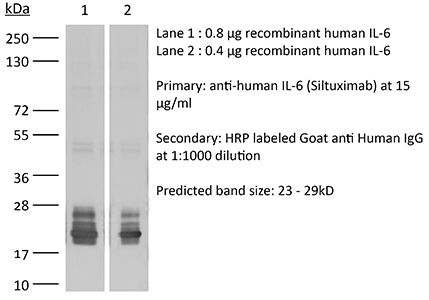
Product Description
Specifications
| Isotype | Human IgG1, κ |
|---|---|
| Recommended Isotype Control(s) | RecombiMAb human IgG1 isotype control, anti-hen egg lysozyme |
| Recommended Dilution Buffer | InVivoPure pH 7.0 Dilution Buffer |
| Conjugation | This product is unconjugated. Conjugation is available via our Antibody Conjugation Services. |
| Immunogen | Human IL-6 |
| Reported Applications |
Functional assays ELISA |
| Formulation |
PBS, pH 7.0 Contains no stabilizers or preservatives |
| Endotoxin |
≤0.5EU/mg (≤0.0005EU/μg) Determined by LAL assay |
| Aggregation |
<5% Determined by SEC |
| Purity |
≥95% Determined by SDS-PAGE |
| Sterility | 0.2 µm filtration |
| Production | Purified from cell culture supernatant in an animal-free facility |
| Purification | Protein A |
| Molecular Weight | 150 kDa |
| Murine Pathogen Tests |
Ectromelia/Mousepox Virus: Negative Hantavirus: Negative K Virus: Negative Lactate Dehydrogenase-Elevating Virus: Negative Lymphocytic Choriomeningitis virus: Negative Mouse Adenovirus: Negative Mouse Cytomegalovirus: Negative Mouse Hepatitis Virus: Negative Mouse Minute Virus: Negative Mouse Norovirus: Negative Mouse Parvovirus: Negative Mouse Rotavirus: Negative Mycoplasma Pulmonis: Negative Pneumonia Virus of Mice: Negative Polyoma Virus: Negative Reovirus Screen: Negative Sendai Virus: Negative Theiler’s Murine Encephalomyelitis: Negative |
| Storage | The antibody solution should be stored at the stock concentration at 4°C. Do not freeze. |
| Need a Custom Formulation? | See All Antibody Customization Options |
Product Citations
-
L-cystine alleviates necrotizing enterocolitis by regulating ferroptosis and Th17 cell differentiation via the IL-6/STAT3 pathway.
In Commun Biol on 29 December 2025 by Zhu, Q., Wang, Y., et al.
PubMed
Necrotizing enterocolitis (NEC) severely affects preterm infants with limited treatments. Although intestinal homeostasis dysfunction is considered a trigger for NEC, the key targets and mechanisms remain unclear. Using lipopolysaccharide-stimulated colonic epithelial cells and hypothermic hypoxia-induced NEC mice (both sexes), we demonstrate that the gut metabolite L-cystine alleviates intestinal inflammation by balancing Th17/Treg responses and inhibiting ferroptosis. Mechanistically, L-cystine directly targets KIF11 to suppress RC3H1 expression, blocking IL-6 transcripts through transcriptional modifications, thereby inhibiting IL-6 secretion and ferroptosis. Conditioned medium from L-cystine-treated cells inactivates IL-6/STAT3 signaling, reducing pro-inflammatory cytokine release and restoring Th17/Treg balance. Notably, microbiota colonization from NEC preterm infants exacerbates intestinal damage, an effect mitigated by L-cystine and IL-6/STAT3 inhibition. Thus, L-cystine attenuates NEC by suppressing ferroptosis in epithelial cells, restoring immune homeostasis, and preserving intestinal barrier integrity. Targeting intestinal metabolites represents a promising prophylactic and therapeutic strategy for NEC, addressing unmet clinical needs in neonatal intestinal injury management.