
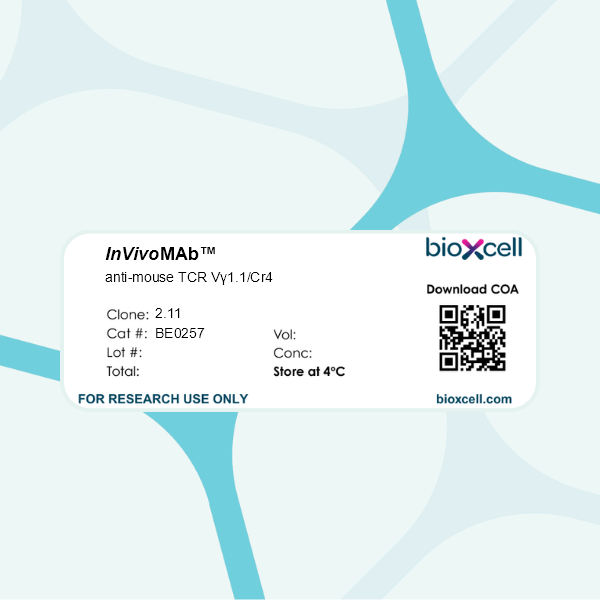
InVivoMAb anti-mouse TCR Vγ1.1/Cr4
Flow cytometry
Product Description
Specifications
| Isotype | Armenian hamster IgG |
|---|---|
| Recommended Isotype Control(s) | InVivoMAb polyclonal Armenian hamster IgG |
| Recommended Dilution Buffer | InVivoPure pH 7.0 Dilution Buffer |
| Conjugation | This product is unconjugated. Conjugation is available via our Antibody Conjugation Services. |
| Immunogen | 3.13.1 T cell hybridoma |
| Reported Applications |
in vivo Vγ1 TCR+ cell depletion Flow cytometry |
| Formulation |
PBS, pH 7.0 Contains no stabilizers or preservatives |
| Endotoxin |
≤1EU/mg (≤0.001EU/μg) Determined by LAL assay |
| Purity |
≥95% Determined by SDS-PAGE |
| Sterility | 0.2 µm filtration |
| Production | Purified from cell culture supernatant in an animal-free facility |
| Purification | Protein G |
| RRID | AB_2687736 |
| Molecular Weight | 150 kDa |
| Storage | The antibody solution should be stored at the stock concentration at 4°C. Do not freeze. |
| Need a Custom Formulation? | See All Antibody Customization Options |
Application References
-
Zheng, L., et al (2017). "Recruitment of Neutrophils Mediated by Vγ2 γδ T Cells Deteriorates Liver Fibrosis Induced by Schistosoma japonicum Infection in C57BL/6 Mice" Infect Immun 85(8).
PubMed
Conventional adaptive T cell responses contribute to the pathogenesis of Schistosoma japonicum infection, leading to liver fibrosis. However, the role of gamma-delta (γδ) T cells in this disease is less clear. γδ T cells are known to secrete interleukin-17 (IL-17) in response to infection, exerting either protective or pathogenic functions. In the present study, mice infected with S. japonicum are used to characterize the role of γδ T cells. Combined with the infection of S. japonicum, an extremely significant increase in the percentage of neutrophils in the CD45(+) cells was detected (from approximately 2.45% to 46.10% in blood and from 0.18% to 7.34% in spleen). Further analysis identified two different γδ T cell subsets that have different functions in the formation of granulomas in S. japonicum-infected mice. The Vγ1 T cells secrete gamma interferon (IFN-γ) only, while the Vγ2 T cells secrete both IL-17A and IFN-γ. Both subtypes lose the ability to secrete cytokine during the late stage of infection (12 weeks postinfection). When we depleted the Vγ2 T cells in infected mice, the percentage of neutrophils in blood and spleen decreased significantly, the liver fibrosis in the granulomas was reduced, and the level of IL-17A in the serum decreased (P < 0.05). These results suggest that during S. japonicum infection, Vγ2 T cells can recruit neutrophils and aggravate liver fibrosis by secreting IL-17A. This is the first report that a subset of γδ T cells plays a partial role in the pathological process of schistosome infection.
-
Narayan, K., et al (2012). "Intrathymic programming of effector fates in three molecularly distinct gammadelta T cell subtypes" Nat Immunol 13(5): 511-518.
PubMed
Innate gammadelta T cells function in the early phase of immune responses. Although innate gammadelta T cells have often been studied as one homogenous population, they can be functionally classified into effector subsets on the basis of the production of signature cytokines, analogous to adaptive helper T cell subsets. However, unlike the function of adaptive T cells, gammadelta effector T cell function correlates with genomically encoded T cell antigen receptor (TCR) chains, which suggests that clonal TCR selection is not the main determinant of the differentiation of gammadelta effector cells. A high-resolution transcriptome analysis of all emergent gammadelta thymocyte subsets segregated on the basis of use of the TCR gamma-chain or delta-chain indicated the existence of three separate subtypes of gammadelta effector cells in the thymus. The immature gammadelta subsets were distinguished by unique transcription-factor modules that program effector function.
Product Citations
-
Mammary γδ T cells promote IL-17A-mediated immunity against Staphylococcus aureus-induced mastitis in a microbiota-dependent manner.
In iScience on 15 December 2023 by Pan, N., Xiu, L., et al.
PubMed
Mastitis, a common disease for female during lactation period that could cause a health risk for human or huge economic losses for animals, is mainly caused by S. aureus invasion. Here, we found that neutrophil recruitment via IL-17A-mediated signaling was required for host defense against S. aureus-induced mastitis in a mouse model. The rapid accumulation and activation of Vγ4+ γδ T cells in the early stage of infection triggered the IL-17A-mediated immune response. Interestingly, the accumulation and influence of γδT17 cells in host defense against S. aureus-induced mastitis in a commensal microbiota-dependent manner. Overall, this study, focusing on γδT17 cells, clarified innate immune response mechanisms against S. aureus-induced mastitis, and provided a specific response to target for future immunotherapies. Meanwhile, a link between commensal microbiota community and host defense to S. aureus mammary gland infection may unveil potential therapeutic strategies to combat these intractable infections.
-
Vγ1 and Vγ4 gamma-delta T cells play opposing roles in the immunopathology of traumatic brain injury in males.
In Nat Commun on 18 July 2023 by Abou-El-Hassan, H., Rezende, R. M., et al.
PubMed
Traumatic brain injury (TBI) is a leading cause of morbidity and mortality. The innate and adaptive immune responses play an important role in the pathogenesis of TBI. Gamma-delta (γδ) T cells have been shown to affect brain immunopathology in multiple different conditions, however, their role in acute and chronic TBI is largely unknown. Here, we show that γδ T cells affect the pathophysiology of TBI as early as one day and up to one year following injury in a mouse model. TCRδ-/- mice are characterized by reduced inflammation in acute TBI and improved neurocognitive functions in chronic TBI. We find that the Vγ1 and Vγ4 γδ T cell subsets play opposing roles in TBI. Vγ4 γδ T cells infiltrate the brain and secrete IFN-γ and IL-17 that activate microglia and induce neuroinflammation. Vγ1 γδ T cells, however, secrete TGF-β that maintains microglial homeostasis and dampens TBI upon infiltrating the brain. These findings provide new insights on the role of different γδ T cell subsets after brain injury and lay down the principles for the development of targeted γδ T-cell-based therapy for TBI.
-
Vγ1 and Vγ4 γδ T cell subsets play opposing roles in traumatic brain injury
In Research Square on 2 September 2022 by Weiner, H., Abou-El-Hassan, H., et al.
-
Vγ1 and Vγ4 γδ T cell subsets play opposing roles in traumatic brain injury
In Research Square on 2 September 2022 by Weiner, H., Abou-El-Hassan, H., et al.