
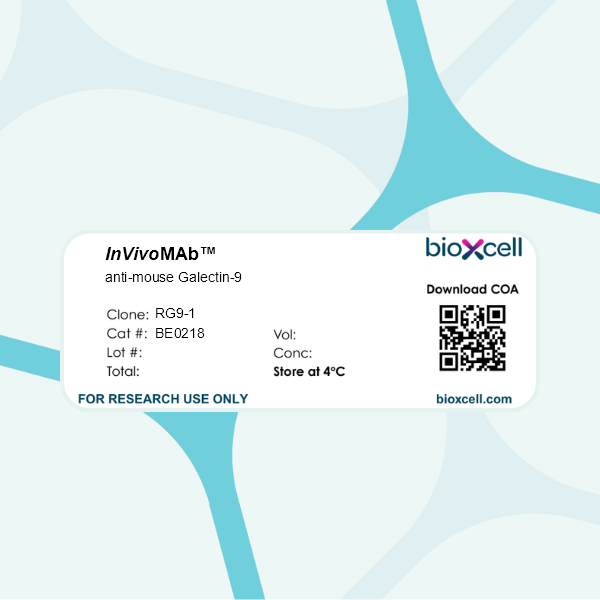
InVivoMAb anti-mouse Galectin-9
in vitro Galectin-9 blockade
Product Description
Specifications
| Isotype | Rat IgG2b, κ |
|---|---|
| Recommended Isotype Control(s) | InVivoMAb rat IgG2b isotype control, anti-keyhole limpet hemocyanin |
| Recommended Dilution Buffer | InVivoPure pH 7.0 Dilution Buffer |
| Conjugation | This product is unconjugated. Conjugation is available via our Antibody Conjugation Services. |
| Immunogen | Recombinant mouse galectin-9 |
| Reported Applications |
in vivo Galectin-9 blockade in vitro Galectin-9 blockade |
| Formulation |
PBS, pH 7.0 Contains no stabilizers or preservatives |
| Endotoxin |
≤1EU/mg (≤0.001EU/μg) Determined by LAL assay |
| Purity |
≥95% Determined by SDS-PAGE |
| Sterility | 0.2 µm filtration |
| Production | Purified from cell culture supernatant in an animal-free facility |
| Purification | Protein G |
| RRID | AB_2687702 |
| Molecular Weight | 150 kDa |
| Storage | The antibody solution should be stored at the stock concentration at 4°C. Do not freeze. |
| Need a Custom Formulation? | See All Antibody Customization Options |
Application References
-
Dolina, J. S., et al (2014). "Liver-primed CD8+ T cells suppress antiviral adaptive immunity through galectin-9-independent T-cell immunoglobulin and mucin 3 engagement of high-mobility group box 1 in mice" Hepatology 59(4): 1351-1365.
PubMed
The liver is a tolerogenic environment exploited by persistent infections, such as hepatitis B (HBV) and C (HCV) viruses. In a murine model of intravenous hepatotropic adenovirus infection, liver-primed antiviral CD8(+) T cells fail to produce proinflammatory cytokines and do not display cytolytic activity characteristic of effector CD8(+) T cells generated by infection at an extrahepatic, that is, subcutaneous, site. Importantly, liver-generated CD8(+) T cells also appear to have a T-regulatory (Treg) cell function exemplified by their ability to limit proliferation of antigen-specific T-effector (Teff ) cells in vitro and in vivo via T-cell immunoglobulin and mucin 3 (Tim-3) expressed by the CD8(+) Treg cells. Regulatory activity did not require recognition of the canonical Tim-3 ligand, galectin-9, but was dependent on CD8(+) Treg cell-surface Tim-3 binding to the alarmin, high-mobility group box 1 (HMGB-1). CONCLUSION: Virus-specific Tim-3(+) CD8(+) T cells operating through HMGB-1 recognition in the setting of acute and chronic viral infections of the liver may act to dampen hepatic T-cell responses in the liver microenvironment and, as a consequence, limit immune-mediated tissue injury or promote the establishment of persistent infections.
-
de Mingo Pulido, A., et al (2018). "TIM-3 Regulates CD103(+) Dendritic Cell Function and Response to Chemotherapy in Breast Cancer" Cancer Cell 33(1): 60-74 e66.
PubMed
Intratumoral CD103(+) dendritic cells (DCs) are necessary for anti-tumor immunity. Here we evaluated the expression of immune regulators by CD103(+) DCs in a murine model of breast cancer and identified expression of TIM-3 as a target for therapy. Anti-TIM-3 antibody improved response to paclitaxel chemotherapy in models of triple-negative and luminal B disease, with no evidence of toxicity. Combined efficacy was CD8(+) T cell dependent and associated with increased granzyme B expression; however, TIM-3 expression was predominantly localized to myeloid cells in both human and murine tumors. Gene expression analysis identified upregulation of Cxcl9 within intratumoral DCs during combination therapy, and therapeutic efficacy was ablated by CXCR3 blockade, Batf3 deficiency, or Irf8 deficiency.
-
Daley, D., et al (2016). "gammadelta T Cells Support Pancreatic Oncogenesis by Restraining alphabeta T Cell Activation" Cell 166(6): 1485-1499 e1415.
PubMed
Inflammation is paramount in pancreatic oncogenesis. We identified a uniquely activated gammadeltaT cell population, which constituted approximately 40% of tumor-infiltrating T cells in human pancreatic ductal adenocarcinoma (PDA). Recruitment and activation of gammadeltaT cells was contingent on diverse chemokine signals. Deletion, depletion, or blockade of gammadeltaT cell recruitment was protective against PDA and resulted in increased infiltration, activation, and Th1 polarization of alphabetaT cells. Although alphabetaT cells were dispensable to outcome in PDA, they became indispensable mediators of tumor protection upon gammadeltaT cell ablation. PDA-infiltrating gammadeltaT cells expressed high levels of exhaustion ligands and thereby negated adaptive anti-tumor immunity. Blockade of PD-L1 in gammadeltaT cells enhanced CD4(+) and CD8(+) T cell infiltration and immunogenicity and induced tumor protection suggesting that gammadeltaT cells are critical sources of immune-suppressive checkpoint ligands in PDA. We describe gammadeltaT cells as central regulators of effector T cell activation in cancer via novel cross-talk.
Product Citations
-
Inflammatory immune modulators of AML lung infiltration and respiratory failure.
In Nat Immunol on 1 August 2026 by Paraskevopoulou, V., Lin, Z., et al.
PubMed
Acute myeloid leukemia (AML) is a blood cancer with poor survival outcomes. Acute respiratory failure frequently occurs due to leukemia infiltration of the lungs. Underlying mechanisms remain unexplored and therapeutic interventions remain empiric. Here we map the AML lung microenvironment at spatial and single-cell resolution. We show that extensive remodeling is coupled with inflammation and impaired tissue integrity and function. Steroid treatment significantly reduces AML burden and lung infiltration, improving oxygenation and pulmonary function. As a mechanistic correlate, the S-type lectin Lgals9 is triggered by inflammation and mediates cell-cell interactions within infiltrated lungs. Also, the alarmin IL-33 and its receptor (IL-1RL1) are involved in cell-cell interactions within the leukemic lung microenvironment. Targeting either the Lgals9 or IL-33 axis significantly decreases overall AML burden and lung infiltration through effects on both the immune microenvironment and AML cells. Our studies delineate pulmonary infiltration phenotypes in acute leukemia, enabling new treatment strategies.
-
Galectin-9high Neutrophils Exacerbate Radiation-Induced Frailty.
In Aging Cell on 1 April 2026 by Cheng, Z., Ma, L., et al.
PubMed
Local radiation injury-induced frailty seriously impacts the quality of life of patients undergoing radiotherapy or nuclear accident casualties and causes a significant medical and economic burden. However, the underlying mechanisms of the frailty remain unknown. In this study, a unique population of hyperactive GAL-9high neutrophils is identified with characteristics of elevated ROS, NETs, and IFN-γ, prolonged lifespan, etc. These neutrophils infiltrate into multiple organs to induce injuries, also disrupt the bone marrow microenvironment, drive sustained bone marrow myeloid-biased differentiation, and resist clearance by bone marrow macrophages, serving as a crucial factor to exacerbate frailty. GAL-9 protein is demonstrated to play a vital role in the regulation of neutrophil hyperactivity. EccDNA shedding after skin radiation injury is shown to activate the JAK1/2-STAT1 pathway in splenic GMP cells, which is a potential origin of GAL-9high neutrophils. In summary, our results highlight the significance of the previously unrecognized hyperactive GAL-9high neutrophils to exacerbate frailty through a 'skin-spleen-bone marrow-multiple organs' axis after local radiation injury.
-
Alternatively activated neutrophils limit T cell-driven neuroinflammation.
In J Neuroinflammation on 27 March 2026 by Atkinson, J. R., Bellinger, C., et al.
PubMed
OBJECTIVE: Non-canonical myeloid cell populations are increasingly recognized as critical regulators of inflammation in neuroimmunological disease. Here, we investigate the role of alternatively activated neutrophils (aaN) in limiting encephalitogenic T cell responses during experimental autoimmune encephalomyelitis (EAE), a widely used model of multiple sclerosis. METHODS: Arginase-1–expressing aaN were identified and characterized within central nervous system (CNS) infiltrates during EAE using flow cytometry, single-cell RNA sequencing, and fluorescent in situ hybridization (RNAscope) combined with immunohistochemistry. The immunomodulatory properties of aaN were evaluated in vitro using CD4⁺ T cell suppression assays and in vivo by adoptive transfer of ex vivo–generated aaN during the preclinical phase following encephalitogenic T-cell injection. RESULTS: aaN were consistently detected within the CNS throughout EAE and spatially co-localized with encephalitogenic T cells. Transcriptomic profiling of aaN revealed enrichment of pathways associated with regulation of T cell activation and immune suppression. CNS-derived aaN potently inhibited CD4⁺ T cell proliferation in vitro. Therapeutic augmentation of this population, via adoptive transfer of ex vivo–generated aaN into mice following the injection of encephalitogenic T cells, delayed clinical EAE onset, markedly reduced the accumulation of pathogenic T cells within CNS lesions, and significantly enhanced neuronal survival. Mechanistically, ex vivo–generated aaN suppressed T cell responses through a contact-dependent, PD-L1–independent pathway, indicating a previously unrecognized mode of neutrophil-mediated immunoregulation. INTERPRETATION: These findings identify aaN as a previously underappreciated immunoregulatory population within the inflamed CNS that restrains pathogenic T cell responses and limits neuroinflammation during EAE. Collectively, our data support the therapeutic potential of strategies that augment aaN activity, including autologous aaN-based cell therapy or interventions that promote CNS homing, polarization, and persistence of endogenous aaN, as novel approaches for disease modification in multiple sclerosis.
-
Alternatively activated neutrophils limit T cell-driven neuroinflammation.
In J Neuroinflammation on 27 March 2026 by Atkinson, J. R., Bellinger, C., et al.
PubMed
OBJECTIVE: Non-canonical myeloid cell populations are increasingly recognized as critical regulators of inflammation in neuroimmunological disease. Here, we investigate the role of alternatively activated neutrophils (aaN) in limiting encephalitogenic T cell responses during experimental autoimmune encephalomyelitis (EAE), a widely used model of multiple sclerosis. METHODS: Arginase-1–expressing aaN were identified and characterized within central nervous system (CNS) infiltrates during EAE using flow cytometry, single-cell RNA sequencing, and fluorescent in situ hybridization (RNAscope) combined with immunohistochemistry. The immunomodulatory properties of aaN were evaluated in vitro using CD4⁺ T cell suppression assays and in vivo by adoptive transfer of ex vivo–generated aaN during the preclinical phase following encephalitogenic T-cell injection. RESULTS: aaN were consistently detected within the CNS throughout EAE and spatially co-localized with encephalitogenic T cells. Transcriptomic profiling of aaN revealed enrichment of pathways associated with regulation of T cell activation and immune suppression. CNS-derived aaN potently inhibited CD4⁺ T cell proliferation in vitro. Therapeutic augmentation of this population, via adoptive transfer of ex vivo–generated aaN into mice following the injection of encephalitogenic T cells, delayed clinical EAE onset, markedly reduced the accumulation of pathogenic T cells within CNS lesions, and significantly enhanced neuronal survival. Mechanistically, ex vivo–generated aaN suppressed T cell responses through a contact-dependent, PD-L1–independent pathway, indicating a previously unrecognized mode of neutrophil-mediated immunoregulation. INTERPRETATION: These findings identify aaN as a previously underappreciated immunoregulatory population within the inflamed CNS that restrains pathogenic T cell responses and limits neuroinflammation during EAE. Collectively, our data support the therapeutic potential of strategies that augment aaN activity, including autologous aaN-based cell therapy or interventions that promote CNS homing, polarization, and persistence of endogenous aaN, as novel approaches for disease modification in multiple sclerosis.