
$172.00 - $4,494.00

$172.00 - $4.00

Choose an Option...
  • 100 mg - $4,494.00
  • 50 mg - $3,175.00
  • 25 mg - $2,109.00
  • 5 mg - $630.00
  • 1 mg - $172.00
  • Custom Amount (Quotes Only)
In stock
Only %1 left

Product Description

The 53-5.8 monoclonal antibody reacts with mouse CD8β also known as Lyt 3.2. The CD8 antigen is a transmembrane glycoprotein that acts as a co-receptor for the T cell receptor (TCR). Like the TCR, CD8 binds to class I MHC molecules displayed by antigen presenting cells (APC). CD8 is primarily expressed on the surface of cytotoxic T cells, but can also be found on thymocytes, natural killer cells, and some dendritic cell subsets. CD8 most commonly exists as a heterodimer composed of one CD8α and one CD8β chain however, it can also exist as a homodimer composed of two CD8α chains. Both the CD8α and CD8β chains share significant homology to immunoglobulin variable light chains. The molecular weight of each CD8 chain is approximately 34 kDa. The 53-5.8 antibody has been shown to deplete CD8+ T cells completely but not deplete CD8+ CD11c+ dendritic cells when used in vivo.

Specifications

Isotype Rat IgG1, κ
Recommended Isotype Control(s) InVivoMAb rat IgG1 isotype control, anti-horseradish peroxidase
Recommended Dilution Buffer InVivoPure pH 7.0 Dilution Buffer
Conjugation This product is unconjugated. Conjugation is available via our Antibody Conjugation Services.
Immunogen Mouse thymus or spleen
Reported Applications in vivo CD8+ T cell depletion
in vitro CD8 blockade
Immunofluorescence
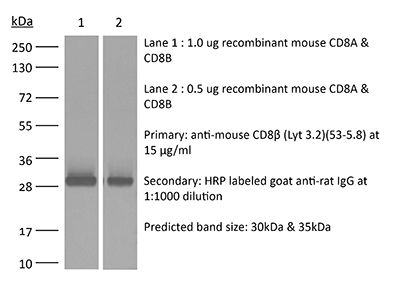
Formulation PBS, pH 7.0
Contains no stabilizers or preservatives
Endotoxin ≤1EU/mg (≤0.001EU/μg)
Determined by LAL assay
Purity ≥95%
Determined by SDS-PAGE
Sterility 0.2 µm filtration
Production Purified from cell culture supernatant in an animal-free facility
Purification Protein G
RRID AB_2687706
Molecular Weight 150 kDa
Storage The antibody solution should be stored at the stock concentration at 4°C. Do not freeze.
Need a Custom Formulation? See All Antibody Customization Options

Application References

in vivo CD8+ T cell depletion
Kobayashi, T., et al. (2015). "NKT cell-targeted vaccination plus anti-4-1BB antibody generates persistent CD8 T cell immunity against B cell lymphoma" Oncoimmunology 4(3): e990793.
PubMed

Harnessing the immune adjuvant properties of natural killer T (NKT) cells is an effective strategy to generate anticancer immunity. The objective of this study was to increase the potency and durability of vaccine-induced immunity against B cell lymphoma by combining alpha-galactosylceramide (alpha-GalCer)-loaded tumor cell vaccination with an agonistic antibody targeting the immune checkpoint molecule 4-1BB (CD137). We observed potent synergy when combining vaccination and anti-4-1BB antibody treatment resulting in significantly enhanced survival of mice harboring Emu-myc tumors, including complete eradication of lymphoma in over 50% of mice. Tumor-free survival required interferon gamma (IFNgamma)-dependent expansion of CD8+ T cells and was associated with 4-1BB-mediated differentiation of KLRG1+ effector CD8+ T cells. ‘Cured’ mice were also resistant to lymphoma re-challenge 80 days later indicating successful generation of immunological memory. Overall, our results demonstrate that therapeutic anticancer vaccination against B cell lymphoma using an NKT cell ligand can be boosted by subsequent co-stimulation through 4-1BB leading to a sustainable immune response that may enhance outcomes to conventional treatment.

in vivo CD8+ T cell depletion
Guillerey, C., et al. (2015). "Immunosurveillance and therapy of multiple myeloma are CD226 dependent" J Clin Invest 125(5): 2077-2089.
PubMed

Multiple myeloma (MM) is an age-dependent hematological malignancy. Evaluation of immune interactions that drive MM relies on in vitro experiments that do not reflect the complex cellular stroma involved in MM pathogenesis. Here we used Vk*MYC transgenic mice, which spontaneously develop MM, and demonstrated that the immune system plays a critical role in the control of MM progression and the response to treatment. We monitored Vk*MYC mice that had been crossed with Cd226 mutant mice over a period of 3 years and found that CD226 limits spontaneous MM development. The CD226-dependent anti-myeloma immune response against transplanted Vk*MYC MM cells was mediated both by NK and CD8+ T cells through perforin and IFN-gamma pathways. Moreover, CD226 expression was required for optimal antimyeloma efficacy of cyclophosphamide (CTX) and bortezomib (Btz), which are both standardly used to manage MM in patients. Activation of costimulatory receptor CD137 with mAb (4-1BB) exerted strong antimyeloma activity, while inhibition of coinhibitory receptors PD-1 and CTLA-4 had no effect. Taken together, the results of this study provide in vivo evidence that CD226 is important for MM immunosurveillance and indicate that specific immune components should be targeted for optimal MM treatment efficacy. As progressive immunosuppression associates with MM development, strategies aimed to increase immune functions may have important therapeutic implications in MM.

Immunofluorescence
Howland, S. W., et al. (2015). "Activated Brain Endothelial Cells Cross-Present Malaria Antigen" PLoS Pathog 11(6): e1004963.
PubMed

In the murine model of cerebral malaria caused by P. berghei ANKA (PbA), parasite-specific CD8+ T cells directly induce pathology and have long been hypothesized to kill brain endothelial cells that have internalized PbA antigen. We previously reported that brain microvessel fragments from infected mice cross-present PbA epitopes, using reporter cells transduced with epitope-specific T cell receptors. Here, we confirm that endothelial cells are the population responsible for cross-presentation in vivo, not pericytes or microglia. PbA antigen cross-presentation by primary brain endothelial cells in vitro confers susceptibility to killing by CD8+ T cells from infected mice. IFNgamma stimulation is required for brain endothelial cross-presentation in vivo and in vitro, which occurs by a proteasome- and TAP-dependent mechanism. Parasite strains that do not induce cerebral malaria were phagocytosed and cross-presented less efficiently than PbA in vitro. The main source of antigen appears to be free merozoites, which were avidly phagocytosed. A human brain endothelial cell line also phagocytosed P. falciparum merozoites. Besides being the first demonstration of cross-presentation by brain endothelial cells, our results suggest that interfering with merozoite phagocytosis or antigen processing may be effective strategies for cerebral malaria intervention.

in vivo CD8+ T cell depletion
Allard, B., et al. (2013). "Targeting CD73 enhances the antitumor activity of anti-PD-1 and anti-CTLA-4 mAbs" Clin Cancer Res 19(20): 5626-5635.
PubMed

PURPOSE: Monoclonal antibodies (mAb) that block programmed death (PD)-1 or cytotoxic T lymphocyte antigen (CTLA-4) receptors have been associated with durable clinical responses against a variety of cancer types and hold great potential as novel cancer therapeutics. Recent evidence suggest that targeted blockade of multiple immunosuppressive pathways can induce synergistic antitumor responses. EXPERIMENTAL DESIGN: In this study, we investigated whether targeted blockade of CD73, an ectonucleotidase that catabolizes the hydrolysis of extracellular adenosine monophosphate (AMP) to adenosine, can enhance the antitumor activity of anti-CTLA-4 and anti-PD-1 mAbs against transplanted and chemically induced mouse tumors. RESULTS: Anti-CD73 mAb significantly enhanced the activity of both anti-CTLA-4 and anti-PD-1 mAbs against MC38-OVA (colon) and RM-1 (prostate) subcutaneous tumors, and established metastatic 4T1.2 breast cancer. Anti-CD73 mAb also significantly enhanced the activity of anti-PD-1 mAb against 3-methylcholanthrene (MCA)-induced fibrosarcomas. Gene-targeted mice revealed that single-agent therapies and combinatorial treatments were dependent on host IFN-gamma and CD8(+) T cells, but independent of perforin. Interestingly, anti-CD73 mAb preferentially synergized with anti-PD-1 mAb. We investigated the effect of extracellular adenosine on tumor-infiltrating T cells and showed that activation of A2A adenosine receptor enhances PD-1 expression, but not CTLA-4 expression, on tumor-specific CD8+ T cells and CD4+ Foxp3+ T regulatory cells. CONCLUSIONS: Taken together, our study revealed that targeted blockade of CD73 can enhance the therapeutic activity of anti-PD-1 and anti-CTLA-4 mAbs and may thus potentiate therapeutic strategies targeting immune checkpoint inhibitors in general.

in vivo CD8+ T cell depletion
Verbrugge, I., et al. (2012). "Radiotherapy increases the permissiveness of established mammary tumors to rejection by immunomodulatory antibodies" Cancer Res 72(13): 3163-3174.
PubMed

It is becoming increasingly evident that radiotherapy may benefit from coincident or subsequent immunotherapy. In this study, we examined whether the antitumor effects of radiotherapy, in established triple-negative breast tumors could be enhanced with combinations of clinically relevant monoclonal antibodies (mAb), designed to stimulate immunity [anti-(alpha)-CD137, alpha-CD40] or relieve immunosuppression [alpha-programmed death (PD)-1]. While the concomitant targeting of the costimulatory molecules CD137 and CD40 enhanced the antitumor effects of radiotherapy and promoted the rejection of subcutaneous BALB/c-derived 4T1.2 tumors, this novel combination was noncurative in mice bearing established C57BL/6-derived AT-3 tumors. We identified PD-1 signaling within the AT-3 tumors as a critical limiting factor to the therapeutic efficacy of alpha-CD137 therapy, alone and in combination with radiotherapy. Strikingly, all mice bearing established orthotopic AT-3 mammary tumors were cured when alpha-CD137 and alpha-PD-1 mAbs were combined with single- or low-dose fractionated radiotherapy. CD8+ T cells were essential for curative responses to this combinatorial regime. Interestingly, CD137 expression on tumor-associated CD8+ T cells was largely restricted to a subset that highly expressed PD-1. These CD137+PD-1High CD8+ T cells, persisted in irradiated AT-3 tumors, expressed Tim-3, granzyme B and Ki67 and produced IFN-gamma ex vivo in response to phorbol 12-myristate 13-acetate (PMA) and ionomycin stimulation. Notably, radiotherapy did not deplete, but enriched tumors of functionally active, tumor-specific effector cells. Collectively, these data show that concomitant targeting of immunostimulatory and inhibitory checkpoints with immunomodulatory mAbs can enhance the curative capacity of radiotherapy in established breast malignancy.

in vivo CD8+ T cell depletion
Ahmed, K. A., et al. (2012). "Direct in vivo evidence of CD4+ T cell requirement for CTL response and memory via pMHC-I targeting and CD40L signaling" J Leukoc Biol 92(2): 289-300.
PubMed

CD4(+) T cell help contributes critically to DC-induced CD8(+) CTL immunity. However, precisely how these three cell populations interact and how CD4(+) T cell signals are delivered to CD8(+) T cells in vivo have been unclear. In this study, we developed a novel, two-step approach, wherein CD4(+) T cells and antigen-presenting DCs productively engaged one another in vivo in the absence of cognate CD8(+) T cells, after which, we selectively depleted the previously engaged CD4(+) T cells or DCs before allowing interactions of either population alone with naive CD8(+) T cells. This protocol thus allows us to clearly document the importance of CD4(+) T-licensed DCs and DC-primed CD4(+) T cells in CTL immunity. Here, we provide direct in vivo evidence that primed CD4(+) T cells or licensed DCs can stimulate CTL response and memory, independent of DC-CD4(+) T cell clusters. Our results suggest that primed CD4(+) T cells with acquired pMHC-I from DCs represent crucial “immune intermediates” for rapid induction of CTL responses and for functional memory via CD40L signaling. Importantly, intravital, two-photon microscopy elegantly provide unequivocal in vivo evidence for direct CD4-CD8(+) T cell interactions via pMHC-I engagement. This study corroborates the coexistence of direct and indirect mechanisms of T cell help for a CTL response in noninflammatory situations. These data suggest a new “dynamic model of three-cell interactions” for CTL immunity derived from stimulation by dissociated, licensed DCs, primed CD4(+) T cells, and DC-CD4(+) T cell clusters and may have significant implications for autoimmunity and vaccine design.

in vitro CD8 blockade
Takada, K. and S. C. Jameson. (2009). "Self-class I MHC molecules support survival of naive CD8 T cells, but depress their functional sensitivity through regulation of CD8 expression levels" J Exp Med 206(10): 2253-2269.
PubMed

Previous studies have suggested that naive CD8 T cells require self-peptide-major histocompatability complex (MHC) complexes for maintenance. However, interpretation of such studies is complicated because of the involvement of lymphopenic animals, as lymphopenia drastically alters naive T cell homeostasis and function. In this study, we explored naive CD8 T cell survival and function in nonlymphopenic conditions by using bone marrow chimeric donors and hosts in which class I MHC expression is absent or limited to radiosensitive versus radioresistant cells. We found that long-term survival of naive CD8 T cells (but not CD4 T cells) was impaired in the absence of class I MHC. However, distinct from this effect, class I MHC deprivation also enhanced naive CD8 T cell responsiveness to low-affinity (but not high-affinity) peptide-MHC ligands. We found that this improved sensitivity was a consequence of up-regulated CD8 levels, which was mediated through a transcriptional mechanism. Hence, our data suggest that, in a nonlymphopenic setting, self-class I MHC molecules support CD8 T cell survival, but that these interactions also attenuate naive T cell sensitivity by dynamic tuning of CD8 levels.

View More

Product Citations

    • Immunology and Microbiology
    • Genetics
    mRNA vaccine expressing enterovirus D68 virus-like particles induces potent neutralizing antibodies and protects against infection.

    In Mol Ther Nucleic Acids on 9 December 2025 by Kunishima, Y., Senpuku, K., et al.

    PubMed

    Enterovirus D68 (EV-D68) causes respiratory illness in children. It also causes severe paralysis called acute flaccid myelitis (AFM), which has become a global health threat. Here, we generated an mRNA vaccine expressing virus-like particles (VLPs) of EV-D68. We found that the mRNA vaccine elicited potent neutralizing antibodies against EV-D68 in the blood, and the neutralizing titer was superior to that of the inactivated whole virion (IWV) vaccine. The mRNA vaccine showed protective effects against intranasal challenge with EV-D68, and antisera from the vaccinated mice prevented the paralysis caused by EV-D68 infection in neonatal mice. Moreover, the mRNA vaccine induced neutralizing antibodies in the respiratory tract, which is the entry site for EV-D68. Additionally, it attenuated infection with coxsackievirus B3 (CVB3), which belongs to another enterovirus group, via CD8+ T cell responses. In conclusion, our results suggest that this mRNA vaccine is a promising candidate for EV-D68 prevention.

    • Immunology and Microbiology
    Salmonella-superspreader hosts require gut regulatory T cells to maintain a disease-tolerant state.

    In J Exp Med on 3 November 2025 by Di Luccia, B., Massis, L. M., et al.

    PubMed

    Host-pathogen interactions involve two critical strategies: resistance, whereby hosts clear invading microbes, and tolerance, whereby hosts carry high pathogen burden asymptomatically. Here, we investigate mechanisms by which Salmonella-superspreader (SSP) hosts maintain an asymptomatic state during chronic infection. We found that regulatory T cells (Tregs) are essential for this disease-tolerant state, limiting intestinal immunopathology and enabling SSP hosts to thrive, while facilitating Salmonella transmission. Treg depletion in SSP mice resulted in decreased survival, heightened gut inflammation, and impairment of the intestinal barrier, without affecting Salmonella persistence. Colonic Tregs from SSP mice exhibited a unique transcriptomic profile characterized by the upregulation of type 1 inflammatory genes, including the transcription factor T-bet. In the absence of Tregs, we observed robust expansion of cytotoxic CD4+ T cells, with CD4+ T cell depletion restoring homeostasis. These results uncover a critical host strategy to establish disease tolerance during chronic enteric infection, providing novel insights into mucosal responses to persistent pathogens and chronic intestinal inflammation.

    • Cancer Research
    STING activation reshapes the tumor microenvironment leading to tumor regression in osteosarcoma

    In bioRxiv on 25 October 2025 by Young, E. P., Johnson, C. A., et al.

    • Immunology and Microbiology
    • Cancer Research
    A Potent Oral Sialylation Inhibitor Augments the Immunotherapy in Pancreatic Ductal Adenocarcinoma.

    In ACS Cent Sci on 22 October 2025 by Mou, J., Chen, R., et al.

    PubMed

    Pancreatic ductal adenocarcinoma (PDAC) remains refractory to current immune checkpoint blockade (ICB) therapies, necessitating innovative therapeutic strategies. Emerging evidence implicates aberrant sialoglycan upregulation as a key mediator of immune evasion in PDAC. Herein, we report Y-320, a highly potent oral sialylation inhibitor discovered through high-throughput screening. Y-320 suppresses α-2,3/2,6-sialylation in PDAC cells (IC50 ≈ 200 nM) with >300-fold higher activity than the known pan-inhibitor P-3Fax-Neu5Ac. Structural analyses reveal competitive occupation of multiple sialyltransferases' substrate-binding pockets as Y-320's action mechanism. In vivo, Y-320 significantly inhibits tumor growth and remodels the tumor immune microenvironment. Mechanistic studies establish that the therapeutic efficacy of Y-320 depends on the coordinated engagement between CD8+ T cell and macrophage. Importantly, Y-320 synergizes with anti-PD-1 therapy to overcome ICB resistance in PDAC, demonstrating superior tumor suppression compared to monotherapies. Our findings demonstrate that Y-320 shows promise for use as a therapeutic agent for cancer and validates sialylation inhibition as a novel glycoimmune checkpoint strategy for PDAC and other immunotherapy-resistant malignancies.

    • Immunology and Microbiology
    • Cancer Research
    Inhibiting NEDD4 in triple-negative breast cancer cells reprograms tumor immune microenvironment via the β-TrCP/YAP/ECM axis.

    In Cell Rep Med on 21 October 2025 by Su, N., Lian, W., et al.

    PubMed

    Tumor immune microenvironment greatly influences triple-negative breast cancer (TNBC) progression. Identifying targets to convert "cold" tumors into "hot" tumors holds promise for improving treatment outcomes. Here, we show that high expression of NEDD4, an HECT-type E3 ubiquitin ligase, correlates with poor prognosis and reduced CD8+ T cell infiltration in TNBC patients. NEDD4 depletion in TNBC cells significantly inhibits tumor growth through enhancing CD8+ T cell-mediated cytotoxicity in immunocompetent hosts. Mechanistically, NEDD4 depletion stabilizes β-TrCP, leading to YAP ubiquitination and degradation. Downregulated YAP reprograms the immunosuppressive tumor extracellular matrix (ECM) to increase CD8+ T cell infiltration. Furthermore, a small-molecule inhibitor of NEDD4, XMU-MP-10, exhibits significant in vivo efficacy in inhibiting TNBC tumor growth by enhancing CD8+ T cell infiltration in mouse models. Collectively, our findings suggest that the genetic depletion or pharmacological inhibition of NEDD4 enhances antitumor immune responses via the β-TrCP/YAP/ECM cascades, offering a promising therapeutic strategy for TNBC treatment.

    • Immunology and Microbiology
    • Cancer Research
    αTIGIT-IL2 achieves tumor regression by promoting tumor-infiltrating regulatory T cell fragility in mouse models.

    In Nat Commun on 17 October 2025 by Wang, T., Xu, Y., et al.

    PubMed

    Administration of IL-2 may promote the suppressive function and proliferation of Treg cells that cause immune tolerance in patients with cancer, which causes low-dose IL-2 to fail in achieving an optimal anti-tumor effect. Here, we designed an immunocytokine by fusing IL-2 and an anti-TIGIT monoclonal antibody, named αTIGIT-IL2, that targets Treg cells and promotes their fragility in the tumor milieu. These fragile-like Treg cells show impaired suppressive function and high IFN-γ production, triggering an immune-reactive tumor microenvironment. Such inflammation leads to the recruitment and functional reprogramming of intratumoral neutrophils, improving cross-talk between neutrophils and CD8+ T cells and enhancing the antitumor ability of CD8+ T cells. Combination therapy with αTIGIT-IL2 and PD-1 blocker could eliminate triple-negative breast cancer (TNBC) tumors resistant to immune checkpoint blockade (ICB) therapy. These findings provide the basis for developing a new generation of immunocytokines that target Treg cells and promote their fragility in the tumor milieu, resulting in robust antitumor immunity.

    • Immunology and Microbiology
    • Cancer Research
    A next-generation anti-CTLA-4 probody mitigates toxicity and enhances anti-tumor immunity in mice.

    In Nat Commun on 10 October 2025 by Cao, W., Chen, J., et al.

    PubMed

    CTLA-4 is a promising target for immune checkpoint inhibition in cancer therapy, with CTLA-4 blockade achieving prolonged overall survival for responding patients. However, the progressively elevated doses of anti-CTLA-4 agents, aimed at achieving better efficacy, result in increased toxicities, limiting their clinical applications. Here, we generate a prodrug design of the anti-CTLA-4 antibody, named ProCTLA-4, by folding the Fab fragment of the antibody in a tumor-associated protease-based manner. In preclinical mouse models, ProCTLA-4 effectively depletes suppressive regulatory T cells within the tumor microenvironment and enhances tumor-associated antigen-specific CD8+ T cell responses, while exhibiting reduced toxicity compared to currently available CTLA-4 blockade approaches. Furthermore, compared to the currently used Probody therapeutics for anti-CTLA-4 (BMS986288), ProCTLA-4 has more advantages in efficacy amplification, such as in poor immunogenic melanoma. Our design establishes an alternative paradigm for antibody agents that limits the emergence of immune-related adverse events (irAE) while increasing therapeutic efficacy.

    • Immunology and Microbiology
    BRD9 inhibition overcomes oncolytic virus therapy resistance in glioblastoma.

    In Cell Rep Med on 19 August 2025 by Guo, C., Long, Z., et al.

    PubMed

    Long-term survival of glioblastoma multiforme (GBM) remains challenging, spurring the development of novel therapies such as oncolytic virus therapy. While oncolytic virus shows promise in clinical trials, many patients do not respond to this therapy. Here, we perform a CRISPR screening and identify the non-canonical BRG1/BRM-associated factor (ncBAF) complex as a pivotal tumor-intrinsic factor for oncolytic virotherapy resistance. Knocking out the ncBAF-specific subunit bromodomain-containing protein 9 (BRD9) markedly augments the oncolytic efficacy of oncolytic herpes simplex virus type 1 (oHSV1) and enhances antitumor immunity. Mechanistically, BRD9 binds to RELA and potentiates the expression of downstream antiviral genes. Notably, the application of BRD9 inhibitor (IBRD9) significantly enhances the oncolytic activity of oHSV1 in various GBM models. Moreover, reduced BRD9 levels strongly correlate with improved outcomes in clinical trials of oHSV1. These findings suggest that BRD9 is an attractive target for overcoming the resistance to oHSV1 in glioblastoma treatment.

    • Cancer Research
    • Immunology and Microbiology
    Unraveling Cathepsin S regulation in interleukin-7-mediated anti-tumor immunity reveals its targeting potential against oral cancer.

    In J Biomed Sci on 24 July 2025 by Chang, Y. C., Chen, S. J., et al.

    PubMed

    Immunomodulatory agents benefit a small percentage of patients with oral cancer (OC), a subset of head and neck cancer. Cathepsin S (CTSS), a lysosomal protease, has been frequently associated with tumor immunity. This study aimed to investigate the mechanism by which tumor CTSS affects anti-tumor immunity through the regulation of interleukin-7 (IL-7) to overcome this obstacle.

    • Immunology and Microbiology
    • Cancer Research
    Overcoming resistance to immunotherapy by targeting CD38 in human tumor explants.

    In Cell Rep Med on 15 July 2025 by Revach, O. Y., Cicerchia, A. M., et al.

    PubMed

    CD38, an ecto-enzyme involved in NAD+ catabolism, is highly expressed in exhausted CD8+ T cells and has emerged as an attractive target to improve response to immune checkpoint blockade (ICB) by blunting T cell exhaustion. However, the precise role(s) and regulation of CD38 in exhausted T cells and the efficacy of CD38-directed therapeutic strategies in human cancer remain incompletely defined. Here, we show that CD38+CD8+ T cells are induced by chronic TCR activation and type I interferon stimulation and confirm their association with ICB resistance in human melanoma. Disrupting CD38 restores cellular NAD+ pools and improves T cell bioenergetics and effector functions. Targeting CD38 restores ICB sensitivity in a cohort of patient-derived organotypic tumor spheroids from explanted melanoma specimens. These results support further preclinical and clinical evaluation of CD38-directed therapies in melanoma and underscore the importance of NAD+ as a vital metabolite to enhance those therapies.

    • Immunology and Microbiology
    • Cancer Research
    Epigenomic regulation of stemness contributes to the low immunogenicity of the most mutated human cancer.

    In Cell Rep on 27 May 2025 by Oka, T., Smith, S. S., et al.

    PubMed

    Despite harboring the highest tumor mutational burden of all cancers, basal cell carcinoma (BCC) has low immunogenicity. Here, we demonstrate that BCC's low immunogenicity is associated with epigenomic suppression of antigen presentation machinery reminiscent of its cell of origin. Primary BCC had low T cell infiltrates and low human leukocyte antigen class I (HLA-I) expression compared with cutaneous squamous cell carcinoma (SCC) and normal keratinocytes. Forkhead box C1 (Foxc1), a regulator of quiescence in hair follicle stem cells, was expressed in BCC. Foxc1 bound to promoter of interferon regulatory factor 1 and HLA-I genes, leading to their deacetylation and reduced expression. A histone deacetylase inhibitor, entinostat, overcame Foxc1's effect and upregulated HLA-I in BCC. Topical entinostat plus imiquimod immunotherapy blocked BCC development in mice. Collectively, our findings demonstrate that low BCC immunogenicity is associated with a stem-like quiescent program preserved in the tumor cells, which can be blocked to enable BCC immunotherapy.

    Effective extracellular payload release and immunomodulatory interactions govern the therapeutic effect of trastuzumab deruxtecan (T-DXd).

    In Nat Commun on 2 April 2025 by Tsao, L. C., Wang, J. S., et al.

    PubMed

    Trastuzumab deruxtecan (T-DXd) is an antibody-drug conjugate (ADC) targeting HER2, exhibiting significant clinical efficacy in breast cancer (BC) with varying HER2 expression, including HER2-low and HER2-ultralow. However, the precise mechanism underlying its efficacy and the contribution of immune activation in these settings remain unclear. Here, we demonstrate that T-DXd efficacy in HER2-low and HER2-negative BC is independent of HER2 engagement and ADC internalization. Instead, its activity relies on extracellular proteases, such as cathepsin L (CTSL), within the tumor microenvironment. Irrespective of their HER2 status, tumor and stromal compartments of invasive BC abundantly express CTSL, which efficiently cleaves the specialized linker of T-DXd, facilitating payload release and inducing cytotoxicity against HER2-low/negative tumors. In HER2-positive BC, the antibody backbone of T-DXd engages Fcγ-receptors and drives antibody-dependent cellular phagocytosis (ADCP). Concurrently, its cytotoxic payload (DXd) induces immunogenic cell death, further activating myeloid cells via TLR4 and STING pathways to enhance tumor antigen presentation to CD8+ T cells. Notably, T-DXd cytotoxicity also upregulates tumor CD47 expression, dampening immune activation. Combining T-DXd with CD47 checkpoint blockade significantly enhances anti-tumor immune responses in a HER2-transgenic BC mouse model, while also inducing durable CD8+ T cell memory to prevent tumor recurrence after therapy cessation.

    • Immunology and Microbiology
    • Cell Biology
    • Cancer Research
    Methionine-driven YTHDF1 expression facilitates bladder cancer progression by attenuating RIG-I-modulated immune responses and enhancing the eIF5B-PD-L1 axis.

    In Cell Death Differ on 1 April 2025 by Luo, J., Fu, L. M., et al.

    PubMed

    The impact of amino acids on tumor immunotherapy is gradually being uncovered. In this study, we screened various essential and non-essential amino acids and found that methionine enhances mRNA methylation and reduced the activation of Type I interferon pathway in bladder cancer. Through RNA sequencing, point mutations, MB49 mouse tumor models, and single-cell RNA sequencing, we demonstrated that high methionine levels elevate the expression of m6A reader YTHDF1, promoting the degradation of RIG-I, thereby inhibiting the RIG-I/MAVS-mediated IFN-I pathway and reducing the efficacy of tumor immunotherapy. Additionally, immunoprecipitation and mass spectrometry revealed that YTHDF1 binds to the eukaryotic translation initiation factor eIF5B, which acts on PD-L1 mRNA to enhance its translation and promote immune evasion. By intravesical administration of oncolytic bacteria VNP20009, we effectively depleted methionine locally, significantly prolonging mouse survival and enhancing immune cell infiltration and differentiation within tumors. Multiplex immunofluorescence assays in bladder cancer immunotherapy patients confirmed our findings. Our research elucidates two mechanisms by which methionine inhibits bladder cancer immunotherapy and proposes a targeted methionine depletion strategy that advances research while minimizing nutritional impact on patients.

    • Immunology and Microbiology
    Dietary cysteine enhances intestinal stemness via CD8+T cell-derived IL-22

    In bioRxiv on 16 February 2025 by Chi, F., Zhang, Q., et al.

    • Cancer Research
    • Immunology and Microbiology
    Neoadjuvant anti-4-1BB confers protection against spontaneous metastasis through low-affinity intratumor CD8+T cells in triple-negative breast cancer

    In bioRxiv on 2 February 2025 by Lim, B. J. W., Liu, M., et al.

    • Immunology and Microbiology
    • Cancer Research
    Combined KRAS Inhibition and Immune Therapy Generates Durable Complete Responses in an Autochthonous PDAC Model.

    In Cancer Discov on 13 January 2025 by Liu, Y., Han, J., et al.

    PubMed

    Clinically available KRAS* inhibitors and IO agents alleviated the immunosuppressive tumor microenvironment in PDAC. Profound tumor regression and prolonged survival in an autochthonous PDAC model provide a compelling rationale for combining KRAS* inhibition with IO agents targeting multiple arms of the immunity cycle to combat PDAC.

    • Mus musculus (Mouse)
    • Cancer Research
    • Immunology and Microbiology
    Remodelling of the immune landscape by IFNγ counteracts IFNγ-dependent tumour escape in mouse tumour models.

    In Nat Commun on 2 January 2025 by Lau, V. W. C., Mead, G. J., et al.

    PubMed

    Loss of IFNγ-sensitivity by tumours is thought to be a mechanism enabling evasion, but recent studies suggest that IFNγ-resistant tumours can be sensitised for immunotherapy, yet the underlying mechanism remains unclear. Here, we show that IFNγ receptor-deficient B16-F10 mouse melanoma tumours are controlled as efficiently as WT tumours despite their lower MHC class I expression. Mechanistically, IFNγ receptor deletion in B16-F10 tumours increases IFNγ availability, triggering a remodelling of the immune landscape characterised by inflammatory monocyte infiltration and the generation of 'mono-macs'. This altered myeloid compartment synergises with an increase in antigen-specific CD8+ T cells to promote anti-tumour immunity against IFNγ receptor-deficient tumours, with such an immune crosstalk observed around blood vessels. Importantly, analysis of transcriptomic datasets suggests that similar immune remodelling occurs in human tumours carrying mutations in the IFNγ pathway. Our work thus serves mechanistic insight for the crosstalk between tumour IFNγ resistance and anti-tumour immunity, and implicates this regulation for future cancer therapy.

    • Cancer Research
    • Cell Biology
    Targeting Catechol-O-Methyltransferase Induces Mitochondrial Dysfunction and Enhances the Efficacy of Radiotherapy in Glioma.

    In Cancer Res on 4 November 2024 by Jiao, M., Pirozzi, C. J., et al.

    PubMed

    Radiotherapy (RT) is commonly used to try to eliminate any remaining tumor cells following surgical resection of glioma. However, tumor recurrence is prevalent, highlighting the unmet medical need to develop therapeutic strategies to enhance the efficacy of RT in glioma. Focusing on the radiosensitizing potential of the currently approved drugs known to cross the blood-brain barrier can facilitate rapid clinical translation. Here, we assessed the role of catechol-O-methyltransferase (COMT), a key enzyme to degrade catecholamines and a drug target for Parkinson's disease, in glioma treatment. Analysis of The Cancer Genome Atlas data showed significantly higher COMT expression levels in both low-grade glioma and glioblastoma compared to normal brain tissues. Inhibition of COMT by genetic knockout or FDA-approved COMT inhibitors significantly sensitized glioma cells to RT in vitro and in vivo. Mechanistically, COMT inhibition in glioma cells led to mitochondria dysfunction and increased mitochondrial RNA release into the cytoplasm, activating the cellular antiviral double-stranded RNA sensing pathway and type I interferon (IFN) response. Elevated type I IFNs stimulated the phagocytic capacity of microglial cells, enhancing RT efficacy. Given the long-established safety record of the COMT inhibitors, these findings provide a solid rationale to evaluate them in combination with RT in patients with glioma. Significance: Inhibition of catechol-O-methyltransferase, a well-established drug target in Parkinson's disease, interferes with mitochondrial electron transport and induces mitochondrial double-stranded RNA leakage, activating type I interferon signaling and sensitizing glioma to radiotherapy.

    • Mus musculus (Mouse)
    • Cancer Research
    • Immunology and Microbiology
    Age-Associated Contraction of Tumor-Specific T Cells Impairs Antitumor Immunity.

    In Cancer Immunol Res on 4 November 2024 by Georgiev, P., Han, S., et al.

    PubMed

    Progressive decline of the adaptive immune system with increasing age coincides with a sharp increase in cancer incidence. In this study, we set out to understand whether deficits in antitumor immunity with advanced age promote tumor progression and/or drive resistance to immunotherapy. We found that multiple syngeneic cancers grew more rapidly in aged versus young adult mice, driven by dysfunctional CD8+ T-cell responses. By systematically mapping immune cell profiles within tumors, we identified loss of tumor antigen-specific CD8+ T cells as a primary feature accelerating the growth of tumors in aged mice and driving resistance to immunotherapy. When antigen-specific T cells from young adult mice were administered to aged mice, tumor outgrowth was delayed and the aged animals became sensitive to PD-1 blockade. These studies reveal how age-associated CD8+ T-cell dysfunction may license tumorigenesis in elderly patients and have important implications for the use of aged mice as preclinical models of aging and cancer.

    • In vivo experiments
    • Mus musculus (Mouse)
    • Cancer Research
    • Cell Biology
    • Immunology and Microbiology
    Aberrant cytoplasmic expression of UHRF1 restrains the MHC-I-mediated anti-tumor immune response.

    In Nat Commun on 3 October 2024 by Tan, L. M., Yin, T., et al.

    PubMed

    Immunotherapy successfully complements traditional cancer treatment. However, primary and acquired resistance might limit efficacy. Reduced antigen presentation by MHC-I has been identified as potential resistance factor. Here we show that the epigenetic regulator ubiquitin-like with PHD and ring finger domains 1 (UHRF1), exhibits altered expression and aberrant cytosolic localization in cancerous tissues, where it promotes MHC-I ubiquitination and degradation. Cytoplasmic translocation of UHRF1 is induced by its phosphorylation on a specific serine in response to signals provided by factors present in the tumor microenvironment (TME), such as TGF-β, enabling UHRF1 to bind MHC-I. Downregulation of MHC-I results in suppression of the antigen presentation pathway to establish an immune hostile TME. UHRF1 inactivation by genetic deletion synergizes with immune checkpoint blockade (ICB) treatment and induces an anti-tumour memory response by evoking low-affinity T cells. Our study adds to the understanding of UHRF1 in cancer immune evasion and provides a potential target to synergize with immunotherapy and overcome immunotherapeutic resistance.

1 2 3 4 5 6 7
View More

Product FAQs