
InVivoMAb anti-human TROP-2
Immunohistochemistry (frozen)
Flow cytometry
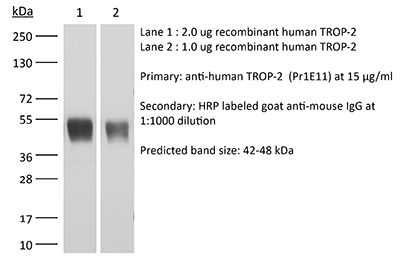
Product Description
Specifications
| Isotype | Mouse IgG1, κ |
|---|---|
| Recommended Isotype Control(s) | InVivoMAb mouse IgG1 isotype control, unknown specificity |
| Recommended Dilution Buffer | InVivoPure pH 7.0 Dilution Buffer |
| Conjugation | This product is unconjugated. Conjugation is available via our Antibody Conjugation Services. |
| Immunogen | Primary human prostate cancer cells |
| Reported Applications |
Western blot Immunohistochemistry (frozen) Flow cytometry |
| Formulation |
PBS, pH 7.0 Contains no stabilizers or preservatives |
| Endotoxin |
≤1EU/mg (≤0.001EU/μg) Determined by LAL assay |
| Purity |
≥95% Determined by SDS-PAGE |
| Sterility | 0.2 µm filtration |
| Production | Purified from cell culture supernatant in an animal-free facility |
| Purification | Protein G |
| Molecular Weight | 150 kDa |
| Storage | The antibody solution should be stored at the stock concentration at 4°C. Do not freeze. |
| Need a Custom Formulation? | See All Antibody Customization Options |
Application References
-
Ikeda M, Yamaguchi M, Kato K, Nakamura K, Shiina S, Ichikawa-Ando T, Misaka H, Myojo K, Nakamura K, Sugimoto Y, Hamada H (2015). "Pr1E11, a novel anti-TROP-2 antibody isolated by adenovirus-based antibody screening, recognizes a unique epitope" Bioch
PubMed
TROP-2 is a type Ⅰ transmembrane glycoprotein that is highly expressed in various epithelial cancer cells, and its increased expression correlates with poor prognosis. Although several anti-TROP-2 antibodies have been described, they were found unsuitable for antitumor therapy use in vivo as naked antibodies. In this study, we established a novel anti-TROP-2 antibody, designated Pr1E11, from mice immunized with primary prostate cancer cells. Antibody screening was based on the infection activity of Adv-LacZ-FZ33, which displays an immunoglobulin G binding domain in the adenoviral fiber protein. We found that Pr1E11 specifically binds to TROP-2 with high affinity and recognizes diverse epithelial cancer cell lines and primary pancreatic cancer tissues. Epitope analysis using TROP-2 deletion mutants revealed that binding site of Pr1E11 is a cysteine-rich domain, a unique epitope compared with other available anti-TROP-2 antibodies. In addition, Pr1E11 exhibited low internalization activity, which may make it suitable for naked antibody therapeutics. Our results suggest that Pr1E11 may stimulate different biological activities from other anti-TROP-2 antibodies based on its unique binding epitope, and is a potential candidate for naked antibody therapeutics for various epithelial cancer treatments.
Product Citations
-
68Ga-MY6349 PET/CT imaging to assess Trop2 expression in multiple types of cancer.
In J Clin Invest on 7 November 2024 by Chen, H., Zhao, L., et al.
PubMed
BACKGROUNDConsidering that trophoblast cell-surface antigen 2 (Trop2) is overexpressed in a wide range of human epithelial cancers, it presents an attractive target for diagnosis and treatment of multiple types of cancer. Herein, we have developed a Trop2-specific radiotracer, 68Ga-MY6349, and present a prospective, investigator-initiated trial to explore the clinical value of 68Ga-MY6349 PET/CT.METHODSIn this translational study, 90 patients with 15 types of cancer who underwent 68Ga-MY6349 PET/CT were enrolled prospectively. Among them, 78 patients underwent paired 68Ga-MY6349 and 18F-FDG PET/CT, and 12 patients with prostate cancer underwent paired 68Ga-MY6349 and 68Ga-PSMA-11 PET/CT.RESULTSAmong the 90 patients across 15 types of cancer, 68Ga-MY6349 uptake in tumors was generally high but heterogeneous, varying among lesions, patients, and cancer types. Trop2 expression level determined by immunohistochemistry was highly correlated with 68Ga-MY6349 uptake at primary and metastatic tumor sites. 68Ga-MY6349 PET/CT showed higher tumor uptake (quantified by maximum standardized uptake value) than 18F-FDG PET/CT in certain types of cancer, including breast (7.2 vs. 5.4, P < 0.001), prostate (9.2 vs. 3.0, P < 0.001), and thyroid cancers (8.5 vs. 3.7, P < 0.001). Compared with 68Ga-PSMA-11, 68Ga-MY6349 PET/CT exhibited comparable lesion uptake (12.2 vs. 12.5, P = 0.223) but a better tumor-to-background contrast (15.8 vs. 12.2, P < 0.001) for primary and metastatic prostate cancer, allowing visualization of more metastatic lesions.CONCLUSION68Ga-MY6349 PET/CT is a noninvasive method for comprehensively assessing Trop2 expression in tumors, which can improve diagnosis and staging for cancer patients and aid in decision making for Trop2-targeted therapies and advancing of personalized treatment.TRIAL REGISTRATIONClinicalTrials.gov NCT06188468.FUNDINGNational Natural Science Foundation of China, National Key R&D Program of China, Nuclear Energy R&D project, Fujian Research and Training Grants for Young and Middle-aged Leaders in Healthcare, Key Scientific Research Program for Young Scholars in Fujian, and Fujian Natural Science Foundation for Distinguished Young Scholars.