
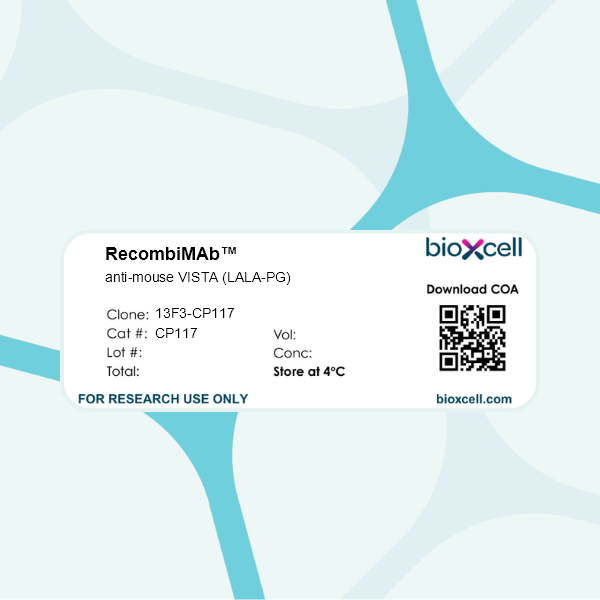
Catalog #CP117
RecombiMAb anti-mouse VISTA (LALA-PG)
Clone
13F3-CP117
Applications
in vivo blocking of VISTA signaling*
in vitro blocking of VISTA signaling*
Flow cytometry*
*Reported for the original 13F3 antibody
in vitro blocking of VISTA signaling*
Flow cytometry*
*Reported for the original 13F3 antibody
Isotype
Mouse IgG2a (LALA-PG), κ
(switched from Armenian hamster IgG)
(switched from Armenian hamster IgG)
You may also be interested in:
Product Description
The 13F3-CP117 monoclonal antibody is a recombinant, chimeric version of the original 13F3 antibody. The variable domain sequences are identical, but the constant region includes the Fc silencing mutation variant LALA-PG, rendering it unable to bind endogenous murine Fcγ receptors or C1q to induce antibody-dependent cell-mediated cytotoxicity (ADCC) or complement-dependent cytotoxicity (CDC). The LALA-PG variant has demonstrated significantly reduced effector function, C1q binding and C3 fixation compared to other common silencing mutations such as the LALA and DANG variants while retaining favorable biophysical and manufacturing properties. Species-matched chimeric antibodies demonstrate reduced immunogenicity and formation of anti-drug antibodies (ADAs) compared to xenogenic antibodies in animal models. The highly controlled sequence and lack of genetic drift in recombinant antibodies provide more reliable and reproducible results over hybridoma derived antibodies.
The 13F3-CP117 monoclonal antibody reacts with mouse V-domain Ig suppressor of T cell activation (VISTA) also known as PD-1H and B7-H5. VISTA is a 309 aa type I transmembrane glycoprotein and a member of the Ig superfamily. VISTA is expressed on naïve and activated T cells, NK cells, macrophages, dendritic cells, and neutrophils. VISTA functions as a negative immune-checkpoint protein that suppresses T cell cytokine production and proliferation. VISTA is overexpressed by tumor-infiltrating lymphocytes, such as myeloid cells and regulatory T cells. Blockade of VISTA results in delayed tumor growth in mouse models of melanoma.
The 13F3-CP117 monoclonal antibody reacts with mouse V-domain Ig suppressor of T cell activation (VISTA) also known as PD-1H and B7-H5. VISTA is a 309 aa type I transmembrane glycoprotein and a member of the Ig superfamily. VISTA is expressed on naïve and activated T cells, NK cells, macrophages, dendritic cells, and neutrophils. VISTA functions as a negative immune-checkpoint protein that suppresses T cell cytokine production and proliferation. VISTA is overexpressed by tumor-infiltrating lymphocytes, such as myeloid cells and regulatory T cells. Blockade of VISTA results in delayed tumor growth in mouse models of melanoma.
Specifications
| Isotype | Mouse IgG2a (LALA-PG), κ |
|---|---|
| Recommended Isotype Control(s) | RecombiMAb mouse IgG2a (LALA-PG) isotype control, anti-hen egg lysozyme |
| Recommended Dilution Buffer | InVivoPure pH 7.0 Dilution Buffer |
| Mutations | LALA-PG |
| Immunogen | EL4 cells overexpressing mouse VISTA-RFP and then boosted with VISTA-Ig fusion protein |
| Reported Applications |
in vivo blocking of VISTA signaling* in vitro blocking of VISTA signaling* Flow cytometry* *Reported for the original 13F3 antibody |
| Formulation |
PBS, pH 7.0 Contains no stabilizers or preservatives |
| Endotoxin |
≤0.5EU/mg (≤0.0005EU/μg) Determined by LAL assay |
| Aggregation |
<5% Determined by SEC |
| Purity |
≥95% Determined by SDS-PAGE |
| Sterility | 0.2 µm filtration |
| Production | Purified from HEK293 cell supernatant in an animal-free facility |
| Purification | Protein A |
| Molecular Weight | 150 kDa |
| Murine Pathogen Tests |
Ectromelia/Mousepox Virus: Negative Hantavirus: Negative K Virus: Negative Lactate Dehydrogenase-Elevating Virus: Negative Lymphocytic Choriomeningitis virus: Negative Mouse Adenovirus: Negative Mouse Cytomegalovirus: Negative Mouse Hepatitis Virus: Negative Mouse Minute Virus: Negative Mouse Norovirus: Negative Mouse Parvovirus: Negative Mouse Rotavirus: Negative Mycoplasma Pulmonis: Negative Pneumonia Virus of Mice: Negative Polyoma Virus: Negative Reovirus Screen: Negative Sendai Virus: Negative Theiler’s Murine Encephalomyelitis: Negative |
| Storage | The antibody solution should be stored at the stock concentration at 4°C. Do not freeze. |
| Need a Custom Formulation? | See All Antibody Customization Options |