
Catalog #CP221
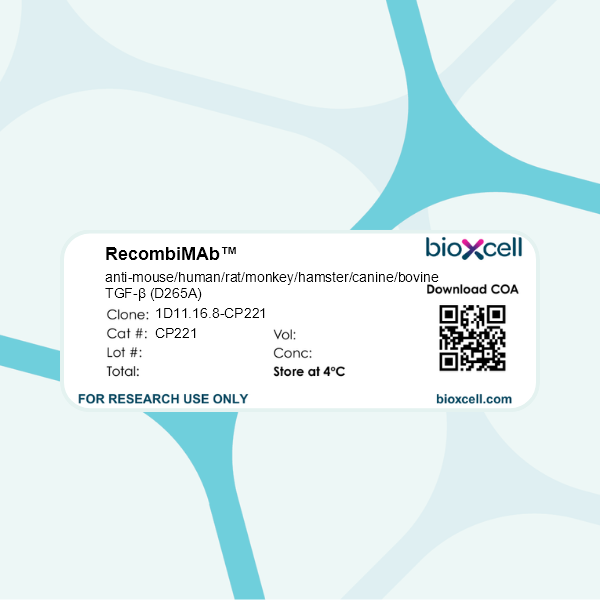
RecombiMAb anti-mouse/human/rat/monkey/ hamster/canine/bovine TGF-β (D265A)
Clone
1D11.16.8-CP221
Reactivities
Mouse, Human, Rat, Bovine, Canine, Hamster, Monkey
Applications
Western Blot
in vivo TGFβ neutralization*
in vitro TGFβ neutralization*
*Reported for the original 1D11.16.8 clone
in vivo TGFβ neutralization*
in vitro TGFβ neutralization*
*Reported for the original 1D11.16.8 clone
Isotype
Mouse IgG1 (D265A), κ
Product Description
The 1D11.16.8-CP221 monoclonal antibody is a recombinant version of the original 1D11.16.8 clone. 1D11.16.8-CP221 includes the D265A mutation in the Fc region to reduce binding to endogenous murine Fcγ receptors preventing antibody-dependent cell-mediated cytotoxicity (ADCC) while preserving FcRn-mediated half-life. Fc-silent anti-TGF-β antibodies allow for TGF-β blockade and neutralization without ADCC-mediated cell depletion. The highly controlled sequence and lack of genetic drift in recombinant antibodies provide more reliable and reproducible results over hybridoma derived antibodies.
The 1D11.16.8-CP221 monoclonal antibody reacts with mouse, human, rat, monkey, hamster, canine and bovine TGF-β (transforming growth factor beta) isoforms 1, 2 and 3. TGF-β is a multifunctional cytokine that regulates the proliferation of epithelial cells, endothelial cells, fibroblasts, neurons, lymphoid cells including T lymphocytes and NK cells, and other hematopoietic cell types. TGF-β also regulates the activities of activated macrophages and the development of regulatory T cells. Additionally, TGF-β plays roles in immune function, tissue remodeling and wound repair. TGF-β exists as five highly similar isoforms (TGF-β 1-5) with homologies of 70-80%. TGF-β1 is synthesized by the enzymatic cleavage of a long precursor TGF-β1 polypeptide encoded by the TGFB1 gene which yields the mature protein and the Latency Associated Peptide (LAP). The LAP and mature TGF-β1 non-covalently associate during secretion. TGF-β is ubiquitously expressed by many cell types including macrophages and platelets which express high levels of TGF-β. TGF-β signaling has been shown to play roles in cancer, autoimmune diseases, asthma, heart disease, and diabetes.
The 1D11.16.8-CP221 monoclonal antibody reacts with mouse, human, rat, monkey, hamster, canine and bovine TGF-β (transforming growth factor beta) isoforms 1, 2 and 3. TGF-β is a multifunctional cytokine that regulates the proliferation of epithelial cells, endothelial cells, fibroblasts, neurons, lymphoid cells including T lymphocytes and NK cells, and other hematopoietic cell types. TGF-β also regulates the activities of activated macrophages and the development of regulatory T cells. Additionally, TGF-β plays roles in immune function, tissue remodeling and wound repair. TGF-β exists as five highly similar isoforms (TGF-β 1-5) with homologies of 70-80%. TGF-β1 is synthesized by the enzymatic cleavage of a long precursor TGF-β1 polypeptide encoded by the TGFB1 gene which yields the mature protein and the Latency Associated Peptide (LAP). The LAP and mature TGF-β1 non-covalently associate during secretion. TGF-β is ubiquitously expressed by many cell types including macrophages and platelets which express high levels of TGF-β. TGF-β signaling has been shown to play roles in cancer, autoimmune diseases, asthma, heart disease, and diabetes.
Specifications
| Isotype | Mouse IgG1 (D265A) |
|---|---|
| Recommended Isotype Control(s) | RecombiMAb mouse IgG1 (D265A) isotype control, anti-hen egg lysozyme |
| Recommended Dilution Buffer | InVivoPure pH 7.0 Dilution Buffer |
| Mutations | D265A |
| Immunogen | Bovine TGFβ isoform 2 |
| Reported Applications |
Western Blot in vivo TGFβ neutralization* in vitro TGFβ neutralization* *Reported for the original 1D11.16.8 clone |
| Formulation |
PBS, pH 7.0 Contains no stabilizers or preservatives |
| Endotoxin |
≤0.5EU/mg (≤0.0005EU/μg) Determined by LAL assay |
| Aggregation |
<5% Determined by SEC |
| Purity |
≥95% Determined by SDS-PAGE |
| Sterility | 0.2 µm filtration |
| Production | Purified from mammalian cell supernatant in an animal-free facility |
| Molecular Weight | 150 kDa |
| Murine Pathogen Tests |
Ectromelia/Mousepox Virus: Negative Hantavirus: Negative K Virus: Negative Lactate Dehydrogenase-Elevating Virus: Negative Lymphocytic Choriomeningitis virus: Negative Mouse Adenovirus: Negative Mouse Cytomegalovirus: Negative Mouse Hepatitis Virus: Negative Mouse Minute Virus: Negative Mouse Norovirus: Negative Mouse Parvovirus: Negative Mouse Rotavirus: Negative Mycoplasma Pulmonis: Negative Pneumonia Virus of Mice: Negative Polyoma Virus: Negative Reovirus Screen: Negative Sendai Virus: Negative Theiler’s Murine Encephalomyelitis: Negative |
| Storage | The antibody solution should be stored at the stock concentration at 4°C. Do not freeze. |
| Need a Custom Formulation? | See All Antibody Customization Options |