
Catalog #CP087
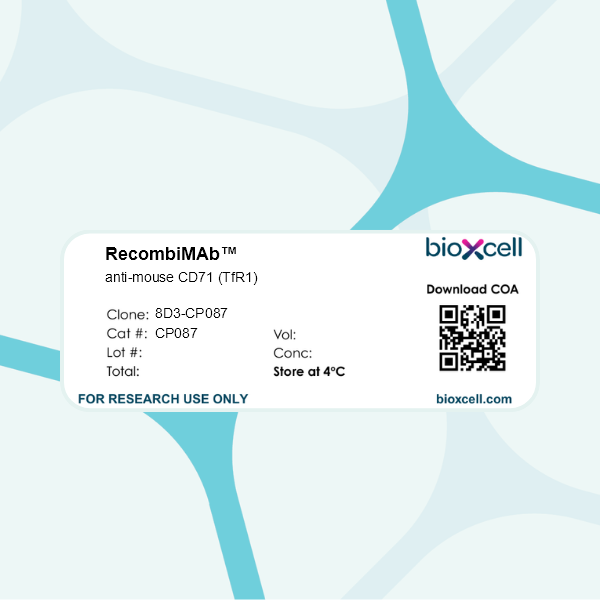
RecombiMAb anti-mouse CD71 (TfR1)
Clone
8D3-CP087
Reactivities
Mouse
Applications
Targeted drug delivery to the brain*
Immunohistochemistry*
Flow Cytometry*
Western Blot*
In vivo anti-tumor activity*
*Reported for the original 8D3 antibody. For information on in vivo applications, please contact technicalservice@bioxcell.com
Immunohistochemistry*
Flow Cytometry*
Western Blot*
In vivo anti-tumor activity*
*Reported for the original 8D3 antibody. For information on in vivo applications, please contact technicalservice@bioxcell.com
Isotype
Mouse IgG1, kappa
(switched from rat IgG2a, kappa)
(switched from rat IgG2a, kappa)
You may also be interested in:
Product Description
The 8D3-CP087 monoclonal antibody is a recombinant, chimeric version of the original 8D3 antibody. The variable domain sequences are identical to the original 8D3 but the constant region sequences have been switched from rat IgG2a to mouse IgG1 for use in murine models. Species-matched chimeric antibodies exhibit regulated effector functions—including Fc receptor binding and complement activation—and result in less immunogenicity and formation of anti-drug antibodies (ADAs) than xenogenic antibodies in animal models. In vivo studies using chimeric recombinant 8D3 with mouse IgG1 isotype demonstrated rapid uptake in the brain at levels comparable to the hybridoma derived rat IgG2a isotype antibody.
The 8D3 monoclonal antibody reacts with native, soluble and denatured forms of murine CD71, also known as transferrin receptor protein 1 (TfR1). CD71 is a 170-180 kDa type II homodimeric transmembrane glycoprotein expressed on the surface of proliferating cells, reticulocytes, and erythroid precursors. CD71 plays a role in the control of cellular proliferation and is required for iron import from transferrin into cells by endocytosis. CD71 is overexpressed on many different types of cancer cells and expression level correlates with advanced stage and/or poorer prognosis in several cancers, including solid cancers. Elevated levels of CD71 expression on malignant cells, together with its extracellular accessibility, ability to internalize, and central role in cancer cell pathology make this receptor an attractive target for antibody-mediated therapy. In addition, cells of the vascular endothelium of brain capillaries that compose the blood-brain barrier (BBB) also express high levels of CD71 allowing for receptor-mediated transcytosis of large biomolecules into the brain. Recombinant chimeric anti-CD71 clone 8D3 has been used as a BBB transporter in mice and is suitable for studying CD71 expression and iron uptake into different tissues.
References:
Boado, Ruben J et al. “Engineering and expression of a chimeric transferrin receptor monoclonal antibody for blood-brain barrier delivery in the mouse.” Biotechnology and bioengineering vol. 102,4 (2009): 1251-8. doi:10.1002/bit.22135
The 8D3 monoclonal antibody reacts with native, soluble and denatured forms of murine CD71, also known as transferrin receptor protein 1 (TfR1). CD71 is a 170-180 kDa type II homodimeric transmembrane glycoprotein expressed on the surface of proliferating cells, reticulocytes, and erythroid precursors. CD71 plays a role in the control of cellular proliferation and is required for iron import from transferrin into cells by endocytosis. CD71 is overexpressed on many different types of cancer cells and expression level correlates with advanced stage and/or poorer prognosis in several cancers, including solid cancers. Elevated levels of CD71 expression on malignant cells, together with its extracellular accessibility, ability to internalize, and central role in cancer cell pathology make this receptor an attractive target for antibody-mediated therapy. In addition, cells of the vascular endothelium of brain capillaries that compose the blood-brain barrier (BBB) also express high levels of CD71 allowing for receptor-mediated transcytosis of large biomolecules into the brain. Recombinant chimeric anti-CD71 clone 8D3 has been used as a BBB transporter in mice and is suitable for studying CD71 expression and iron uptake into different tissues.
References:
Boado, Ruben J et al. “Engineering and expression of a chimeric transferrin receptor monoclonal antibody for blood-brain barrier delivery in the mouse.” Biotechnology and bioengineering vol. 102,4 (2009): 1251-8. doi:10.1002/bit.22135
Specifications
| Isotype | Mouse IgG1, κ |
|---|---|
| Recommended Dilution Buffer | InVivoPure pH 7.0 Dilution Buffer |
| Immunogen | Mouse transformed endothelioma cell line t.end1 |
| Reported Applications |
Targeted drug delivery to the brain* Immunohistochemistry* Flow Cytometry* Western Blot* In vivo anti-tumor activity* *Reported for the original 8D3 antibody. For information on in vivo applications, please contact technicalservice@bioxcell.com |
| Formulation |
PBS, pH 7.0 Contains no stabilizers or preservatives |
| Endotoxin |
≤0.5EU/mg (≤0.0005EU/μg) Determined by LAL assay |
| Aggregation |
<5% Determined by SEC |
| Purity |
≥95% Determined by SDS-PAGE |
| Sterility | 0.2 µm filtration |
| Production | Purified from HEK293 cell supernatant in an animal-free facility |
| Purification | Protein G |
| RRID | AB_3751656 |
| Molecular Weight | 150 kDa |
| Murine Pathogen Tests |
Ectromelia/Mousepox Virus: Negative Hantavirus: Negative K Virus: Negative Lactate Dehydrogenase-Elevating Virus: Negative Lymphocytic Choriomeningitis virus: Negative Mouse Adenovirus: Negative Mouse Cytomegalovirus: Negative Mouse Hepatitis Virus: Negative Mouse Minute Virus: Negative Mouse Norovirus: Negative Mouse Parvovirus: Negative Mouse Rotavirus: Negative Mycoplasma Pulmonis: Negative Pneumonia Virus of Mice: Negative Polyoma Virus: Negative Reovirus Screen: Negative Sendai Virus: Negative Theiler’s Murine Encephalomyelitis: Negative |
| Storage | This product should be stored at the stock concentration at 4°C. Do not freeze. |
| Need a Custom Formulation? | See All Antibody Customization Options |