
RecombiMAb anti-mouse CD16/CD32
Fc receptor blocking, flow cytometry*
Fc receptor blocking, immunofluorescence*
*Reported for the original rat IgG2b 2.4G2 antibody
(switched from rat IgG2b)
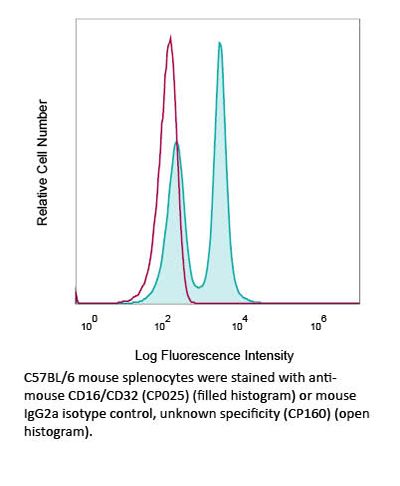
Product Description
Specifications
| Isotype | Mouse IgG2a, κ |
|---|---|
| Recommended Isotype Control(s) | RecombiMAb mouse IgG2a isotype control, anti-hen egg lysozyme |
| Recommended Dilution Buffer | InVivoPure pH 7.0 Dilution Buffer |
| Conjugation | This product is unconjugated. Conjugation is available via our Antibody Conjugation Services. |
| Immunogen | BALB/c mouse macrophage cell line J774 |
| Reported Applications |
in vivo Fc receptor blocking* Fc receptor blocking, flow cytometry* Fc receptor blocking, immunofluorescence* *Reported for the original rat IgG2b 2.4G2 antibody |
| Formulation |
PBS, pH 7.0 Contains no stabilizers or preservatives |
| Endotoxin |
≤0.5EU/mg (≤0.0005EU/μg) Determined by LAL assay |
| Aggregation |
<5% Determined by SEC |
| Purity |
≥95% Determined by SDS-PAGE |
| Sterility | 0.2 µm filtration |
| Production | Purified from HEK293 cell supernatant in an animal-free facility |
| Purification | Protein G |
| Molecular Weight | 150 kDa |
| Murine Pathogen Tests |
Ectromelia/Mousepox Virus: Negative Hantavirus: Negative K Virus: Negative Lactate Dehydrogenase-Elevating Virus: Negative Lymphocytic Choriomeningitis virus: Negative Mouse Adenovirus: Negative Mouse Cytomegalovirus: Negative Mouse Hepatitis Virus: Negative Mouse Minute Virus: Negative Mouse Norovirus: Negative Mouse Parvovirus: Negative Mouse Rotavirus: Negative Mycoplasma Pulmonis: Negative Pneumonia Virus of Mice: Negative Polyoma Virus: Negative Reovirus Screen: Negative Sendai Virus: Negative Theiler’s Murine Encephalomyelitis: Negative |
| Storage | The antibody solution should be stored at the stock concentration at 4°C. Do not freeze. |
| Need a Custom Formulation? | See All Antibody Customization Options |
Product Citations
-
Optimising Recovery of Hepatic Regulatory T Cells: A Practical Guide Using ARTC2 Blockade.
In Eur J Immunol on 1 December 2025 by Abbott, C. A., Mouro, V., et al.
PubMed
This is an update to the Guidelines for the use of flow cytometry and cell sorting in immunological studies (third edition), Chapter 3: 12C, by Cossarizza et al. Administration of anti-ARTC2 nanobody(S+16a) prevents cell death during tissue processing. We demonstrate that the phenotype of CD44midTreg is significantly impacted, whereas the eTreg phenotype remains stable following S+16a treatment, outlining specific protocols for population recovery.
-
Radiation-induced amphiregulin drives tumour metastasis.
In Nature on 1 July 2025 by Piffko, A., Yang, K., et al.
PubMed
The anti-tumour effect of radiotherapy beyond the treatment field-the abscopal effect-has garnered much interest1. However, the potentially deleterious effect of radiation in promoting metastasis is less well studied. Here we show that radiotherapy induces the expression of the EGFR ligand amphiregulin in tumour cells, which reprogrammes EGFR-expressing myeloid cells toward an immunosuppressive phenotype and reduces phagocytosis. This stimulates distant metastasis growth in human patients and in pre-clinical mouse tumour models. The inhibition of these tumour-promoting factors induced by radiotherapy may represent a novel therapeutic strategy to improve patient outcomes.
-
Radiation-induced amphiregulin drives tumour metastasis.
In Nature on 1 July 2025 by Piffko, A., Yang, K., et al.
PubMed
The anti-tumour effect of radiotherapy beyond the treatment field-the abscopal effect-has garnered much interest1. However, the potentially deleterious effect of radiation in promoting metastasis is less well studied. Here we show that radiotherapy induces the expression of the EGFR ligand amphiregulin in tumour cells, which reprogrammes EGFR-expressing myeloid cells toward an immunosuppressive phenotype and reduces phagocytosis. This stimulates distant metastasis growth in human patients and in pre-clinical mouse tumour models. The inhibition of these tumour-promoting factors induced by radiotherapy may represent a novel therapeutic strategy to improve patient outcomes.