
Catalog #CP099
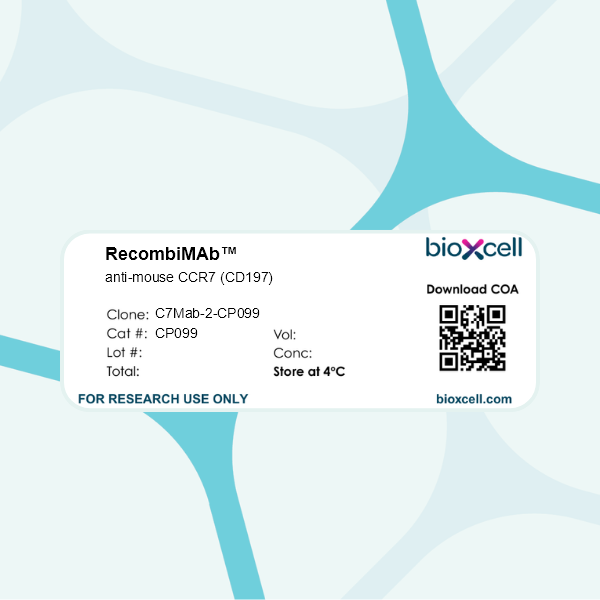
RecombiMab anti-mouse CCR7 (CD197)
Clone
C7Mab-2-CP099
Reactivities
Mouse
Applications
Flow cytometry
ELISA
Immunohistochemistry (paraffin)
in vivo CCR7 blockade*
*Reported for the original rat IgG2b C7Mab-2 antibody
ELISA
Immunohistochemistry (paraffin)
in vivo CCR7 blockade*
*Reported for the original rat IgG2b C7Mab-2 antibody
Isotype
Mouse IgG2a, κ
(switched from Rat Ig2b, κ)
(switched from Rat Ig2b, κ)
You may also be interested in:
Product Description
The C7Mab-2-CP099 monoclonal antibody is a recombinant, Fc-engineered chimeric version of the original C7Mab-2 antibody. The variable domain sequences are identical but the constant region sequences have been switched from Rat IgG2b, κ to Mouse IgG2a, κ for use in murine models. Species-matched chimeric antibodies exhibit regulated effector functions—including Fc receptor binding and complement activation—and result in less immunogenicity and formation of anti-drug antibodies (ADAs) than xenogenic antibodies in animal models. This antibody has an effector function competent Fc domain allowing for activation of Fcγ receptors (FcγRs) to trigger antibody‑dependent cellular cytotoxicity (ADCC), antibody‑dependent cellular phagocytosis (ADCP), complement‑dependent cytotoxicity (CDC) and opsonization to promote target cell depletion. The mouse IgG2a isotype demonstrates strong effector functions due to potent interaction with mFcγRIV, which is functionally similar to the FcγRIIIa receptor involved in human ADCC. The highly controlled sequence and lack of genetic drift in recombinant antibodies provide more reliable and reproducible results over hybridoma derived antibodies.
The C7Mab-2 monoclonal antibody reacts with extracellular loop 3 of mouse CC chemokine receptor type-7 (CCR7). The CCR7 protein is also called the MIP-3 beta receptor, EBI1, and CD197. CCR7 is expressed as a multipass transmembrane protein on a wide range of immune cells, such as naive T and B cells, central memory T cells, regulatory T cells (Tregs), natural killer (NK) cells, mature dendritic cells (DCs), plasmacytoid dendritic cells (pDCs), and some cancer cells. The primary ligands of CCR7 are CCL19 and CCL21, which are constitutively expressed in the high endothelial venules (HEVs) and lymph node parenchyma. CCR7-CCL19/CCL21 signaling promotes the migration of CCR7+ cells to secondary lymphoid organs (e.g., lymph nodes, thymus, and spleen). Experiments involving genetic knockout of CCR7 and impaired T cell migration to lymphoid organs have demonstrated the essential role of CCR7 for T cell recruitment in vivo. CCR7 is involved in the pathophysiology of cancer metastasis to lymph nodes, immuno-allergic reactions (including asthma), autoimmune diseases (e.g., rheumatoid arthritis and systemic lupus erythematosus), and infections (e.g., pneumonia, HIV-1, and malaria). Antibody-based blockade of CCR7 signaling-mediated chemotaxis is emerging as a promising strategy for experimental immunotherapy of cancers and other diseases.
The C7Mab-2 monoclonal antibody reacts with extracellular loop 3 of mouse CC chemokine receptor type-7 (CCR7). The CCR7 protein is also called the MIP-3 beta receptor, EBI1, and CD197. CCR7 is expressed as a multipass transmembrane protein on a wide range of immune cells, such as naive T and B cells, central memory T cells, regulatory T cells (Tregs), natural killer (NK) cells, mature dendritic cells (DCs), plasmacytoid dendritic cells (pDCs), and some cancer cells. The primary ligands of CCR7 are CCL19 and CCL21, which are constitutively expressed in the high endothelial venules (HEVs) and lymph node parenchyma. CCR7-CCL19/CCL21 signaling promotes the migration of CCR7+ cells to secondary lymphoid organs (e.g., lymph nodes, thymus, and spleen). Experiments involving genetic knockout of CCR7 and impaired T cell migration to lymphoid organs have demonstrated the essential role of CCR7 for T cell recruitment in vivo. CCR7 is involved in the pathophysiology of cancer metastasis to lymph nodes, immuno-allergic reactions (including asthma), autoimmune diseases (e.g., rheumatoid arthritis and systemic lupus erythematosus), and infections (e.g., pneumonia, HIV-1, and malaria). Antibody-based blockade of CCR7 signaling-mediated chemotaxis is emerging as a promising strategy for experimental immunotherapy of cancers and other diseases.
Specifications
| Isotype | Mouse IgG2a, κ |
|---|---|
| Recommended Isotype Control(s) | RecombiMAb mouse IgG2a isotype control, unknown specificity |
| Recommended Dilution Buffer | InVivoPure pH 7.0 Dilution Buffer |
| Conjugation | This product is unconjugated. Conjugation is available via our Antibody Conjugation Services. |
| Immunogen | Synthetic peptides corresponding to extracellular loops of mouse CCR7 |
| Reported Applications |
Flow cytometry ELISA Immunohistochemistry (paraffin) in vivo CCR7 blockade* *Reported for the original rat IgG2b C7Mab-2 antibody |
| Formulation |
PBS, pH 7.0 Contains no stabilizers or preservatives |
| Endotoxin |
≤0.5EU/mg (≤0.0005EU/μg) Determined by LAL assay |
| Aggregation |
<5% Determined by SEC |
| Purity |
≥95% Determined by SDS-PAGE |
| Sterility | 0.2 µm filtration |
| Production | Purified from mammalian cell supernatant in an animal-free facility |
| Purification | Protein A |
| RRID | AB_3751667 |
| Molecular Weight | 150 kDa |
| Murine Pathogen Tests |
Ectromelia/Mousepox Virus: Negative Hantavirus: Negative K Virus: Negative Lactate Dehydrogenase-Elevating Virus: Negative Lymphocytic Choriomeningitis virus: Negative Mouse Adenovirus: Negative Mouse Cytomegalovirus: Negative Mouse Hepatitis Virus: Negative Mouse Minute Virus: Negative Mouse Norovirus: Negative Mouse Parvovirus: Negative Mouse Rotavirus: Negative Mycoplasma Pulmonis: Negative Pneumonia Virus of Mice: Negative Polyoma Virus: Negative Reovirus Screen: Negative Sendai Virus: Negative Theiler’s Murine Encephalomyelitis: Negative |
| Storage | The antibody solution should be stored at the stock concentration at 4°C. Do not freeze. |
| Need a Custom Formulation? | See All Antibody Customization Options |