
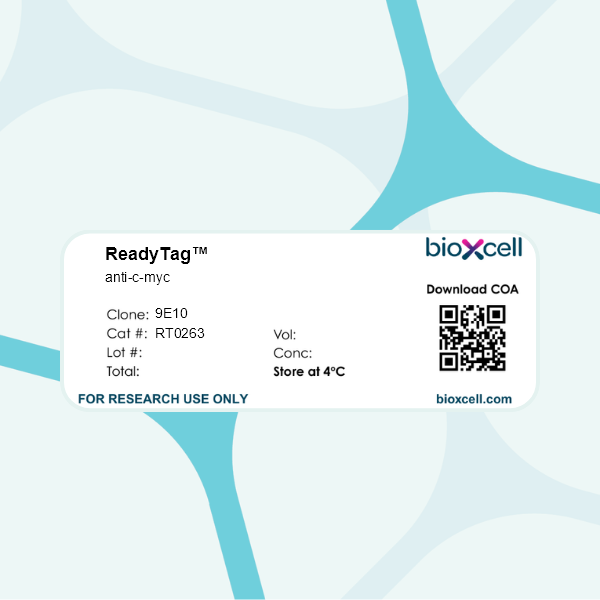
ReadyTag anti-c-myc
ELISA
Immunoprecipitation
Flow cytometry
Product Description
Specifications
| Isotype | Mouse IgG1 |
|---|---|
| Recommended Dilution Buffer | InVivoPure pH 7.0 Dilution Buffer |
| Conjugation | This product is unconjugated. Conjugation is available via our Antibody Conjugation Services. |
| Immunogen | C-terminal peptide of human c-myc (aa 408-439) |
| Reported Applications |
Western blot ELISA Immunoprecipitation Flow cytometry |
| Formulation |
PBS, pH 7.0 Contains no stabilizers or preservatives |
| Endotoxin |
≤1EU/mg (≤0.001EU/μg) Determined by LAL assay |
| Purity |
≥95% Determined by SDS-PAGE |
| Sterility | 0.2 µm filtration |
| Production | Purified from cell culture supernatant in an animal-free facility |
| Purification | Protein G |
| RRID | AB_2687720 |
| Molecular Weight | 150 kDa |
| Storage | The antibody solution should be stored at the stock concentration at 4°C. Do not freeze. |
| Need a Custom Formulation? | See All Antibody Customization Options |
Application References
-
Meng, X., et al (2020). "DNA polymerase ε relies on a unique domain for efficient replisome assembly and strand synthesis" Nat Commun 11(1): 2437.
PubMed
DNA polymerase epsilon (Pol ε) is required for genome duplication and tumor suppression. It supports both replisome assembly and leading strand synthesis; however, the underlying mechanisms remain to be elucidated. Here we report that a conserved domain within the Pol ε catalytic core influences both of these replication steps in budding yeast. Modeling cancer-associated mutations in this domain reveals its unexpected effect on incorporating Pol ε into the four-member pre-loading complex during replisome assembly. In addition, genetic and biochemical data suggest that the examined domain supports Pol ε catalytic activity and symmetric movement of replication forks. Contrary to previously characterized Pol ε cancer variants, the examined mutants cause genome hyper-rearrangement rather than hyper-mutation. Our work thus suggests a role of the Pol ε catalytic core in replisome formation, a reliance of Pol ε strand synthesis on a unique domain, and a potential tumor-suppressive effect of Pol ε in curbing genome re-arrangements.
-
Wan, B., et al (2019). "Molecular Basis for Control of Diverse Genome Stability Factors by the Multi-BRCT Scaffold Rtt107" Mol Cell 75(2): 238-251.e235.
PubMed
BRCT domains support myriad protein-protein interactions involved in genome maintenance. Although di-BRCT recognition of phospho-proteins is well known to support the genotoxic response, whether multi-BRCT domains can acquire distinct structures and functions is unclear. Here we present the tetra-BRCT structures from the conserved yeast protein Rtt107 in free and ligand-bound forms. The four BRCT repeats fold into a tetrahedral structure that recognizes unmodified ligands using a bi-partite mechanism, suggesting repeat origami enabling function acquisition. Functional studies show that Rtt107 binding of partner proteins of diverse activities promotes genome replication and stability in both distinct and concerted manners. A unified theme is that tetra- and di-BRCT domains of Rtt107 collaborate to recruit partner proteins to chromatin. Our work thus illustrates how a master regulator uses two types of BRCT domains to recognize distinct genome factors and direct them to chromatin for constitutive genome protection.
-
Li, Q., et al (2017). "Conserved properties of Drosophila Insomniac link sleep regulation and synaptic function" PLoS Genet 13(5): e1006815.
PubMed
Sleep is an ancient animal behavior that is regulated similarly in species ranging from flies to humans. Various genes that regulate sleep have been identified in invertebrates, but whether the functions of these genes are conserved in mammals remains poorly explored. Drosophila insomniac (inc) mutants exhibit severely shortened and fragmented sleep. Inc protein physically associates with the Cullin-3 (Cul3) ubiquitin ligase, and neuronal depletion of Inc or Cul3 strongly curtails sleep, suggesting that Inc is a Cul3 adaptor that directs the ubiquitination of neuronal substrates that impact sleep. Three proteins similar to Inc exist in vertebrates-KCTD2, KCTD5, and KCTD17-but are uncharacterized within the nervous system and their functional conservation with Inc has not been addressed. Here we show that Inc and its mouse orthologs exhibit striking biochemical and functional interchangeability within Cul3 complexes. Remarkably, KCTD2 and KCTD5 restore sleep to inc mutants, indicating that they can substitute for Inc in vivo and engage its neuronal targets relevant to sleep. Inc and its orthologs localize similarly within fly and mammalian neurons and can traffic to synapses, suggesting that their substrates may include synaptic proteins. Consistent with such a mechanism, inc mutants exhibit defects in synaptic structure and physiology, indicating that Inc is essential for both sleep and synaptic function. Our findings reveal that molecular functions of Inc are conserved through ~600 million years of evolution and support the hypothesis that Inc and its orthologs participate in an evolutionarily conserved ubiquitination pathway that links synaptic function and sleep regulation.
-
Ghorashian, S., et al (2015). "CD8 T cell tolerance to a tumor-associated self-antigen is reversed by CD4 T cells engineered to express the same T cell receptor" J Immunol 194(3): 1080-1089.
PubMed
Ag receptors used for cancer immunotherapy are often directed against tumor-associated Ags also expressed in normal tissues. Targeting of such Ags can result in unwanted autoimmune attack of normal tissues or induction of tolerance in therapeutic T cells. We used a murine model to study the phenotype and function of T cells redirected against the murine double minute protein 2 (MDM2), a tumor-associated Ag that shows low expression in many normal tissues. Transfer of MDM2-TCR-engineered T cells into bone marrow chimeric mice revealed that Ag recognition in hematopoietic tissues maintained T cell function, whereas presentation of MDM2 in nonhematopoietic tissues caused reduced effector function. TCR-engineered CD8(+) T cells underwent rapid turnover, downmodulated CD8 expression, and lost cytotoxic function. We found that MDM2-TCR-engineered CD4(+) T cells provided help and restored cytotoxic function of CD8(+) T cells bearing the same TCR. Although the introduction of the CD8 coreceptor enhanced the ability of CD4(+) T cells to recognize MDM2 in vitro, the improved self-antigen recognition abolished their ability to provide helper function in vivo. The data indicate that the same class I-restricted TCR responsible for Ag recognition and tolerance induction in CD8(+) T cells can, in the absence of the CD8 coreceptor, elicit CD4 T cell help and partially reverse tolerance. Thus MHC class I-restricted CD4(+) T cells may enhance the efficacy of therapeutic TCR-engineered CD8(+) T cells and can be readily generated with the same TCR.