
InVivoMAb anti-rat L-selectin (CD62L)
in vitro blocking of L-selectin (CD62L)
in vitro functional assay
Flow cytometry
ELISA
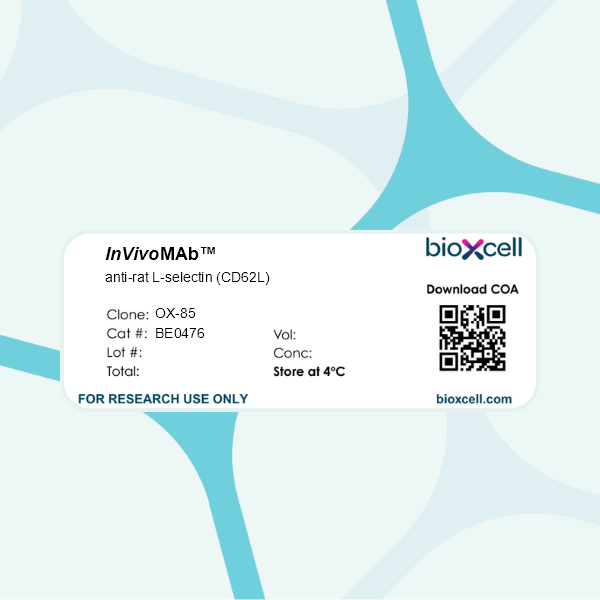
Product Description
Specifications
| Isotype | Mouse IgG1, κ |
|---|---|
| Recommended Isotype Control(s) | InVivoMAb mouse IgG1 isotype control, unknown specificity |
| Recommended Dilution Buffer | InVivoPure pH 7.0 Dilution Buffer |
| Immunogen | Rat purified CD62L-CD4 |
| Reported Applications |
in vivo blocking of L-selectin (CD62L) in vitro blocking of L-selectin (CD62L) in vitro functional assay Flow cytometry ELISA |
| Formulation |
PBS, pH 7.0 Contains no stabilizers or preservatives |
| Endotoxin |
≤1EU/mg (≤0.001EU/μg) Determined by LAL assay |
| Purity |
≥95% Determined by SDS-PAGE |
| Sterility | 0.2 µm filtration |
| Production | Purified from cell culture supernatant in an animal-free facility |
| Purification | Protein G |
| RRID | AB_3751624 |
| Molecular Weight | 150 kDa |
| Storage | This product should be stored at the stock concentration at 4°C. Do not freeze. |
| Need a Custom Formulation? | See All Antibody Customization Options |
Application References
-
Milićević NM, Nohroudi K, Milićević Z, Westermann J (2004). "Blood lymphocytes, monocytes and NK cells modulate their expression of CD44, ICAM-1, LFA-1 and MHC class II after arrival into lymphoid organs" Immunol Invest 33(4):439-52.
PubMed
Adhesion molecules expressed on surface membranes of lymphocytes and other leukocytes enable their entry into the lymphoid and other tissues. However, little is known about molecules that govern the transit of leukocytes through the parenchyma of lymphoid organs proper. We show that in comparison to blood leukocytes, the corresponding cells isolated from lymphoid organs, i.e., lymph nodes and spleen, have a significantly augmented expression of certain surface molecules. The helper and cytotoxic subsets of T cells, as well as B cells, display the increased expression of CD44, ICAM-1 and LFA-1, whereas B cells additionally show the augmented expression of MHC class II. In comparison with blood monocytes, splenic monocytes show the increased expression of ICAM-1 and MHC class II molecules. When compared with blood NK cells, splenic NK cells only show the increased expression of ICAM-1. The molecules, which we show to be up regulated upon the entry of leukocytes into lymphoid organs, could be involved in their retention within the tissue via cell-cell or cell-extracellular matrix interactions and in control of their transit through lymphoid tissues.
-
Nicholson MW, Barclay AN, Singer MS, Rosen SD, van der Merwe PA (1998). "Affinity and kinetic analysis of L-selectin (CD62L) binding to glycosylation-dependent cell-adhesion molecule-1" J Biol Chem 273(2):763-70.
PubMed
The selectin family of cell adhesion molecules mediates the tethering and rolling of leukocytes on blood vessel endothelium. It has been postulated that the molecular basis of this highly dynamic adhesion is the low affinity and rapid kinetics of selectin interactions. However, affinity and kinetic analyses of monomeric selectins binding their natural ligands have not previously been reported. Leukocyte selectin (L-selectin, CD62L) binds preferentially to O-linked carbohydrates present on a small number of mucin-like glycoproteins, such as glycosylation-dependent cell adhesion molecule-1 (GlyCAM-1), expressed in high endothelial venules. GlyCAM-1 is a soluble secreted protein which, following binding to CD62L, stimulates beta2-integrin-mediated adhesion of lymphocytes. Using surface plasmon resonance, we show that a soluble monomeric form of CD62L binds to purified immobilized GlyCAM-1 with a dissociation constant (Kd) of 108 microM. CD62L dissociates from GlyCAM-1 with a very fast dissociation rate constant (>/=10 s-1) which agrees well with the reported dissociation rate constant of CD62L-mediated leukocyte tethers. The calculated association rate constant is >/=10(5) M-1 s-1. At concentrations just above its mean serum level (approximately 1.5 microg/ml or approximately 30 nM), GlyCAM-1 binds multivalently to immobilized CD62L. It follows that soluble GlyCAM-1 may cross-link CD62L when it binds to cells, suggesting a mechanism for signal transduction.
-
Kühl AA, Kakirman H, Janotta M, Dreher S, Cremer P, Pawlowski NN, Loddenkemper C, Heimesaat MM, Grollich K, Zeitz M, Farkas S, Hoffmann JC (2007). "Aggravation of different types of experimental colitis by depletion or adhesion blockade of neutrophil
PubMed
Background & aims: Neutrophils are generally thought to play an important proinflammatory role in the pathogenesis of inflammatory bowel disease. The objective of this study was to evaluate whether blocking the invasion of neutrophils by anti-L-selectin monoclonal antibodies modulates chemically induced colitis and how this modulation is accomplished. Methods: Trinitrobenzene sulfonic acid/dinitrobenzene sulfonic acid (TNBS/DNBS)-induced colitis was studied in rats on treatment with anti-L-selectin monoclonal antibodies (mAb) or antineutrophil antiserum. Different anti-L-selectin mAb, either blocking or nonblocking, as well as F(ab)(2) fragments were evaluated. Additionally, leukocyte migration was examined using intravital microscopy. Furthermore, the effect of neutrophil depletion in rat TNBS-induced colitis was studied either prior to or after colitis induction as well as murine CD4(+)CD45RB(high) transfer colitis. Finally, bacterial translocation during DNBS-induced colitis was studied in neutrophil-depleted and control rats. Results: Anti-L-selectin mAb treatment resulted in increased mortality and bowel inflammation as well as hemorrhagic eye secretion. No clear difference was found between blocking and nonblocking mAb or F(ab)(2) fragments. For all investigated antibodies/fragments, either complete blockade of leukocyte invasion or marked neutrophil depletion was found. Accordingly, neutrophil depletion by antiserum resulted in aggravation of rat DNBS-induced colitis as well as murine transfer colitis. Conclusions: Adhesion blockade or neutrophil depletion aggravates rat TNBS/DNBS-induced colitis together with extraintestinal manifestations of the eyes. Therefore, neutrophils appear to have an important role in mucosal repair processes. Importantly, adhesion blockade as a therapeutic concept can be detrimental in inflammatory bowel disease.
-
Milićević NM, Nohroudi K, Milićević Z, Westermann J (2004). "Blood lymphocytes, monocytes and NK cells modulate their expression of CD44, ICAM-1, LFA-1 and MHC class II after arrival into lymphoid organs" Immunol Invest 33(4):439-52.
PubMed
Adhesion molecules expressed on surface membranes of lymphocytes and other leukocytes enable their entry into the lymphoid and other tissues. However, little is known about molecules that govern the transit of leukocytes through the parenchyma of lymphoid organs proper. We show that in comparison to blood leukocytes, the corresponding cells isolated from lymphoid organs, i.e., lymph nodes and spleen, have a significantly augmented expression of certain surface molecules. The helper and cytotoxic subsets of T cells, as well as B cells, display the increased expression of CD44, ICAM-1 and LFA-1, whereas B cells additionally show the augmented expression of MHC class II. In comparison with blood monocytes, splenic monocytes show the increased expression of ICAM-1 and MHC class II molecules. When compared with blood NK cells, splenic NK cells only show the increased expression of ICAM-1. The molecules, which we show to be up regulated upon the entry of leukocytes into lymphoid organs, could be involved in their retention within the tissue via cell-cell or cell-extracellular matrix interactions and in control of their transit through lymphoid tissues.