
InVivoMAb anti-mouse Thy1 (CD90)
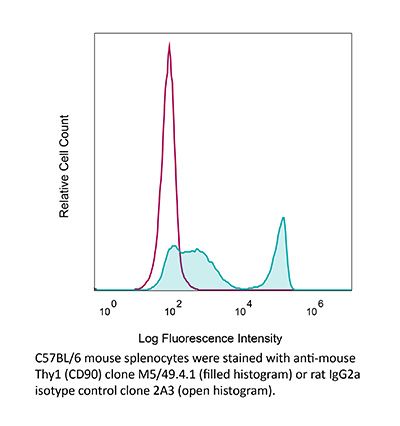
Product Description
Specifications
| Isotype | Rat IgG2a |
|---|---|
| Recommended Isotype Control(s) | InVivoMAb rat IgG2a isotype control, anti-trinitrophenol |
| Recommended Dilution Buffer | InVivoPure pH 7.0 Dilution Buffer |
| Conjugation | This product is unconjugated. Conjugation is available via our Antibody Conjugation Services. |
| Immunogen | Mixed lymphocyte culture |
| Reported Applications | in vitro T cell depletion |
| Formulation |
PBS, pH 7.0 Contains no stabilizers or preservatives |
| Endotoxin |
≤1EU/mg (≤0.001EU/μg) Determined by LAL assay |
| Purity |
≥95% Determined by SDS-PAGE |
| Sterility | 0.2 µm filtration |
| Production | Purified from cell culture supernatant in an animal-free facility |
| Purification | Protein G |
| RRID | AB_1107681 |
| Molecular Weight | 150 kDa |
| Storage | The antibody solution should be stored at the stock concentration at 4°C. Do not freeze. |
| Need a Custom Formulation? | See All Antibody Customization Options |
Application References
-
Weng, X., et al (2014). "The adaptor protein SAP regulates type II NKT-cell development, cytokine production, and cytotoxicity against lymphoma" Eur J Immunol 44(12): 3646-3657.
PubMed
CD1d-restricted NKT cells represent a unique lineage of immunoregulatory T cells that are divided into two groups, type I and type II, based on their TCR usage. Because there are no specific tools to identify type II NKT cells, little is known about their developmental requirements and functional regulation. In our previous study, we showed that signaling lymphocytic activation molecule associated protein (SAP) is essential for the development of type II NKT cells. Here, using a type II NKT-cell TCR transgenic mouse model, we demonstrated that CD1d-expressing hematopoietic cells, but not thymic epithelial cells, meditate efficient selection of type II NKT cells. Furthermore, we showed that SAP regulates type II NKT-cell development by controlling early growth response 2 protein and promyelocytic leukemia zinc finger expression. SAP-deficient 24alphabeta transgenic T cells (24alphabeta T cells) exhibited an immature phenotype with reduced Th2 cytokine-producing capacity and diminished cytotoxicity to CD1d-expressing lymphoma cells. The impaired IL-4 production by SAP-deficient 24alphabeta T cells was associated with reduced IFN regulatory factor 4 and GATA-3 induction following TCR stimulation. Collectively, these data suggest that SAP is critical for regulating type II NKT cell responses. Aberrant responses of these T cells may contribute to the immune dysregulation observed in X-linked lymphoproliferative disease caused by mutations in SAP.
Product Citations
-
High-salt diet induces immune-independent re-differentiation, metabolic shut down and cell cycle arrest of melanoma.
In Cell Death Dis on 20 December 2025 by Lisowski, C., Stumpf, N. E., et al.
PubMed
High salt diet (HSD) is known to reduce cancer growth in some tumor models, which has been attributed to tissue accumulation of sodium that enhances local anti-tumor immunity. Here, we show that a HSD inhibits melanoma growth independent of sodium accumulation and immune cells in skin and lung. Melanoma cells from mice on a HSD upregulated the metabolic inhibitor Tuberous sclerosis complex 2 (TSC2), causing metabolic shutdown despite nutrient availability. Furthermore, Microphthalmia-associated transcription factor (MITF), a crucial regulator of melanoma metabolism and differentiation, was upregulated, resulting in enhanced melanogenesis and cell cycle arrest. Thus, a HSD reversed the de-differentiation of melanoma cells and promoted their re-differentiation into a "normal" melanocytic state. These findings suggest that the anti-tumor effect of HSD may be tumor-specific and in some cases immune cell-independent.
-
T Cells Instruct Immune Checkpoint Inhibitor Therapy Resistance in Tumors Responsive to IL1 and TNFα Inflammation.
In Cancer Immunol Res on 3 February 2025 by Cho, N. W., Guldberg, S. M., et al.
PubMed
Resistance to immune checkpoint inhibitors (ICI) is common, even in tumors with T-cell infiltration. We thus investigated consequences of ICI-induced T-cell infiltration in the microenvironment of resistant tumors. T cells and neutrophil numbers increased in ICI-resistant tumors following treatment, in contrast to ICI-responsive tumors. Resistant tumors were distinguished by high expression of IL1 receptor 1, enabling a synergistic response to IL1 and TNFα to induce G-CSF, CXCL1, and CXCL2 via NF-κB signaling, supporting immunosuppressive neutrophil accumulation in tumor. Perturbation of this inflammatory resistance circuit sensitized tumors to ICIs. Paradoxically, T cells drove this resistance circuit via TNFα both in vitro and in vivo. Evidence of this inflammatory resistance circuit and its impact also translated to human cancers. These data support a mechanism of ICI resistance, wherein treatment-induced T-cell activity can drive resistance in tumors responsive to IL1 and TNFα, with important therapeutic implications.
-
Combining vanadyl sulfate with Newcastle disease virus potentiates rapid innate immune-mediated regression with curative potential in murine cancer models.
In Mol Ther Oncolytics on 26 March 2021 by McAusland, T. M., van Vloten, J. P., et al.
PubMed
The avian paramyxovirus, Newcastle disease virus (NDV), is a promising oncolytic agent that has been shown to be safe and effective in a variety of pre-clinical cancer models and human clinical trials. NDV preferentially replicates in tumor cells due to signaling defects in apoptotic and antiviral pathways acquired during the transformation process and is a potent immunostimulatory agent. However, when used as a monotherapy NDV lacks the ability to consistently generate durable remissions. Here we investigate the use of viral sensitizer-mediated combination therapy to enhance the anti-neoplastic efficacy of NDV. Intratumoral injection of vanadyl sulfate, a pan-inhibitor of protein tyrosine phosphatases, in combination with NDV significantly increased the number and activation status of natural killer (NK) cells in the tumor microenvironment, concomitant with increased expression of interferon-β, granulocyte-macrophage colony-stimulating factor, and monocyte chemoattractant protein-1, leading to rapid tumor regression and long-term cures in mice bearing syngeneic B16-F10 melanomas. The anti-tumor efficacy of this combination therapy was abrogated when NK cells were depleted and when interferon-β expression was transiently suppressed. Tumor-specific CD8+ T cell responses were not detected, nor were mice whose tumors regressed protected from re-challenge. This suggested efficacy of the combination therapy predominantly relied on the innate immune system. Importantly, efficacy was not limited to melanoma; it was also demonstrated in a murine prostate cancer model. Taken together, these results suggest that combining NDV with vanadyl sulfate potentiates an innate immune response that can potentiate rapid clearance of tumors, with type I interferon signaling and NK cells being important mechanisms of action.
-
The adaptor protein SAP regulates type II NKT-cell development, cytokine production, and cytotoxicity against lymphoma.
In Eur J Immunol on 1 December 2014 by Weng, X., Liao, C. M., et al.
PubMed
CD1d-restricted NKT cells represent a unique lineage of immunoregulatory T cells that are divided into two groups, type I and type II, based on their TCR usage. Because there are no specific tools to identify type II NKT cells, little is known about their developmental requirements and functional regulation. In our previous study, we showed that signaling lymphocytic activation molecule associated protein (SAP) is essential for the development of type II NKT cells. Here, using a type II NKT-cell TCR transgenic mouse model, we demonstrated that CD1d-expressing hematopoietic cells, but not thymic epithelial cells, meditate efficient selection of type II NKT cells. Furthermore, we showed that SAP regulates type II NKT-cell development by controlling early growth response 2 protein and promyelocytic leukemia zinc finger expression. SAP-deficient 24αβ transgenic T cells (24αβ T cells) exhibited an immature phenotype with reduced Th2 cytokine-producing capacity and diminished cytotoxicity to CD1d-expressing lymphoma cells. The impaired IL-4 production by SAP-deficient 24αβ T cells was associated with reduced IFN regulatory factor 4 and GATA-3 induction following TCR stimulation. Collectively, these data suggest that SAP is critical for regulating type II NKT cell responses. Aberrant responses of these T cells may contribute to the immune dysregulation observed in X-linked lymphoproliferative disease caused by mutations in SAP.