
InVivoMAb anti-mouse CD31 (PECAM-1)
Intravital imaging
Immunofluorescence
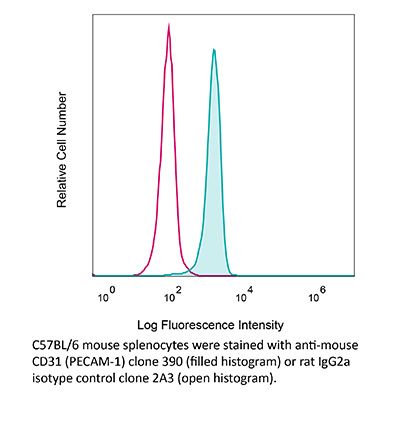
Flow cytometry
Product Description
Specifications
| Isotype | Rat IgG2a, κ |
|---|---|
| Recommended Isotype Control(s) | InVivoMAb rat IgG2a isotype control, anti-trinitrophenol |
| Recommended Dilution Buffer | InVivoPure pH 7.0 Dilution Buffer |
| Conjugation | This product is unconjugated. Conjugation is available via our Antibody Conjugation Services. |
| Immunogen | C3H/HeJ mouse hematopoietic progenitor cell line 3 |
| Reported Applications |
in vivo CD31 blocking Intravital imaging Immunofluorescence Flow cytometry |
| Formulation |
PBS, pH 7.0 Contains no stabilizers or preservatives |
| Endotoxin |
≤1EU/mg (≤0.001EU/μg) Determined by LAL assay |
| Purity |
≥95% Determined by SDS-PAGE |
| Sterility | 0.2 µm filtration |
| Purification | Protein G |
| RRID | AB_2927514 |
| Molecular Weight | 150 kDa |
| Storage | The antibody solution should be stored at the stock concentration at 4°C. Do not freeze. |
| Need a Custom Formulation? | See All Antibody Customization Options |
Application References
-
Chojnacki, A., et al (2019). "Intravital imaging allows real-time characterization of tissue resident eosinophils" Commun Biol 2: 181.
PubMed
Eosinophils are core components of the immune system, yet tools are lacking to directly observe eosinophils in action in vivo. To better understand the role of tissue resident eosinophils, we used eosinophil-specific CRE (eoCRE) mice to create GFP and tdTomato reporters. We then employed intravital microscopy to examine the dynamic behaviour of eosinophils in the healthy GI tract, mesentery, liver, lymph node, skin and lung. Given the role of eosinophils in allergic airway diseases, we also examined eosinophils in the lung following ovalbumin sensitization and challenge. We were able to monitor and quantify eosinophilic behaviours including patrolling, crawling, clustering, tissue distribution and interactions with other leukocytes. Thus, these reporter mice allow eosinophils to be examined in real-time in living animals, paving the way to further understanding the roles eosinophils play in both health and disease.
-
Cheung, K., et al (2015). "CD31 signals confer immune privilege to the vascular endothelium" Proc Natl Acad Sci U S A 112(43): E5815-5824.
PubMed
Constitutive resistance to cell death induced by inflammatory stimuli activating the extrinsic pathway of apoptosis is a key feature of vascular endothelial cells (ECs). Although this property is central to the maintenance of the endothelial barrier during inflammation, the molecular mechanisms of EC protection from cell-extrinsic, proapoptotic stimuli have not been investigated. We show that the Ig-family member CD31, which is expressed by endothelial but not epithelial cells, is necessary to prevent EC death induced by TNF-alpha and cytotoxic T lymphocytes in vitro. Combined quantitative RT-PCR array and biochemical analysis show that, upon the engagement of the TNF receptor with TNF-alpha on ECs, CD31 becomes activated and, in turn, counteracts the proapoptotic transcriptional program induced by TNF-alpha via activation of the Erk/Akt pathway. Specifically, Akt activation by CD31 signals prevents the localization of the forkhead transcription factor FoxO3 to the nucleus, thus inhibiting transcription of the proapoptotic genes CD95/Fas and caspase 7 and de-repressing the expression of the antiapoptotic gene cFlar. Both CD31 intracellular immunoreceptor tyrosine-based inhibition motifs are required for its prosurvival function. In vivo, CD31 gene transfer is sufficient to recapitulate the cytoprotective mechanisms in CD31(-) pancreatic beta cells, which become resistant to immune-mediated rejection when grafted in fully allogeneic recipients.
-
Greineder, C. F., et al (2013). "Vascular immunotargeting to endothelial determinant ICAM-1 enables optimal partnering of recombinant scFv-thrombomodulin fusion with endogenous cofactor" PLoS One 8(11): e80110.
PubMed
The use of targeted therapeutics to replenish pathologically deficient proteins on the luminal endothelial membrane has the potential to revolutionize emergency and cardiovascular medicine. Untargeted recombinant proteins, like activated protein C (APC) and thrombomodulin (TM), have demonstrated beneficial effects in acute vascular disorders, but have failed to have a major impact on clinical care. We recently reported that TM fused with an scFv antibody fragment to platelet endothelial cell adhesion molecule-1 (PECAM-1) exerts therapeutic effects superior to untargeted TM. PECAM-1 is localized to cell-cell junctions, however, whereas the endothelial protein C receptor (EPCR), the key co-factor of TM/APC, is exposed in the apical membrane. Here we tested whether anchoring TM to the intercellular adhesion molecule (ICAM-1) favors scFv/TM collaboration with EPCR. Indeed: i) endothelial targeting scFv/TM to ICAM-1 provides ~15-fold greater activation of protein C than its PECAM-targeted counterpart; ii) blocking EPCR reduces protein C activation by scFv/TM anchored to endothelial ICAM-1, but not PECAM-1; and iii) anti-ICAM scFv/TM fusion provides more profound anti-inflammatory effects than anti-PECAM scFv/TM in a mouse model of acute lung injury. These findings, obtained using new translational constructs, emphasize the importance of targeting protein therapeutics to the proper surface determinant, in order to optimize their microenvironment and beneficial effects.
-
DeLisser, H. M., et al (1997). "Involvement of endothelial PECAM-1/CD31 in angiogenesis" Am J Pathol 151(3): 671-677.
PubMed
The adhesive interactions of endothelial cells with each other and the adhesion receptors that mediate these interactions are probably of fundamental importance to the process of angiogenesis. We therefore studied the effect of inhibiting the function of the endothelial cell-cell adhesion molecule, PECAM-1/ CD31, in rat and murine models of angiogenesis. A polyclonal antibody to human PECAM-1, which cross-reacts with rat PECAM-1, was found to block in vitro tube formation by rat capillary endothelial cells and cytokine-induced rat corneal neovascularization. In mice, two monoclonal antibodies against murine PECAM-1 prevented vessel growth into subcutaneously implanted gels supplemented with basic fibroblast growth factor (bFGF). Taken together these findings provide evidence that PECAM-1 is involved in angiogenesis and suggest that the interactions of endothelial cell-cell adhesion molecules are important in the formation of new vessels.
Product Citations
-
Neutrophil-derived vesicles control complement activation to facilitate inflammation resolution.
In Cell on 20 March 2025 by Hsu, A. Y., Huang, Q., et al.
PubMed
Although subsets with immunosuppressive properties exist, neutrophils are typically known for their pro-inflammatory role and pathogen clearance capabilities. Here, we reveal that neutrophils can paradoxically aid in resolving inflammation by actively producing anti-inflammatory extracellular vesicles. These large aging-neutrophil-derived vesicles (LAND-Vs) do not fit into classical vesicle categorizations due to their specific size, structure, or biogenesis pathway. They are protected from efferocytotic clearance by phagocytes due to surface "do not eat me" signals and accumulate in the resolution phase of inflammation. CD55 on LAND-Vs exerts a robust, sustained anti-inflammatory effect by inhibiting complement 3 convertase, thereby reducing neutrophil recruitment and tissue damage. CD55+ LAND-Vs originate in ordered lipid raft domains, where CD55 accumulates asymmetrically during neutrophil aging, and are subsequently formed through RhoA-dependent budding. Collectively, LAND-V emerges as a pivotal physiological immunomodulator and showcases functions that transcend the limited lifespan of neutrophils, offering a therapeutic target for inflammatory and infectious diseases.