
InVivoSIM anti-human IL-6R (Tocilizumab Biosimilar)
ELISA
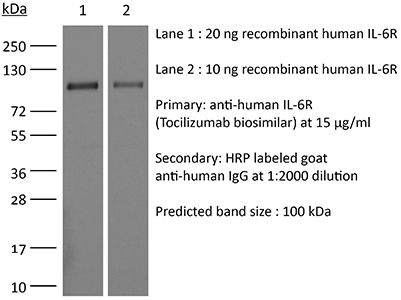
Product Description
Specifications
| Isotype | Human IgG1 |
|---|---|
| Recommended Isotype Control(s) | RecombiMAb human IgG1 isotype control, anti-hen egg lysozyme |
| Recommended Dilution Buffer | InVivoPure pH 7.0 Dilution Buffer |
| Conjugation | This product is unconjugated. Conjugation is available via our Antibody Conjugation Services. |
| Immunogen | Human IL-6R |
| Reported Applications |
Functional assays ELISA |
| Formulation |
PBS, pH 7.0 Contains no stabilizers or preservatives |
| Endotoxin |
≤0.5EU/mg (≤0.0005EU/μg) Determined by LAL assay |
| Aggregation |
<5% Determined by SEC |
| Purity |
≥95% Determined by SDS-PAGE |
| Sterility | 0.2 µm filtration |
| Production | Purified from cell culture supernatant in an animal-free facility |
| Purification | Protein A |
| RRID | AB_2894735 |
| Molecular Weight | 150 kDa |
| Murine Pathogen Tests |
Ectromelia/Mousepox Virus: Negative Hantavirus: Negative K Virus: Negative Lactate Dehydrogenase-Elevating Virus: Negative Lymphocytic Choriomeningitis virus: Negative Mouse Adenovirus: Negative Mouse Cytomegalovirus: Negative Mouse Hepatitis Virus: Negative Mouse Minute Virus: Negative Mouse Norovirus: Negative Mouse Parvovirus: Negative Mouse Rotavirus: Negative Mycoplasma Pulmonis: Negative Pneumonia Virus of Mice: Negative Polyoma Virus: Negative Reovirus Screen: Negative Sendai Virus: Negative Theiler’s Murine Encephalomyelitis: Negative |
| Storage | The antibody solution should be stored at the stock concentration at 4°C. Do not freeze. |
| Need a Custom Formulation? | See All Antibody Customization Options |
Product Citations
-
TNF-α induces type I IFN signalling to suppress neurogenesis and recruit T cells.
In Nat Commun on 7 July 2026 by Nissen, T. A. D., Baig, A., et al.
PubMed
Adult hippocampal neurogenesis is essential for learning, memory, and mood regulation, and its disruption is implicated in ageing, neurodegeneration, and mood disorders. However, the mechanisms linking inflammation to adult hippocampal neurogenesis impairment remain unclear. Here, we identify chronic tumour necrosis factor-alpha signalling as a key driver of neurogenic dysregulation via a previously unrecognised type I interferon autocrine/paracrine loop in human hippocampal progenitor cells. Using a female-derived human in vitro neurogenesis model, single-cell RNA sequencing, and functional T cell migration assays, we show that tumour necrosis factor-alpha induces a robust type I interferon response in hippocampal progenitor cells, promoting chemokine-mediated and CXC motif chemokine receptor 3-dependent T cell recruitment and suppressing neurogenesis. This inflammatory signalling cascade drives a fate switch in hippocampal progenitor cells from a neurogenic trajectory towards an immune-defensive phenotype, with critical implications for infectious and inflammatory disease pathogenesis. These findings uncover a key inflammatory checkpoint regulating human adult hippocampal neurogenesis and highlight potential therapeutic targets to restore neurogenesis in chronic inflammatory states.
-
TNF-α induces type I IFN signalling to suppress neurogenesis and recruit T cells
In bioRxiv on 24 June 2025 by Nissen, T. A. D., Baig, A., et al.
-
Inflammatory arthritis immune related adverse events represent a unique autoimmune disease entity primarily driven by T cells, but likely not autoantibodies
In medRxiv on 6 June 2025 by Zhu, X., Yu, Y., et al.