
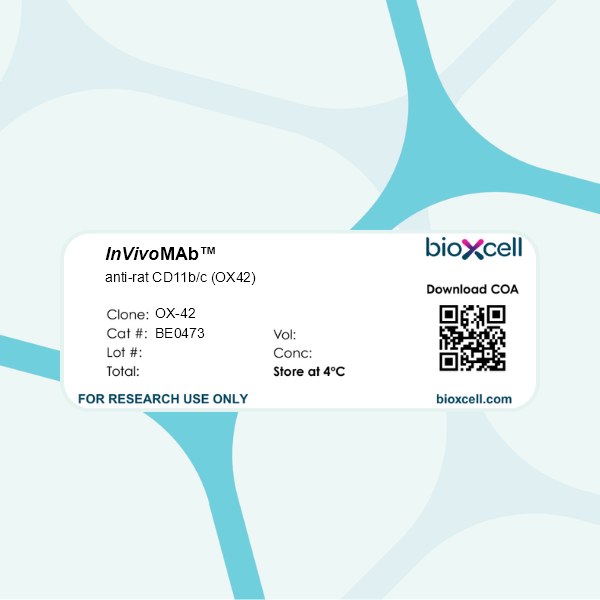
InVivoMAb anti-rat CD11b/c (OX42)
in vitro blocking of C3bi binding to CR3
in vitro functional assay
Immunoprecipitation
Flow cytometry
Immunofluorescence
Immunohistochemistry (paraffin)
Immunohistochemistry (frozen)
Product Description
Specifications
| Isotype | Mouse IgG2a, κ |
|---|---|
| Recommended Isotype Control(s) | InVivoMAb mouse IgG2a isotype control, unknown specificity |
| Recommended Dilution Buffer | InVivoPure pH 7.0 Dilution Buffer |
| Immunogen | Peritoneal macrophages of rat |
| Reported Applications |
in vivo blocking of C3bi binding to CR3 in vitro blocking of C3bi binding to CR3 in vitro functional assay Immunoprecipitation Flow cytometry Immunofluorescence Immunohistochemistry (paraffin) Immunohistochemistry (frozen) |
| Formulation |
PBS, pH 7.0 Contains no stabilizers or preservatives |
| Endotoxin |
≤1EU/mg (≤0.001EU/μg) Determined by LAL assay |
| Purity |
≥95% Determined by SDS-PAGE |
| Sterility | 0.2 µm filtration |
| Production | Purified from cell culture supernatant in an animal-free facility |
| Purification | Protein G |
| Molecular Weight | 150 kDa |
| Storage | The antibody solution should be stored at the stock concentration at 4°C. Do not freeze. |
| Need a Custom Formulation? | See All Antibody Customization Options |
Application References
-
Robinson AP, White TM, Mason DW (1986). "Macrophage heterogeneity in the rat as delineated by two monoclonal antibodies MRC OX-41 and MRC OX-42, the latter recognizing complement receptor type 3" Immunology 57(2):239-47.
PubMed
Two monoclonal antibodies, designated MRC OX-41 and MRC OX-42, have been shown to label subsets of macrophages. Using immunoperoxidase and immunofluorescence analysis, tissue macrophages were shown to be heterogeneous with respect to binding of MRC OX-41 and MRC OX-42 antibodies. Although both antibodies labelled subsets of macrophages, the antibodies also reacted with granulocytes and dendritic cells. The antigens recognized by these antibodies were identified by metabolic and cell surface labelling followed by immunoprecipitation and sodium dodecyl sulphate polyacrylamide gel electrophoresis (SDS-PAGE). MRC OX-41 recognized a surface protein of 110,000-120,000 MW, while MRC OX-42 immunoprecipitated three polypeptides with molecular weights of 160,000, 103,000 and 95,000. The Fab fragment of MRC OX-42 antibody inhibited complement-mediated rosette formation between sensitized erythrocytes and rat macrophages and granulocytes. Membrane molecules with similar biochemical and functional properties to MRC OX-42 antigen have been identified in mouse and man as the receptors for iC3b, and it is probable that MRC OX-42 antibody recognizes the rat homologue of the receptors in these other species.
-
Drasković-Pavlović B, Van Der Laan LJ, Pejnović N, Dijkstra CD, Colić M (1999). "Differential effects of anti-rat CD11b monoclonal antibodies on granulocyte adhesiveness" Immunology 96(1):83-9.
PubMed
Four different monoclonal antibodies (mAbs) reactive with rat CD11b (ED7, ED8, OX-42 and 1B6c) have been characterized for their ability to induce homotypic aggregation of granulocytes or to modify granulocyte adhesiveness triggered by phorbol myristate acetate (PMA) or N-formyl-methionyl-leucyl-phenylalanine (fMLP). Cross-blocking experiments showed that these mAbs recognize at least three different epitopes on CD11b. OX-42 mAb recognizes an inhibitory epitope since the mAb inhibited homotypic aggregation of granulocytes and their adherence to plastic in the presence of PMA or fMLP. ED7 and ED8 induced homotypic aggregation of granulocytes which was blocked by OX-42 and anti-CD18 mAb (WT3) suggesting that CR3 itself is involved in the adhesion process. The aggregation was dependent on active cell metabolism, intact cytoskeleton, divalent cations and activation of tyrosine kinases sensitive to genistein. Staurosporine, okadaic acid and orthovanadate potentiated the aggregation. ED7 and ED8 potentiated homotypic aggregation and adhesion of granulocytes to plastic caused by fMLP, but inhibited granulocyte adhesion to plastic induced by PMA. 1B6c recognizes an epitope that transmits a proaggregatory signal upon binding of the mAb but only if the granulocytes are in contact with plastic or are activated by fMLP. In contrast, 1B6c inhibited granulocyte adhesion to plastic triggered by PMA or fMLP. These data suggest the existence of functionally different epitopes on rat CD11b and indicate that some anti-CD11b mAbs are able to functionally activate CR3.
-
Wu X, Pippin J, Lefkowith JB (1993). "Attenuation of immune-mediated glomerulonephritis with an anti-CD11b monoclonal antibody" Am J Physiol 264(4 Pt 2):F715-21.
PubMed
Nephrotoxic nephritis (NTN), a model of autoimmune glomerulonephritis, is characterized by glomerular inflammation, which results in both proteinuria and an increase in eicosanoid production. In light of the ability of CD18 integrins to participate in leukocyte adherence (and thereby migration), we examined the role of the integrin CD11b/CD18 in NTN using OX42, a monoclonal antibody directed against rat CD11b. Administration of OX42 30 min before induction of NTN decreased proteinuria (by 50%) but did not affect the number of leukocytes found in the glomerulus or the accompanying increase in glomerular eicosanoid production. Administration of OX42 16 h before disease induction led to a more substantial decrease in proteinuria (80%) and, in contrast to 30 min pretreatment, decreased the number of neutrophils found in the glomerulus and the accompanying increase in glomerular eicosanoid production (both by 50%). OX42 pretreatment had no effect on the number of macrophages found in glomeruli. Circulating leukocytes from animals treated with OX42 in vivo showed saturating surface levels of antibody by fluorescence-activated cell sorting (FACS) analysis and normal upregulation of CD11b by pharmacological activation. Sixteen hours after in vivo injection of OX42, 50% more peripheral leukocytes were labeled relative to control leukocytes labeled with OX42 ex vivo. Glomerular leukocytes in NTN exhibited upregulated expression of CD11b relative to peripheral leukocytes. These data show that CD11b/CD18 may participate in the acute expression of glomerular damage in NTN in a fashion not wholly dependent on blocking neutrophil migration into glomeruli. Blockade of surface receptors (as opposed to inhibition of upregulation) is sufficient to obtain this effect.
-
Dick AD, Broderick C, Forrester JV, Wright GJ (2001). "Distribution of OX2 antigen and OX2 receptor within retina" Invest Ophthalmol Vis Sci 42(1):170-6.
PubMed
Purpose: OX2 is a member of the immunoglobulin superfamily expressed on a broad range of tissues including neurons of the central and peripheral nervous systems, thymocytes, and endothelium. The recently identified OX2 receptor (OX2R) is restricted to the surfaces of myeloid lineage cells, including microglia. Functional data have implicated the OX2-OX2R interaction as a myeloid downregulatory signal. The purpose of this study was to determine the distribution and extent of expression of OX2 and its receptor within the retina, a tissue developed to restrain immune-mediated inflammatory damage. Methods: OX2 and OX2R monoclonal antibodies (mAbs) were used to determine OX2 and OX2R protein expression, respectively, by flow cytometry of isolated myeloid-derived cells from normal and inflamed rat retina and by immunohistochemistry of serial sections of rat retina. For comparison, distribution of OX2 was documented using species-specific monoclonal antibodies in mouse and human retina. No OX2R mAbs are available for mouse or human detection. Results: OX2 was expressed on retinal vascular endothelium and glial fibrillary acidic protein (GFAP)-negative neurons in retina and optic nerve and on a subpopulation of CD45(+) perivascular and juxtavascular cells. Within normal retina, OX2R was not detected on myeloid-derived cells. During experimental autoimmune uveoretinitis (EAU), expression of both OX2 and OX2R was noted on infiltrating leukocytes. Conclusions: Taking these results of the distribution of OX2 in normal and OX2R in inflamed retina with other functional data of OX2-OX2R interaction, it is suggested that the OX2-OX2R interaction has the potential to contribute to a novel pathway that suppresses and limits immunologic inflammatory damage within the retina.