
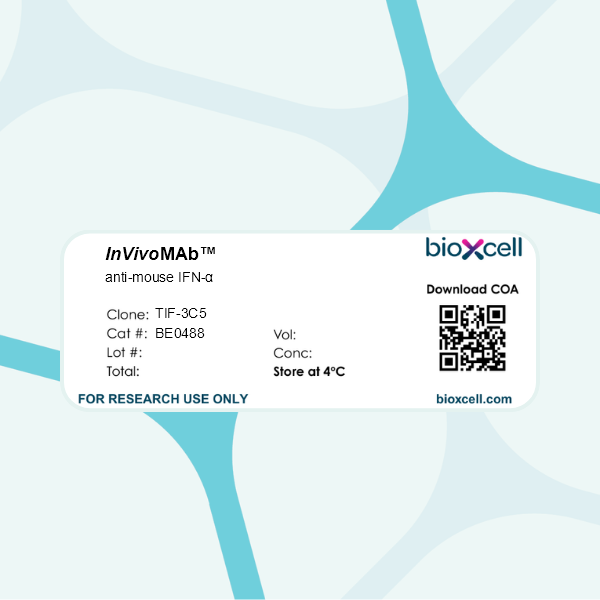
InVivoMAb anti-mouse IFN-α
in vitro neutralization of IFN-α
ELISA
Product Description
Specifications
| Isotype | Armenian Hamster IgG1 |
|---|---|
| Recommended Isotype Control(s) | InVivoMAb Armenian hamster IgG isotype control, anti-S. japonicum glutathione S-transferase |
| Recommended Dilution Buffer | InVivoPure pH 7.0 Dilution Buffer |
| Immunogen | Recombinant murine IFN-α5 |
| Reported Applications |
in vivo neutralization of IFN-α in vitro neutralization of IFN-α ELISA |
| Formulation |
PBS, pH 7.0 Contains no stabilizers or preservatives |
| Endotoxin |
≤1EU/mg (≤0.001EU/μg) Determined by LAL assay |
| Purity |
≥95% Determined by SDS-PAGE |
| Sterility | 0.2 µm filtration |
| Production | Purified from cell culture supernatant in an animal-free facility |
| Purification | Protein G |
| RRID | AB_3751635 |
| Molecular Weight | 150 kDa |
| Storage | The antibody solution should be stored at the stock concentration at 4°C. Do not freeze. |
| Need a Custom Formulation? | See All Antibody Customization Options |
Application References
-
Sheehan KC, Lazear HM, Diamond MS, Schreiber RD (2015). "Selective Blockade of Interferon-α and -β Reveals Their Non-Redundant Functions in a Mouse Model of West Nile Virus Infection" PLoS One 10(5):e0128636.
PubMed
Although type I interferons (IFNs) were first described almost 60 years ago, the ability to monitor and modulate the functional activities of the individual IFN subtypes that comprise this family has been hindered by a lack of reagents. The major type I IFNs, IFN-β and the multiple subtypes of IFN-α, are expressed widely and induce their effects on cells by interacting with a shared heterodimeric receptor (IFNAR). In the mouse, the physiologic actions of IFN-α and IFN-β have been defined using polyclonal anti-type I IFN sera, by targeting IFNAR using monoclonal antibodies or knockout mice, or using Ifnb-/- mice. However, the corresponding analysis of IFN-α has been difficult because of its polygenic nature. Herein, we describe two monoclonal antibodies (mAbs) that differentially neutralize murine IFN-β or multiple subtypes of murine IFN-α. Using these mAbs, we distinguish specific contributions of IFN-β versus IFN-α in restricting viral pathogenesis and identify IFN-α as the key mediator of the antiviral response in mice infected with West Nile virus. This study thus suggests the utility of these new reagents in dissecting the antiviral and immunomodulatory roles of IFN-β versus IFN-α in murine models of infection, immunity, and autoimmunity.
-
Ng CT, Sullivan BM, Teijaro JR, Lee AM, Welch M, Rice S, Sheehan KC, Schreiber RD, Oldstone MB (2015). "Blockade of interferon Beta, but not interferon alpha, signaling controls persistent viral infection" Cell Host Microbe 17(5):653-61.
PubMed
Although type I interferon (IFN-I) is thought to be beneficial against microbial infections, persistent viral infections are characterized by high interferon signatures suggesting that IFN-I signaling may promote disease pathogenesis. During persistent lymphocytic choriomeningitis virus (LCMV) infection, IFNα and IFNβ are highly induced early after infection, and blocking IFN-I receptor (IFNAR) signaling promotes virus clearance. We assessed the specific roles of IFNβ versus IFNα in controlling LCMV infection. While blockade of IFNβ alone does not alter early viral dissemination, it is important in determining lymphoid structure, lymphocyte migration, and anti-viral T cell responses that lead to accelerated virus clearance, approximating what occurs during attenuation of IFNAR signaling. Comparatively, blockade of IFNα was not associated with improved viral control, but with early dissemination of virus. Thus, despite their use of the same receptor, IFNβ and IFNα have unique and distinguishable biologic functions, with IFNβ being mainly responsible for promoting viral persistence.
-
Oldstone MBA, Ware BC, Horton LE, Welch MJ, Aiolfi R, Zarpellon A, Ruggeri ZM, Sullivan BM (2018). "Lymphocytic choriomeningitis virus Clone 13 infection causes either persistence or acute death dependent on IFN-1, cytotoxic T lymphocytes (CTLs), and
PubMed
Understanding of T cell exhaustion and successful therapy to restore T cell function was first described using Clone (Cl) 13 variant selected from the lymphocytic choriomeningitis virus (LCMV) Armstrong (ARM) 53b parental strain. T cell exhaustion plays a pivotal role in both persistent infections and cancers of mice and humans. C57BL/6, BALB, SWR/J, A/J, 129, C3H, and all but one collaborative cross (CC) mouse strain following Cl 13 infection have immunosuppressed T cell responses, high PD-1, and viral titers leading to persistent infection and normal life spans. In contrast, the profile of FVB/N, NZB, PL/J, SL/J, and CC NZO mice challenged with Cl 13 is a robust T cell response, high titers of virus, PD-1, and Lag3 markers on T cells. These mice all die 7 to 9 d after Cl 13 infection. Death is due to enhanced pulmonary endothelial vascular permeability, pulmonary edema, collapse of alveolar air spaces, and respiratory failure. Pathogenesis involves abundant levels of Cl 13 receptor alpha-dystroglycan on endothelial cells, with high viral replication in such cells leading to immunopathologic injury. Death is aborted by blockade of interferon-1 (IFN-1) signaling or deletion of CD8 T cells.