
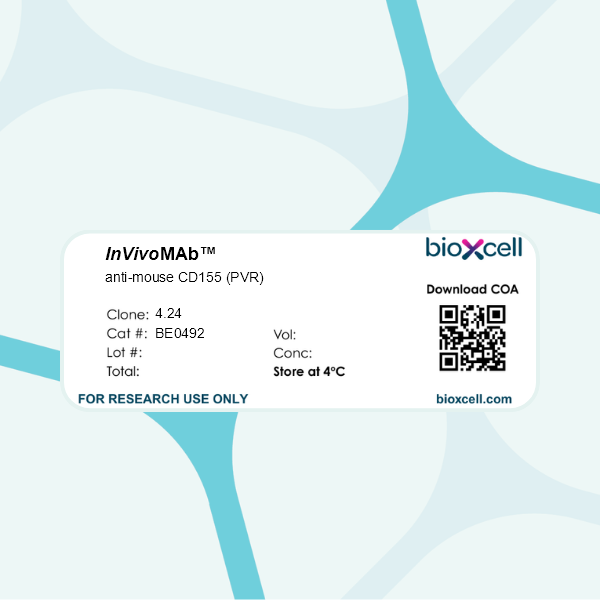
InVivoMAb anti-mouse CD155 (PVR)
in vitro neutralization of CD155
Flow cytometry
Product Description
Specifications
| Isotype | Rat IgG2a, κ |
|---|---|
| Recommended Isotype Control(s) | InVivoMAb rat IgG2a isotype control, anti-trinitrophenol |
| Recommended Dilution Buffer | InVivoPure pH 7.0 Dilution Buffer |
| Immunogen | A recombinant protein consisting of the mCD155 extracellular region fused to human Fc |
| Reported Applications |
in vivo neutralization of CD155 in vitro neutralization of CD155 Flow cytometry |
| Formulation |
PBS, pH 7.0 Contains no stabilizers or preservatives |
| Endotoxin |
≤1EU/mg (≤0.001EU/μg) Determined by LAL assay |
| Purity |
≥95% Determined by SDS-PAGE |
| Sterility | 0.2 µm filtration |
| Production | Purified from cell culture supernatant in an animal-free facility |
| Purification | Protein G |
| Molecular Weight | 150 kDa |
| Storage | The antibody solution should be stored at the stock concentration at 4°C. Do not freeze. |
| Need a Custom Formulation? | See All Antibody Customization Options |
Application References
-
Gilfillan S, Chan CJ, Cella M, Haynes NM, Rapaport AS, Boles KS, Andrews DM, Smyth MJ, Colonna M (2008). "DNAM-1 promotes activation of cytotoxic lymphocytes by nonprofessional antigen-presenting cells and tumors" J Exp Med 205(13):2965-73.
PubMed
Natural killer (NK) cells and CD8 T cells require adhesion molecules for migration, activation, expansion, differentiation, and effector functions. DNAX accessory molecule 1 (DNAM-1), an adhesion molecule belonging to the immunoglobulin superfamily, promotes many of these functions in vitro. However, because NK cells and CD8 T cells express multiple adhesion molecules, it is unclear whether DNAM-1 has a unique function or is effectively redundant in vivo. To address this question, we generated mice lacking DNAM-1 and evaluated DNAM-1-deficient CD8 T cell and NK cell function in vitro and in vivo. Our results demonstrate that CD8 T cells require DNAM-1 for co-stimulation when recognizing antigen presented by nonprofessional antigen-presenting cells; in contrast, DNAM-1 is dispensable when dendritic cells present the antigen. Similarly, NK cells require DNAM-1 for the elimination of tumor cells that are comparatively resistant to NK cell-mediated cytotoxicity caused by the paucity of other NK cell-activating ligands. We conclude that DNAM-1 serves to extend the range of target cells that can activate CD8 T cell and NK cells and, hence, may be essential for immunosurveillance against tumors and/or viruses that evade recognition by other activating or accessory molecules.
-
Martinet L, Ferrari De Andrade L, Guillerey C, Lee JS, Liu J, Souza-Fonseca-Guimaraes F, Hutchinson DS, Kolesnik TB, Nicholson SE, Huntington ND, Smyth MJ (2015). "DNAM-1 expression marks an alternative program of NK cell maturation" Cell Rep 11(1):8
PubMed
Natural killer (NK) cells comprise a heterogeneous population of cells important for pathogen defense and cancer surveillance. However, the functional significance of this diversity is not fully understood. Here, we demonstrate through transcriptional profiling and functional studies that the activating receptor DNAM-1 (CD226) identifies two distinct NK cell functional subsets: DNAM-1(+) and DNAM-1(-) NK cells. DNAM-1(+) NK cells produce high levels of inflammatory cytokines, have enhanced interleukin 15 signaling, and proliferate vigorously. By contrast, DNAM-1(-) NK cells that differentiate from DNAM-1(+) NK cells have greater expression of NK-cell-receptor-related genes and are higher producers of MIP1 chemokines. Collectively, our data reveal the existence of a functional program of NK cell maturation marked by DNAM-1 expression.
-
Chan CJ, Andrews DM, McLaughlin NM, Yagita H, Gilfillan S, Colonna M, Smyth MJ (2010). "DNAM-1/CD155 interactions promote cytokine and NK cell-mediated suppression of poorly immunogenic melanoma metastases" J Immunol 184(2):902-11.
PubMed
A role for NK cells in therapeutic intervention for hematologic malignancies, such as acute myeloid leukemia and multiple myeloma, and nonhematologic malignancies, such as melanoma, is becoming more apparent. DNAM-1 is an NK cell receptor whose importance in facilitating activation signals received by NK cells in natural and cytokine-driven responses to tumor metastases in vivo is poorly explored. In this study, we used matched tumor lines expressing a variety of relevant ligands, neutralizing monoclonal Abs, and DNAM-1 gene-targeted mice to determine the relative importance of DNAM-1-ligand interactions in controlling tumor metastases. Our results demonstrate that NK cells require DNAM-1 for natural or cytokine (IL-2, IL-12, or IL-21) suppression of tumor metastases or their variants expressing CD70 or CD80. In contrast, DNAM-1 was dispensable when tumor cells were targets of Ab-dependent cellular cytotoxicity or presented ligands for NKG2D. CD155 appeared to be a key ligand recognized by DNAM-1 in NK cell-mediated suppression of metastases, and DNAM-1-mediated suppression coincided with perforin activity. Overall, these data implied a general role for DNAM-1-CD155 interactions in NK cell-mediated killing of tumors, even in the presence of tumor CD70 or CD80 expression, and further defined the optimal efficacy requirements of cytokines that directly activate NK cells.
-
Chan CJ, Martinet L, Gilfillan S, Souza-Fonseca-Guimaraes F, Chow MT, Town L, Ritchie DS, Colonna M, Andrews DM, Smyth MJ (2014). "The receptors CD96 and CD226 oppose each other in the regulation of natural killer cell functions" Nat Immunol 15(5):43
PubMed
CD96, CD226 (DNAM-1) and TIGIT belong to an emerging family of receptors that interact with nectin and nectin-like proteins. CD226 activates natural killer (NK) cell-mediated cytotoxicity, whereas TIGIT reportedly counterbalances CD226. In contrast, the role of CD96, which shares the ligand CD155 with CD226 and TIGIT, has remained unclear. In this study we found that CD96 competed with CD226 for CD155 binding and limited NK cell function by direct inhibition. As a result, Cd96(-/-) mice displayed hyperinflammatory responses to the bacterial product lipopolysaccharide (LPS) and resistance to carcinogenesis and experimental lung metastases. Our data provide the first description, to our knowledge, of the ability of CD96 to negatively control cytokine responses by NK cells. Blocking CD96 may have applications in pathologies in which NK cells are important.