
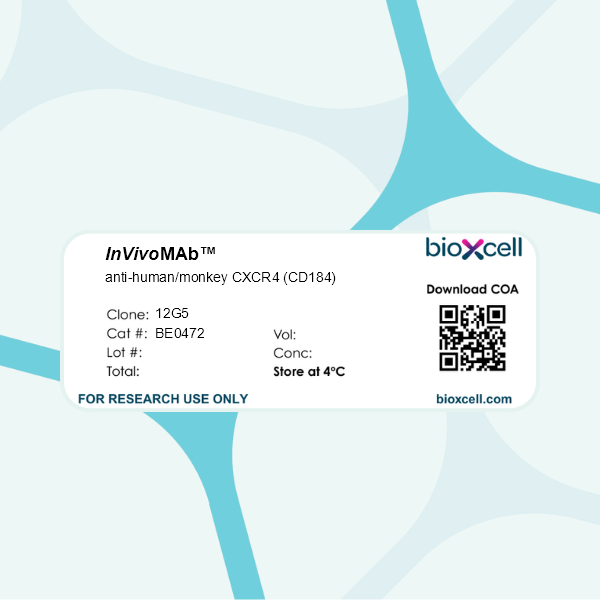
InVivoMAb anti-human/monkey CXCR4 (CD184)
in vitro blocking of CXCR4
in vivo imaging
in vitro functional assay
Immunoprecipitation
flow cytometry
immunofluorescence
Immunohistochemistry (paraffin)
Immunohistochemistry (frozen)
Product Description
Specifications
| Isotype | Mouse IgG2a, κ |
|---|---|
| Recommended Isotype Control(s) | InVivoMAb mouse IgG2a isotype control, unknown specificity |
| Recommended Dilution Buffer | InVivoPure pH 7.0 Dilution Buffer |
| Immunogen | CP-MAC-infected Sup-T1 cells |
| Reported Applications |
in vivo blocking of CXCR4 in vitro blocking of CXCR4 in vivo imaging in vitro functional assay Immunoprecipitation flow cytometry immunofluorescence Immunohistochemistry (paraffin) Immunohistochemistry (frozen) |
| Formulation |
PBS, pH 7.0 Contains no stabilizers or preservatives |
| Endotoxin |
≤1EU/mg (≤0.001EU/μg) Determined by LAL assay |
| Purity |
≥95% Determined by SDS-PAGE |
| Sterility | 0.2 µm filtration |
| Production | Purified from cell culture supernatant in an animal-free facility |
| Purification | Protein A |
| Molecular Weight | 150 kDa |
| Storage | The antibody solution should be stored at the stock concentration at 4°C. Do not freeze. |
| Need a Custom Formulation? | See All Antibody Customization Options |
Application References
-
Yang H, Lan C, Xiao Y, Chen YH (2003). "Antibody to CD14 like CXCR4-specific antibody 12G5 could inhibit CXCR4-dependent chemotaxis and HIV Env-mediated cell fusion" Immunol Lett 88(1):27-30.
PubMed
The expression of HIV-1 coreceptors (CXCR4 and CCR5) on monocyte surface can be regulated by the ligand of CD14 (LPS), which stimulate the susceptibility of the cells to HIV-1. To investigate whether it exists potential association between CD14 and HIV-1 coreceptor CXCR4, we tested the impact of CD14-specific monoclonal antibodies (mAbs) upon CXCR4-dependent responses, such as SDF-induced chemotaxis and HIV Env-mediated membrane fusion. The anti-CD14 mAb TUK4 like CXCR4-specific mAb 12G5 could block SDF-induced chemotaxis of U937 cells in a dose-dependent manner, while another CD14-specific mAb UCHM-1 did not show any activity. More interestingly, syncytium assay indicated that only the CD14-specific mAb TUK4 inhibited HIV Env-mediated CXCR4-dependent cell fusion between U937 cells and HIV-1(HXB2) Env transfected CHO cells distinctly, consistent with its activity against CXCR4-dependent chemotaxis. These results provided experimental evidence for existence of close association between CD14 and HIV coreceptor CXCR4 on human monocytic cells.
-
Moriuchi H, Moriuchi M, Arthos J, Hoxie J, Fauci AS (1997). "Promonocytic U937 subclones expressing CD4 and CXCR4 are resistant to infection with and cell-to-cell fusion by T-cell-tropic human immunodeficiency virus type 1" J Virol 71(12):9664-71.
PubMed
Different strains of human immunodeficiency virus type 1 (HIV-1) vary markedly in the ability to infect cells of the monocyte/macrophage (M/M) lineage. M/M are generally resistant to infection with T-cell-tropic (T-tropic) strains of HIV-1. Recently, the chemokine receptors CCR5 and CXCR4 were identified as cofactors for fusion/entry of macrophage- and T-tropic strains of HIV-1, respectively. To investigate the mechanisms of resistance of M/M to T-tropic HIV-1 infection, we examined a number of subclones of the U937 promonocytic cell line. We found that certain subclones of U937 (plus clones) could, while others (minus clones) could not, support replication of T-tropic strains of HIV-1. We demonstrate that (i) both minus and plus clones support HIV-1 replication when transfected with an infectious molecular cDNA clone of a T-tropic HIV-1; (ii) minus clones do not, but plus clones do, efficiently support fusion with cells expressing HIV-1 IIIB Env; (iii) both plus and minus clones (with the exception of one clone) express physiologically functional CXCR4 protein as well as CD4 on the cell surface; (iv) introduction of CXCR4 into the CXCR4-negative clone does not restore fusogenicity with or susceptibility to T-tropic HIV-1; and (v) a ligand (stromal cell-derived factor 1) for or a monoclonal antibody (12G5) to CXCR4 does not effectively inhibit HIV-mediated cell-to-cell fusion of U937 cells. These data indicate that resistance to T-tropic HIV-1 infection of U937 minus clones occurs at fusion/ entry events and that expression of functional CXCR4 and CD4 is not a sole determinant for susceptibility to T-tropic HIV-1 infection; furthermore, they suggest that other factors are positively or negatively involved in HIV-mediated cell-to-cell fusion in U937 promonocytic cells.
-
Endres MJ, Clapham PR, Marsh M, Ahuja M, Turner JD, McKnight A, Thomas JF, Stoebenau-Haggarty B, Choe S, Vance PJ, Wells TN, Power CA, Sutterwala SS, Doms RW, Landau NR, Hoxie JA (1996). "CD4-independent infection by HIV-2 is mediated by fusin/CXCR4"
PubMed
Several members of the chemokine receptor family have been shown to function in association with CD4 to permit HIV-1 entry and infection. However, the mechanism by which these molecules serve as CD4-associated cofactors is unclear. In the present report, we show that one member of this family, termed Fusin/ CXCR4, is able to function as an alternative receptor for some isolates of HIV-2 in the absence of CD4. This conclusion is supported by the finding that (1) CD4-independent infection by these viruses is inhibited by an anti-Fusin monoclonal antibody, (2) Fusin expression renders human and nonhuman CD4-negative cell lines sensitive to HIV-2-induced syncytium induction and/or infection, and (3) Fusin is selectively down-regulated from the cell surface following HIV-2 infection. The finding that one chemokine receptor can function as a primary viral receptor strongly suggests that the HIV envelope glycoprotein contains a binding site for these proteins and that differences in the affinity and/or the availability of this site can extend the host range of these viruses to include a number of CD4-negative cell types.
-
Ullrich CK, Groopman JE, Ganju RK (2000). "HIV-1 gp120- and gp160-induced apoptosis in cultured endothelial cells is mediated by caspases" Blood 96(4):1438-42.
PubMed
The immune dysfunction and cell destruction that occur in the human immunodeficiency virus (HIV)-infected host appear to result from the direct cytopathic effects of viral infection and the effects of viral proteins on uninfected bystander cells. Recently, the alpha-chemokine receptor CXCR4 has been reported to mediate apoptosis in neuronal cells and in CD4(+) and CD8(+) T cells after its binding to HIV-1 envelope proteins. In the current study, it was observed that human umbilical vein endothelial cells (HUVEC) undergo apoptosis after their treatment with the HIV-1 envelope proteins gp120/160. Anti-CXCR4 monoclonal antibody decreased HIV-1 gp120/160-induced apoptosis, suggesting that the CXCR4 chemokine receptor mediates the apoptotic effects of these HIV envelope glycoproteins. Further studies revealed that caspases play an important role in this process because the pretreatment of cells with a general caspase enzyme inhibitor decreased the extent of HUVEC apoptosis induced by gp120/160. In addition, it was found that caspase-3 was activated on HIV-1 gp120/160 treatment of these cells. It was also observed that gp120/160 treatment slightly increased the expression of the pro-apoptotic molecule Bax. These results suggest that HIV-1 envelope glycoproteins can disrupt endothelial integrity through the interaction with CXCR4, thereby facilitating virus transit out of the bloodstream and contributing to the vascular injury syndromes seen in acquired immunodeficiency syndrome. (Blood. 2000;96:1438-1442)