
Catalog #RP003
Recombinant human/mouse BMP-2 protein
Reactivities
Mouse, Human, Rat, Bovine
Applications
Differentiation of human pluripotent stem cells towards extra-embryonic endoderm, mesenchymal, neural lineages, and chondrocytes
Neural stem cell proliferation and neuronal differentiation
Stem cell differentiation into neural and microglial lineages
Neural stem cell proliferation and neuronal differentiation
Stem cell differentiation into neural and microglial lineages
Product Description
Recombinant human/mouse BMP-2 protein (bone morphogenetic protein 2) is a member of the BMP subgroup of the transforming growth factor beta (TGF-β) superfamily and a potent regulator of embryonic patterning, organogenesis, limb bud formation, and bone and cartilage growth. Synthesized as a preproprotein and proteolytically processed to a 114-residue mature domain, BMP-2 forms active disulfide-linked homodimers as well as heterodimers with BMP-7. Mature human BMP-2 shares 100% amino acid sequence identity with mouse and rat BMP-2 and 85% identity with BMP-4, but less than 51% with other BMPs. As a strong differentiation factor, recombinant BMP-2 directs human pluripotent stem cells toward extra-embryonic endoderm, mesenchymal and neural lineages, and chondrocytes, and induces bone and cartilage formation in vitro and chondrogenesis in adult mesenchymal stem cells, making it a key growth factor for stem cell differentiation and bone/cartilage tissue-engineering research.
This protein is optimized for in vivo and functional applications: low-endotoxin, tag-free, and carrier-free, supporting reproducible performance in demanding preclinical and bioactivity studies.
Species reactivity: human. Species similarity: mouse - 100%, rat - 100%.
It also shares 85% identity with BMP-4, but <51% with other BMPs.
Specifications
| Recommended Dilution Buffer | InVivoPure Reconstitution Buffer A |
|---|---|
| Reported Applications |
Differentiation of human pluripotent stem cells towards extra-embryonic endoderm, mesenchymal, neural lineages, and chondrocytes Neural stem cell proliferation and neuronal differentiation Stem cell differentiation into neural and microglial lineages |
| Formulation | Lyophilized, white powder |
| Endotoxin |
≤0.5 EU/mg LAL assay |
| Purity |
≥95% Determined by SDS-PAGE |
| Sterility | Sterile |
| Production | Microbial. Expressed in E. coli |
| Molecular Weight | 26 kDa (dimer) |
| Storage | Store lyophilized protein between -20 °C and -80 °C until the date of expiry. Avoid freeze-thaw cycles |
| Mycoplasma | Negative |
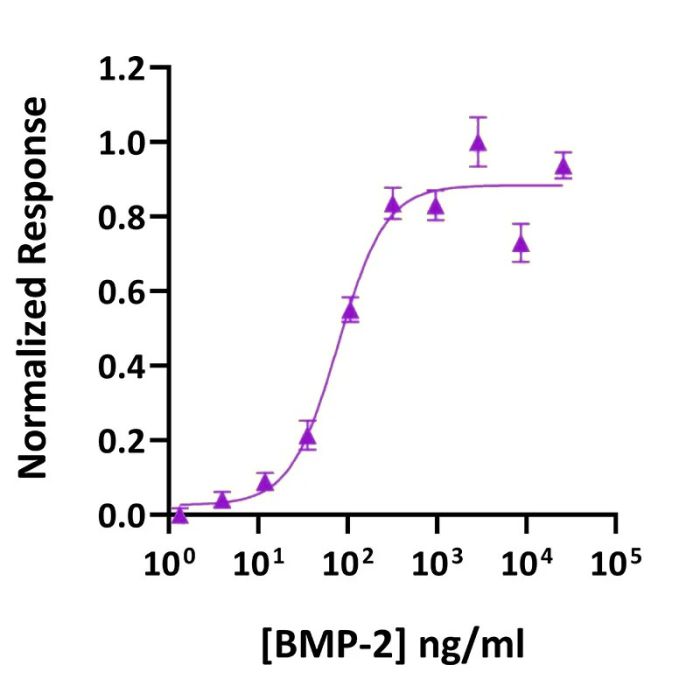
| Bioactivity Assay | No significant difference between EC50 of reference and test lots |
| Reconstitution | Resuspend in 10 mM HCl (Reconstitution Buffer A) at >50 µg/ml. Once reconstituted, store in single-use aliquots to avoid freeze-thaw cycles. Store reconstituted protein at -20 °C to -80 °C for a maximum of 12 months or until the expiry date if sooner. |
| Shelf Life | This product has a guaranteed shelf-life of one year from the date of customer receipt when stored as recommended. |