
RecombiMAb human IgG1 isotype control, anti-respiratory syncytial virus
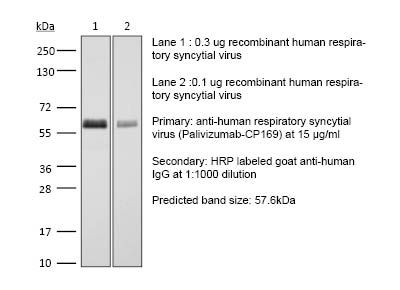
Product Description
Specifications
| Isotype | Human IgG1, κ |
|---|---|
| Recommended Dilution Buffer | InVivoPure pH 7.0 Dilution Buffer |
| Conjugation | This product is unconjugated. Conjugation is available via our Antibody Conjugation Services. |
| Formulation |
PBS, pH 7.0 Contains no stabilizers or preservatives |
| Endotoxin |
≤0.5EU/mg (≤0.0005EU/μg) Determined by LAL assay |
| Aggregation |
<5% Determined by SEC |
| Purity |
≥95% Determined by SDS-PAGE |
| Sterility | 0.2 µm filtration |
| Production | Purified from CHO cell supernatant in an animal-free facility |
| Purification | Protein G |
| RRID | AB_3696243 |
| Molecular Weight | 150 kDa |
| Murine Pathogen Tests |
Ectromelia/Mousepox Virus: Negative Hantavirus: Negative K Virus: Negative Lactate Dehydrogenase-Elevating Virus: Negative Lymphocytic Choriomeningitis virus: Negative Mouse Adenovirus: Negative Mouse Cytomegalovirus: Negative Mouse Hepatitis Virus: Negative Mouse Minute Virus: Negative Mouse Norovirus: Negative Mouse Parvovirus: Negative Mouse Rotavirus: Negative Mycoplasma Pulmonis: Negative Pneumonia Virus of Mice: Negative Polyoma Virus: Negative Reovirus Screen: Negative Sendai Virus: Negative Theiler’s Murine Encephalomyelitis: Negative |
| Storage | The antibody solution should be stored at the stock concentration at 4°C. Do not freeze. |
| Need a Custom Formulation? | See All Antibody Customization Options |
Product Citations
-
Harnessing ExDNA for precision exatecan delivery in cancer: a novel antibody-drug conjugate approach.
In Mol Cancer on 13 October 2025 by Ianniello, Z., Lu, H., et al.
PubMed
BACKGROUND: Current antibody-drug conjugates (ADCs) face limitations due to a lack of tumor-selective targets, inefficient internalization, and challenges in reaching tumors in challenging sites, ultimately limiting their therapeutic efficacy. We developed and characterized V66-exatecan, a novel ADC composed of V66, a humanized antibody with high affinity for extracellular DNA (exDNA), conjugated to exatecan via a cleavable linker. This ADC employs a dual-targeting mechanism based on exDNA and ENT2 transporter expression to enhance nuclear drug delivery and tumor specificity. This study evaluates its anti-tumor activity, mechanism of action, ability to treat challenging tumors, and safety profile. METHODS: To validate tumor selectivity, V66 or a control antibody were conjugated to a fluorescent tag and injected intravenously into tumor-bearing mice; biodistribution analysis demonstrated selective accumulation in tumors and nuclear localization within tumor cells. V66 was then conjugated to exatecan via a cleavable linker. In vitro assays across diverse cancer cell lines assessed cytotoxicity, DNA damage response (DDR) activation, and TOP1 degradation. In vivo efficacy was evaluated in xenograft models of triple-negative breast cancer (TNBC) and BRCA1/2-deficient tumors, including intracranial medulloblastoma. These models were used to assess tumor growth inhibition, survival benefit, and blood-brain barrier (BBB) permeability. Toxicity was assessed through a dose-escalation study, with analysis of hematologic parameters, histopathology of major organs, and liver and kidney function tests (ALT, AST, BUN, total protein) following short- and long-term treatment. RESULTS: V66-exatecan demonstrated potent anti-tumor activity in multiple cancer cell lines but not on healthy mouse primary fibroblasts, with EC50 values in the low nanomolar range. It induced robust DDR signaling, TOP1 degradation, and bystander killing effects. BRCA1/2-deficient models exhibited enhanced penetration and sensitivity, with up to 17-fold lower EC50 compared to BRCA-proficient controls. In vivo, V66-exatecan significantly inhibited tumor growth and extended survival in both TNBC and BRCA-mutant CNS tumors, including complete regressions and prolonged median survival in BRCA2-deficient models. Toxicology studies revealed no significant hematologic, renal, hepatic, or bone marrow toxicity, even at high or repeated doses. CONCLUSIONS: V66-exatecan represents a next-generation of ADCs that overcomes key limitations of traditional platforms by exploiting exDNA-driven tumor selectivity and ENT2-mediated nuclear delivery. It demonstrates broad therapeutic efficacy and a favorable safety profile, supporting its potential for treating DDR-deficient and hard-to-reach tumors.