
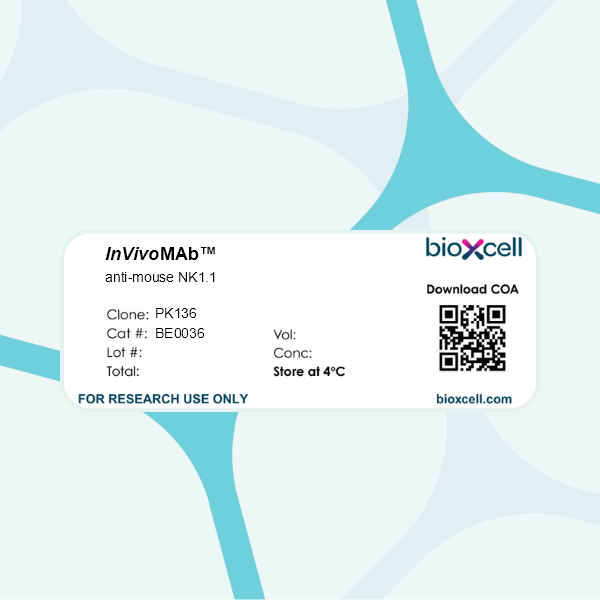
InVivoMAb anti-mouse NK1.1
Product Description
Specifications
| Isotype | Mouse IgG2a, κ |
|---|---|
| Recommended Isotype Control(s) | InVivoMAb mouse IgG2a isotype control, unknown specificity |
| Recommended Dilution Buffer | InVivoPure pH 7.0 Dilution Buffer |
| Conjugation | This product is unconjugated. Conjugation is available via our Antibody Conjugation Services. |
| Immunogen | Mouse spleen and bone marrow cells enriched for NK1+ cells |
| Reported Applications |
in vivo NK cell depletion Flow cytometry |
| Formulation |
PBS, pH 7.0 Contains no stabilizers or preservatives |
| Endotoxin |
≤1EU/mg (≤0.001EU/μg) Determined by LAL assay |
| Purity |
≥95% Determined by SDS-PAGE |
| Sterility | 0.2 µm filtration |
| Production | Purified from cell culture supernatant in an animal-free facility |
| Purification | Protein A |
| RRID | AB_1107737 |
| Molecular Weight | 150 kDa |
| Storage | The antibody solution should be stored at the stock concentration at 4°C. Do not freeze. |
| Need a Custom Formulation? | See All Antibody Customization Options |
Application References
in vivo NK cell depletion
Glasner, A., et al. (2018). "NKp46 Receptor-Mediated Interferon-gamma Production by Natural Killer Cells Increases Fibronectin 1 to Alter Tumor Architecture and Control Metastasis" Immunity 48(1): 107-119 e104.
PubMed
Natural killer (NK) cells are innate lymphoid cells, and their presence within human tumors correlates with better prognosis. However, the mechanisms by which NK cells control tumors in vivo are unclear. Here, we used reflectance confocal microscopy (RCM) imaging in humans and in mice to visualize tumor architecture in vivo. We demonstrated that signaling via the NK cell receptor NKp46 (human) and Ncr1 (mouse) induced interferon-gamma (IFN-gamma) secretion from intratumoral NK cells. NKp46- and Ncr1-mediated IFN-gamma production led to the increased expression of the extracellular matrix protein fibronectin 1 (FN1) in the tumors, which altered primary tumor architecture and resulted in decreased metastases formation. Injection of IFN-gamma into tumor-bearing mice or transgenic overexpression of Ncr1 in NK cells in mice resulted in decreased metastasis formation. Thus, we have defined a mechanism of NK cell-mediated control of metastases in vivo that may help develop NK cell-dependent cancer therapies.
in vivo NK cell depletion
Burrack, K. S., et al. (2018). "Interleukin-15 Complex Treatment Protects Mice from Cerebral Malaria by Inducing Interleukin-10-Producing Natural Killer Cells" Immunity 48(4): 760-772 e764.
PubMed
Cerebral malaria is a deadly complication of Plasmodium infection and involves blood brain barrier (BBB) disruption following infiltration of white blood cells. During experimental cerebral malaria (ECM), mice inoculated with Plasmodium berghei ANKA-infected red blood cells develop a fatal CM-like disease caused by CD8(+) T cell-mediated pathology. We found that treatment with interleukin-15 complex (IL-15C) prevented ECM, whereas IL-2C treatment had no effect. IL-15C-expanded natural killer (NK) cells were necessary and sufficient for protection against ECM. IL-15C treatment also decreased CD8(+) T cell activation in the brain and prevented BBB breakdown without influencing parasite load. IL-15C induced NK cells to express IL-10, which was required for IL-15C-mediated protection against ECM. Finally, we show that ALT-803, a modified human IL-15C, mediates similar induction of IL-10 in NK cells and protection against ECM. These data identify a regulatory role for cytokine-stimulated NK cells in the prevention of a pathogenic immune response.
in vivo NK cell depletion
Ghasemi, R., et al. (2016). "Selective targeting of IL-2 to NKG2D bearing cells for improved immunotherapy" Nat Commun 7: 12878.
PubMed
Despite over 20 years of clinical use, IL-2 has not fulfilled expectations as a safe and effective form of tumour immunotherapy. Expression of the high affinity IL-2Ralpha chain on regulatory T cells mitigates the anti-tumour immune response and its expression on vascular endothelium is responsible for life threatening complications such as diffuse capillary leak and pulmonary oedema. Here we describe the development of a recombinant fusion protein comprised of a cowpox virus encoded NKG2D binding protein (OMCP) and a mutated form of IL-2 with poor affinity for IL-2Ralpha. This fusion protein (OMCP-mutIL-2) potently and selectively activates IL-2 signalling only on NKG2D-bearing cells, such as natural killer (NK) cells, without broadly activating IL-2Ralpha-bearing cells. OMCP-mutIL-2 provides superior tumour control in several mouse models of malignancy and is not limited by mouse strain-specific variability of NK function. In addition, OMCP-mutIL-2 lacks the toxicity and vascular complications associated with parental wild-type IL-2.
in vivo NK cell depletion
Flow Cytometry
Ludigs, K., et al. (2016). "NLRC5 shields T lymphocytes from NK-cell-mediated elimination under inflammatory conditions" Nat Commun 7: 10554.
PubMed
NLRC5 is a transcriptional regulator of MHC class I (MHCI), which maintains high MHCI expression particularly in T cells. Recent evidence highlights an important NK-T-cell crosstalk, raising the question on whether NLRC5 specifically modulates this interaction. Here we show that NK cells from Nlrc5-deficient mice exhibit moderate alterations in inhibitory receptor expression and responsiveness. Interestingly, NLRC5 expression in T cells is required to protect them from NK-cell-mediated elimination upon inflammation. Using T-cell-specific Nlrc5-deficient mice, we show that NK cells surprisingly break tolerance even towards ‘self’ Nlrc5-deficient T cells under inflammatory conditions. Furthermore, during chronic LCMV infection, the total CD8(+) T-cell population is severely decreased in these mice, a phenotype reverted by NK-cell depletion. These findings strongly suggest that endogenous T cells with low MHCI expression become NK-cell targets, having thus important implications for T-cell responses in naturally or therapeutically induced inflammatory conditions.
in vivo NK cell depletion
Moynihan, K. D., et al. (2016). "Eradication of large established tumors in mice by combination immunotherapy that engages innate and adaptive immune responses" Nat Med. doi : 10.1038/nm.4200.
PubMed
Checkpoint blockade with antibodies specific for cytotoxic T lymphocyte-associated protein (CTLA)-4 or programmed cell death 1 (PDCD1; also known as PD-1) elicits durable tumor regression in metastatic cancer, but these dramatic responses are confined to a minority of patients. This suboptimal outcome is probably due in part to the complex network of immunosuppressive pathways present in advanced tumors, which are unlikely to be overcome by intervention at a single signaling checkpoint. Here we describe a combination immunotherapy that recruits a variety of innate and adaptive immune cells to eliminate large tumor burdens in syngeneic tumor models and a genetically engineered mouse model of melanoma; to our knowledge tumors of this size have not previously been curable by treatments relying on endogenous immunity. Maximal antitumor efficacy required four components: a tumor-antigen-targeting antibody, a recombinant interleukin-2 with an extended half-life, anti-PD-1 and a powerful T cell vaccine. Depletion experiments revealed that CD8+ T cells, cross-presenting dendritic cells and several other innate immune cell subsets were required for tumor regression. Effective treatment induced infiltration of immune cells and production of inflammatory cytokines in the tumor, enhanced antibody-mediated tumor antigen uptake and promoted antigen spreading. These results demonstrate the capacity of an elicited endogenous immune response to destroy large, established tumors and elucidate essential characteristics of combination immunotherapies that are capable of curing a majority of tumors in experimental settings typically viewed as intractable.
in vivo NK cell depletion
Mitchell, D. A., et al. (2015). "Tetanus toxoid and CCL3 improve dendritic cell vaccines in mice and glioblastoma patients" Nature 519(7543): 366-369.
PubMed
After stimulation, dendritic cells (DCs) mature and migrate to draining lymph nodes to induce immune responses. As such, autologous DCs generated ex vivo have been pulsed with tumour antigens and injected back into patients as immunotherapy. While DC vaccines have shown limited promise in the treatment of patients with advanced cancers including glioblastoma, the factors dictating DC vaccine efficacy remain poorly understood. Here we show that pre-conditioning the vaccine site with a potent recall antigen such as tetanus/diphtheria (Td) toxoid can significantly improve the lymph node homing and efficacy of tumour-antigen-specific DCs. To assess the effect of vaccine site pre-conditioning in humans, we randomized patients with glioblastoma to pre-conditioning with either mature DCs or Td unilaterally before bilateral vaccination with DCs pulsed with Cytomegalovirus phosphoprotein 65 (pp65) RNA. We and other laboratories have shown that pp65 is expressed in more than 90% of glioblastoma specimens but not in surrounding normal brain, providing an unparalleled opportunity to subvert this viral protein as a tumour-specific target. Patients given Td had enhanced DC migration bilaterally and significantly improved survival. In mice, Td pre-conditioning also enhanced bilateral DC migration and suppressed tumour growth in a manner dependent on the chemokine CCL3. Our clinical studies and corroborating investigations in mice suggest that pre-conditioning with a potent recall antigen may represent a viable strategy to improve anti-tumour immunotherapy.
in vivo NK cell depletion
Yamada, D. H., et al. (2015). "Suppression of Fcgamma-receptor-mediated antibody effector function during persistent viral infection" Immunity 42(2): 379-390.
PubMed
Understanding how viruses subvert host immunity and persist is essential for developing strategies to eliminate infection. T cell exhaustion during chronic viral infection is well described, but effects on antibody-mediated effector activity are unclear. Herein, we show that increased amounts of immune complexes generated in mice persistently infected with lymphocytic choriomeningitis virus (LCMV) suppressed multiple Fcgamma-receptor (FcgammaR) functions. The high amounts of immune complexes suppressed antibody-mediated cell depletion, therapeutic antibody-killing of LCMV infected cells and human CD20-expressing tumors, as well as reduced immune complex-mediated cross-presentation to T cells. Suppression of FcgammaR activity was not due to inhibitory FcgammaRs or high concentrations of free antibody, and proper FcgammaR functions were restored when persistently infected mice specifically lacked immune complexes. Thus, we identify a mechanism of immunosuppression during viral persistence with implications for understanding effective antibody activity aimed at pathogen control.
in vivo NK cell depletion
Flow Cytometry
Wensveen, F. M., et al. (2015). "NK cells link obesity-induced adipose stress to inflammation and insulin resistance" Nat Immunol 16(4): 376-385.
PubMed
An important cause of obesity-induced insulin resistance is chronic systemic inflammation originating in visceral adipose tissue (VAT). VAT inflammation is associated with the accumulation of proinflammatory macrophages in adipose tissue, but the immunological signals that trigger their accumulation remain unknown. We found that a phenotypically distinct population of tissue-resident natural killer (NK) cells represented a crucial link between obesity-induced adipose stress and VAT inflammation. Obesity drove the upregulation of ligands of the NK cell-activating receptor NCR1 on adipocytes; this stimulated NK cell proliferation and interferon-gamma (IFN-gamma) production, which in turn triggered the differentiation of proinflammatory macrophages and promoted insulin resistance. Deficiency of NK cells, NCR1 or IFN-gamma prevented the accumulation of proinflammatory macrophages in VAT and greatly ameliorated insulin sensitivity. Thus NK cells are key regulators of macrophage polarization and insulin resistance in response to obesity-induced adipocyte stress.
in vivo NK cell depletion
Flow Cytometry
Maltez, V. I., et al. (2015). "Inflammasomes Coordinate Pyroptosis and Natural Killer Cell Cytotoxicity to Clear Infection by a Ubiquitous Environmental Bacterium" Immunity 43(5): 987-997.
PubMed
Defective neutrophils in patients with chronic granulomatous disease (CGD) cause susceptibility to extracellular and intracellular infections. Microbes must first be ejected from intracellular niches to expose them to neutrophil attack, so we hypothesized that inflammasomes detect certain CGD pathogens upstream of neutrophil killing. Here, we identified one such ubiquitous environmental bacterium, Chromobacterium violaceum, whose extreme virulence was fully counteracted by the NLRC4 inflammasome. Caspase-1 protected via two parallel pathways that eliminated intracellular replication niches. Pyroptosis was the primary bacterial clearance mechanism in the spleen, but both pyroptosis and interleukin-18 (IL-18)-driven natural killer (NK) cell responses were required for liver defense. NK cells cleared hepatocyte replication niches via perforin-dependent cytotoxicity, whereas interferon-gamma was not required. These insights suggested a therapeutic approach: exogenous IL-18 restored perforin-dependent cytotoxicity during infection by the inflammasome-evasive bacterium Listeria monocytogenes. Therefore, inflammasomes can trigger complementary programmed cell death mechanisms, directing sterilizing immunity against intracellular bacterial pathogens.
in vivo NK cell depletion
Flow Cytometry
Uddin, M. N., et al. (2014). "TNF-alpha-dependent hematopoiesis following Bcl11b deletion in T cells restricts metastatic melanoma" J Immunol 192(4): 1946-1953.
PubMed
Using several tumor models, we demonstrate that mice deficient in Bcl11b in T cells, although having reduced numbers of T cells in the peripheral lymphoid organs, developed significantly less tumors compared with wild-type mice. Bcl11b(-/-) CD4(+) T cells, with elevated TNF-alpha levels, but not the Bcl11b(-/-) CD8(+) T cells, were required for the reduced tumor burden, as were NK1.1(+) cells, found in increased numbers in Bcl11b(F/F)/CD4-Cre mice. Among NK1.1(+) cells, the NK cell population was predominant in number and was the only population displaying elevated granzyme B levels and increased degranulation, although not increased proliferation. Although the number of myeloid-derived suppressor cells was increased in the lungs with metastatic tumors of Bcl11b(F/F)/CD4-Cre mice, their arginase-1 levels were severely reduced. The increase in NK cell and myeloid-derived suppressor cell numbers was associated with increased bone marrow and splenic hematopoiesis. Finally, the reduced tumor burden, increased numbers of NK cells in the lung, and increased hematopoiesis in Bcl11b(F/F)/CD4-Cre mice were all dependent on TNF-alpha. Moreover, TNF-alpha treatment of wild-type mice also reduced the tumor burden and increased hematopoiesis and the numbers and activity of NK cells in the lung. In vitro treatment with TNF-alpha of lineage-negative hematopoietic progenitors increased NK and myeloid differentiation, further supporting a role of TNF-alpha in promoting hematopoiesis. These studies reveal a novel role for TNF-alpha in the antitumor immune response, specifically in stimulating hematopoiesis and increasing the numbers and activity of NK cells.
in vivo NK cell depletion
Guo, Z., et al. (2014). "PD-1 blockade and OX40 triggering synergistically protects against tumor growth in a murine model of ovarian cancer" PLoS One 9(2): e89350.
PubMed
The co-inhibitory receptor Programmed Death-1 (PD-1) curtails immune responses and prevent autoimmunity, however, tumors exploit this pathway to escape from immune destruction. The co-stimulatory receptor OX40 is upregulated on T cells following activation and increases their clonal expansion, survival and cytokine production when engaged. Although antagonistic anti-PD-1 or agonistic anti-OX40 antibodies can promote the rejection of several murine tumors, some poorly immunogenic tumors were refractory to this treatment. In the present study, we evaluated the antitumor effects and mechanisms of combinatorial PD-1 blockade and OX40 triggering in a murine ID8 ovarian cancer model. Although individual anti-PD-1 or OX40 mAb treatment was ineffective in tumor protection against 10-day established ID8 tumor, combined anti-PD-1/OX40 mAb treatment markedly inhibited tumor outgrowth with 60% of mice tumor free 90 days after tumor inoculation. Tumor protection was associated with a systemic immune response with memory and antigen specificity and required CD4(+) cells and CD8(+) T cells. The anti-PD-1/OX40 mAb treatment increased CD4(+) and CD8(+) cells and decreased immunosuppressive CD4(+)FoxP3(+) regulatory T (Treg) cells and CD11b(+)Gr-1(+) myeloid suppressor cells (MDSC), giving rise to significantly higher ratios of both effector CD4(+) and CD8(+) cells to Treg and MDSC in peritoneal cavity; Quantitative RT-PCR data further demonstrated the induction of a local immunostimulatory milieu by anti-PD-1/OX40 mAb treatment. The splenic CD8(+) T cells from combined mAb treated mice produced high levels of IFN-gamma upon tumor antigen stimulation and exhibited antigen-specific cytolytic activity. To our knowledge, this is the first study testing the antitumor effects of combined anti-PD-1/OX40 mAb in a murine ovarian cancer model, and our results provide a rationale for clinical trials evaluating ovarian cancer immunotherapy using this combination of mAb.
in vivo NK cell depletion
Flow Cytometry
Walsh, K. B., et al. (2014). "Animal model of respiratory syncytial virus: CD8+ T cells cause a cytokine storm that is chemically tractable by sphingosine-1-phosphate 1 receptor agonist therapy" J Virol 88(11): 6281-6293.
PubMed
The cytokine storm is an intensified, dysregulated, tissue-injurious inflammatory response driven by cytokine and immune cell components. The cytokine storm during influenza virus infection, whereby the amplified innate immune response is primarily responsible for pulmonary damage, has been well characterized. Now we describe a novel event where virus-specific T cells induce a cytokine storm. The paramyxovirus pneumonia virus of mice (PVM) is a model of human respiratory syncytial virus (hRSV). Unexpectedly, when C57BL/6 mice were infected with PVM, the innate inflammatory response was undetectable until day 5 postinfection, at which time CD8(+) T cells infiltrated into the lung, initiating a cytokine storm by their production of gamma interferon (IFN-gamma) and tumor necrosis factor alpha (TNF-alpha). Administration of an immunomodulatory sphingosine-1-phosphate (S1P) receptor 1 (S1P1R) agonist significantly inhibited PVM-elicited cytokine storm by blunting the PVM-specific CD8(+) T cell response, resulting in diminished pulmonary disease and enhanced survival. IMPORTANCE: A dysregulated overly exuberant immune response, termed a “cytokine storm,” accompanies virus-induced acute respiratory diseases (VARV), is primarily responsible for the accompanying high morbidity and mortality, and can be controlled therapeutically in influenza virus infection of mice and ferrets by administration of sphingosine-1-phosphate 1 receptor (S1P1R) agonists. Here, two novel findings are recorded. First, in contrast to influenza infection, where the cytokine storm is initiated early by the innate immune system, for pneumonia virus of mice (PVM), a model of RSV, the cytokine storm is initiated late in infection by the adaptive immune response: specifically, by virus-specific CD8 T cells via their release of IFN-gamma and TNF-alpha. Blockading these cytokines with neutralizing antibodies blunts the cytokine storm and protects the host. Second, PVM infection is controlled by administration of an S1P1R agonist.
in vivo NK cell depletion
Ellermeier, J., et al. (2013). "Therapeutic efficacy of bifunctional siRNA combining TGF-beta1 silencing with RIG-I activation in pancreatic cancer" Cancer Res 73(6): 1709-1720.
PubMed
Deregulated TGF-beta signaling in pancreatic cancer promotes tumor growth, invasion, metastasis, and a potent immunosuppressive network. A strategy for disrupting this tumor-promoting pathway is silencing TGF-beta by siRNA. By introducing a triphosphate group at the 5′ end of siRNA (ppp-siRNA), gene silencing can be combined with immune activation via the cytosolic helicase retinoic acid-inducible gene I (RIG-I), a ubiquitously expressed receptor recognizing viral RNA. We validated RIG-I as a therapeutic target by showing that activation of RIG-I in pancreatic carcinoma cells induced IRF-3 phosphorylation, production of type I IFN, the chemokine CXCL10, as well as caspase-9-mediated tumor cell apoptosis. Next, we generated a bifunctional ppp-siRNA that combines RIG-I activation with gene silencing of TGF-beta1 (ppp-TGF-beta) and studied its therapeutic efficacy in the orthotopic Panc02 mouse model of pancreatic cancer. Intravenous injection of ppp-TGF-beta reduced systemic and tumor-associated TGF-beta levels. In addition, it induced high levels of type I IFN and CXCL10 in serum and tumor tissue, systemic immune cell activation, and profound tumor cell apoptosis in vivo. Treatment of mice with established tumors with ppp-TGF-beta significantly prolonged survival as compared with ppp-RNA or TGF-beta siRNA alone. Furthermore, we observed the recruitment of activated CD8(+) T cells to the tumor and a reduced frequency of CD11b(+) Gr-1(+) myeloid cells. Therapeutic efficacy was dependent on CD8(+) T cells, whereas natural killer cells were dispensable. In conclusion, combing TGF-beta gene silencing with RIG-I signaling confers potent antitumor efficacy against pancreatic cancer by breaking tumor-induced CD8(+) T cell suppression.
in vivo NK cell depletion
Flow Cytometry
Kearl, T. J., et al. (2013). "Programmed death receptor-1/programmed death receptor ligand-1 blockade after transient lymphodepletion to treat myeloma" J Immunol 190(11): 5620-5628.
PubMed
Early phase clinical trials targeting the programmed death receptor-1/ligand-1 (PD-1/PD-L1) pathway to overcome tumor-mediated immunosuppression have reported promising results for a variety of cancers. This pathway appears to play an important role in the failure of immune reactivity to malignant plasma cells in multiple myeloma patients, as the tumor cells express relatively high levels of PD-L1, and T cells show increased PD-1 expression. In the current study, we demonstrate that PD-1/PD-L1 blockade with a PD-L1-specific Ab elicits rejection of a murine myeloma when combined with lymphodepleting irradiation. This particular combined approach by itself has not previously been shown to be efficacious in other tumor models. The antitumor effect of lymphodepletion/anti-PD-L1 therapy was most robust when tumor Ag-experienced T cells were present either through cell transfer or survival after nonmyeloablative irradiation. In vivo depletion of CD4 or CD8 T cells completely eliminated antitumor efficacy of the lymphodepletion/anti-PD-L1 therapy, indicating that both T cell subsets are necessary for tumor rejection. Elimination of myeloma by T cells occurs relatively quickly as tumor cells in the bone marrow were nearly nondetectable by 5 d after the first anti-PD-L1 treatment, suggesting that antimyeloma reactivity is primarily mediated by preactivated T cells, rather than newly generated myeloma-reactive T cells. Anti-PD-L1 plus lymphodepletion failed to improve survival in two solid tumor models, but demonstrated significant efficacy in two hematologic malignancy models. In summary, our results support the clinical testing of lymphodepletion and PD-1/PD-L1 blockade as a novel approach for improving the survival of patients with multiple myeloma.
in vivo NK cell depletion
Dai, M., et al. (2013). "Long-lasting complete regression of established mouse tumors by counteracting Th2 inflammation" J Immunother 36(4): 248-257.
PubMed
40% of mice with SW1 tumors remained healthy >150 days after last treatment and are probably cured. Therapeutic efficacy was associated with a systemic immune response with memory and antigen specificity, required CD4 cells and involved CD8 cells and NK cells to a less extent. The 3 mAb combination significantly decreased CD19 cells at tumor sites, increased IFN-gamma and TNF-alpha producing CD4 and CD8 T cells and mature CD86 dendritic cells (DC), and it increased the ratios of effector CD4 and CD8 T cells to CD4Foxp3 regulatory T (Treg) cells and to CD11bGr-1 myeloid suppressor cells (MDSC). This is consistent with shifting the tumor microenvironment from an immunosuppressive Th2 to an immunostimulatory Th1 type and is further supported by PCR data. Adding an anti-CD19 mAb to the 3 mAb combination in the SW1 model further increased therapeutic efficacy. Data from ongoing experiments show that intratumoral injection of a combination of mAbs to CD137PD-1CTLA4CD19 can induce complete regression and dramatically prolong survival also in the TC1 carcinoma and B16 melanoma models, suggesting that the approach has general validity.”}” data-sheets-userformat=”{“2″:14851,”3”:{“1″:0},”4”:{“1″:2,”2″:16777215},”12″:0,”14”:{“1″:2,”2″:1521491},”15″:”Roboto, sans-serif”,”16″:12}”>Mice with intraperitoneal ID8 ovarian carcinoma or subcutaneous SW1 melanoma were injected with monoclonal antibodies (mAbs) to CD137PD-1CTLA4 7-15 days after tumor initiation. Survival of mice with ID8 tumors tripled and >40% of mice with SW1 tumors remained healthy >150 days after last treatment and are probably cured. Therapeutic efficacy was associated with a systemic immune response with memory and antigen specificity, required CD4 cells and involved CD8 cells and NK cells to a less extent. The 3 mAb combination significantly decreased CD19 cells at tumor sites, increased IFN-gamma and TNF-alpha producing CD4 and CD8 T cells and mature CD86 dendritic cells (DC), and it increased the ratios of effector CD4 and CD8 T cells to CD4Foxp3 regulatory T (Treg) cells and to CD11bGr-1 myeloid suppressor cells (MDSC). This is consistent with shifting the tumor microenvironment from an immunosuppressive Th2 to an immunostimulatory Th1 type and is further supported by PCR data. Adding an anti-CD19 mAb to the 3 mAb combination in the SW1 model further increased therapeutic efficacy. Data from ongoing experiments show that intratumoral injection of a combination of mAbs to CD137PD-1CTLA4CD19 can induce complete regression and dramatically prolong survival also in the TC1 carcinoma and B16 melanoma models, suggesting that the approach has general validity.
in vivo NK cell depletion
Richter, K., et al. (2013). "Macrophage and T cell produced IL-10 promotes viral chronicity" PLoS Pathog 9(11): e1003735.
PubMed
Chronic viral infections lead to CD8(+) T cell exhaustion, characterized by impaired cytokine secretion. Presence of the immune-regulatory cytokine IL-10 promotes chronicity of Lymphocytic Choriomeningitis Virus (LCMV) Clone 13 infection, while absence of IL-10/IL-10R signaling early during infection results in viral clearance and higher percentages and numbers of antiviral, cytokine producing T cells. IL-10 is produced by several cell types during LCMV infection but it is currently unclear which cellular sources are responsible for induction of viral chronicity. Here, we demonstrate that although dendritic cells produce IL-10 and overall IL-10 mRNA levels decrease significantly in absence of CD11c(+) cells, absence of IL-10 produced by CD11c(+) cells failed to improve the LCMV-specific T cell response and control of LCMV infection. Similarly, NK cell specific IL-10 deficiency had no positive impact on the LCMV-specific T cell response or viral control, even though high percentages of NK cells produced IL-10 at early time points after infection. Interestingly, we found markedly improved T cell responses and clearance of normally chronic LCMV Clone 13 infection when either myeloid cells or T cells lacked IL-10 production and mice depleted of monocytes/macrophages or CD4(+) T cells exhibited reduced overall levels of IL-10 mRNA. These data suggest that the decision whether LCMV infection becomes chronic or can be cleared critically depends on early CD4(+) T cell and monocyte/macrophage produced IL-10.
in vivo NK cell depletion
Hervieu, A., et al. (2013). "Dacarbazine-mediated upregulation of NKG2D ligands on tumor cells activates NK and CD8 T cells and restrains melanoma growth" J Invest Dermatol 133(2): 499-508.
PubMed
Dacarbazine (DTIC) is a cytotoxic drug widely used for melanoma treatment. However, the putative contribution of anticancer immune responses in the efficacy of DTIC has not been evaluated. By testing how DTIC affects host immune responses to cancer in a mouse model of melanoma, we unexpectedly found that both natural killer (NK) and CD8(+) T cells were indispensable for DTIC therapeutic effect. Although DTIC did not directly affect immune cells, it triggered the upregulation of NKG2D ligands on tumor cells, leading to NK cell activation and IFNgamma secretion in mice and humans. NK cell-derived IFNgamma subsequently favored upregulation of major histocompatibility complex class I molecules on tumor cells, rendering them sensitive to cytotoxic CD8(+) T cells. Accordingly, DTIC markedly enhanced cytotoxic T lymphocyte antigen 4 inhibition efficacy in vivo in an NK-dependent manner. These results underscore the immunogenic properties of DTIC and provide a rationale to combine DTIC with immunotherapeutic agents that relieve immunosuppression in vivo.
in vivo NK cell depletion
Flow Cytometry
Monticelli, L. A., et al. (2011). "Innate lymphoid cells promote lung-tissue homeostasis after infection with influenza virus" Nat Immunol 12(11): 1045-1054.
PubMed
Innate lymphoid cells (ILCs), a heterogeneous cell population, are critical in orchestrating immunity and inflammation in the intestine, but whether ILCs influence immune responses or tissue homeostasis at other mucosal sites remains poorly characterized. Here we identify a population of lung-resident ILCs in mice and humans that expressed the alloantigen Thy-1 (CD90), interleukin 2 (IL-2) receptor a-chain (CD25), IL-7 receptor a-chain (CD127) and the IL-33 receptor subunit T1-ST2. Notably, mouse ILCs accumulated in the lung after infection with influenza virus, and depletion of ILCs resulted in loss of airway epithelial integrity, diminished lung function and impaired airway remodeling. These defects were restored by administration of the lung ILC product amphiregulin. Collectively, our results demonstrate a critical role for lung ILCs in restoring airway epithelial integrity and tissue homeostasis after infection with influenza virus.
Product Citations
-
-
Cancer Research
-
Immunology and Microbiology
Intratumoral immune activation with TLR4 agonist synergizes with effector T cells to eradicate established murine tumors.
In NPJ Vaccines on 16 June 2020 by Albershardt, T. C., Leleux, J., et al.
PubMed
Effective T cell-based immunotherapy of solid malignancies requires intratumoral activity of cytotoxic T cells and induction of protective immune memory. A major obstacle to intratumoral trafficking and activation of vaccine-primed or adoptively transferred tumor-specific T cells is the immunosuppressive tumor microenvironment (TME), which currently limits the efficacy of both anti-tumor vaccines and adoptive cell therapy (ACT). Combination treatments to overcome TME-mediated immunosuppression are therefore urgently needed. We combined intratumoral administration of the synthetic toll-like receptor 4 agonist glucopyranosyl lipid A (oil-in-water formulation, G100) with either active vaccination or adoptive transfer of tumor-specific CD8 T cells to mice bearing established melanomas or orthotopically inoculated glioblastomas. In combination with cancer vaccines or ACT, G100 significantly increased expression of innate immune genes, infiltration and expansion of activated effector T cells, antigen spreading, and durable immune responses. Complete tumor regression of both injected and non-injected tumors was observed only in mice receiving combination immunotherapy. TLR4-based intratumoral immune activation may be a viable approach to enhance the efficacy of therapeutic cancer vaccines and ACT in patients.
-
-
-
Cancer Research
Upregulation of Lactobacillus spp. in gut microbiota as a novel mechanism for environmental eustress-induced anti-pancreatic cancer effects.
In Gut Microbes on 1 December 2025 by Liang, Y., Du, M., et al.
PubMed
Pancreatic ductal adenocarcinoma (PDAC) is a highly lethal malignancy with limited effective treatment options. Emerging evidence links enriched environment (EE)-induced eustress to PDAC inhibition. However, the underlying mechanisms remain unclear. In this study, we explored the role of gut microbiota in PDAC-suppressive effects of EE. We demonstrated that depletion of gut microbiota with antibiotics abolished EE-induced tumor suppression, while fecal microbiota transplantation (FMT) from EE mice significantly inhibited tumor growth in both subcutaneous and orthotopic PDAC models housed in standard environment. 16S rRNA sequencing revealed that EE enhanced gut microbiota diversity and selectively enriched probiotic Lactobacillus, particularly L. reuteri. Treatment with L. reuteri significantly suppressed PDAC tumor growth and increased natural killer (NK) cell infiltration into the tumor microenvironment. Depletion of NK cells alleviated the anti-tumor effects of L. reuteri, underscoring the essential role of NK cell-mediated immunity in anti-tumor response. Clinical analysis of PDAC patients showed that higher fecal Lactobacillus abundance correlated with improved progression-free and overall survival, further supporting the therapeutic potential of L. reuteri in PDAC. Overall, this study identifies gut microbiota as a systemic regulator of PDAC under psychological stress. Supplementation of psychobiotic Lactobacillus may offer a novel therapeutic strategy for PDAC.
-
-
-
Cancer Research
An immunometabolic prodrug strategy overcomes DHODH inhibitor resistance in refractory melanoma.
In J Exp Clin Cancer Res on 14 November 2025 by Hai, Y., Wang, W., et al.
PubMed
Metabolic reprogramming, particularly upregulated de novo pyrimidine biosynthesis, drives cancer progression and immune evasion. Dihydroorotate dehydrogenase (DHODH), a key enzyme in this pathway, is a promising therapeutic target, but its inhibitors often face resistance in immune-refractory melanoma, linked to low basal stimulator of interferon genes (STING) expression.
-
-
-
Cancer Research
A monoclonal antibody that inhibits the shedding of CD16a and CD16b and promotes antibody-dependent cellular cytotoxicity against tumors.
In Nat Commun on 11 November 2025 by Bortoleti, B. T. D. S., Quasem, S., et al.
PubMed
CD16a triggers antibody-dependent cellular cytotoxicity (ADCC) and phagocytosis by natural killer (NK) cells and macrophages in anti-tumor immunity. However, CD16a undergoes cleavage by ADAM17 that dampens its anti-tumor immunity. We here develop a monoclonal antibody (F9H4) that binds to CD16a and inhibits its cleavage. F9H4 retains CD16a on the surface of NK cells and macrophages, without triggering or blocking CD16a. F9H4 also binds to and inhibits shedding of CD16b by neutrophils, and inhibits CD16a/b shedding by leukocytes in tumor samples from lung cancer patients. F9H4 promotes ADCC against lung cancer cells that are opsonized by cetuximab, an epidermal growth factor receptor antibody that engages CD16a. F9H4 synergizes with cetuximab to inhibit human lung adenocarcinoma development in immunodeficient mice reconstituted with human NK cells. F9H4 combining with cetuximab also inhibits murine lung carcinoma growth in Fc gamma receptor-humanized mice, and such effect is mediated by NK cells and macrophages. The efficacy of F9H4+cetuximab in lung cancer models is the proof-of-concept for this new approach that promotes anti-tumor functions of Fc-enabled antibodies.
-
-
-
Cell Biology
IRF7 drives macrophages to kill bacteria and improves septic outcomes via autophagy.
In JCI Insight on 10 November 2025 by Chen, G., Li, K., et al.
PubMed
Sepsis contributes substantially to mortality rates worldwide, yet clinical trials that have focused on its underlying pathogenesis have failed to demonstrate benefits. Recently, enhancing self-defense has been regarded as an emerging therapeutic approach. Autophagy is a self-defense mechanism that protects septic mice, but its regulatory factor is still unknown. Moreover, the role of interferon regulatory factor 7 (IRF7) in sepsis has been debated. Here, we showed that Irf7 deficiency increased mortality during polymicrobial sepsis. Furthermore, IRF7 drove macrophages to protect against sepsis. Mechanistically, IRF7 is a transcription factor that upregulates the expression of autophagy-related genes responsible for autophagosome formation and autolysosome maturation, induces autophagic killing of bacteria, and ultimately reduces septic organ injury. Recombinant adeno-associated virus 9-Irf7-mediated IRF7 overexpression promoted the autophagic clearance of pathogens and improved sepsis outcomes, which may be the mechanism underlying the observed improvement in bacterial clearance. These findings provide evidence that IRF7 is the underlying regulatory factor that drives autophagy to eliminate pathogens in macrophages during sepsis. Collectively, IRF7 overexpression represents a potential host-directed therapeutic strategy for preclinical sepsis models, operating independently of antibiotic mechanisms.
-
-
-
Immunology and Microbiology
Damage-induced IL-18 stimulates thymic NK cells limiting endogenous tissue regeneration.
In Nat Immunol on 1 October 2025 by Granadier, D., Cooper, K., et al.
PubMed
Interleukin-18 (IL-18) is an acute-phase proinflammatory molecule crucial for mediating viral clearance by activating T helper 1 CD4+ T cells, cytotoxic CD8+ T cells and natural killer (NK) cells. Here, we show that mature IL-18 is generated in the thymus following numerous distinct forms of tissue damage, all of which cause caspase-1-mediated immunogenic cell death. We report that IL-18-stimulated cytotoxic NK cells limit endogenous thymic regeneration, a critical process that ensures the restoration of immune competence after acute insults such as stress, infection, chemotherapy and radiation. NK cells suppress thymus recovery by aberrantly targeting thymic epithelial cells, which act as the master regulators of organ function and regeneration. Together, our data reveal a new pathway regulating tissue regeneration in the thymus and suggest IL-18 as a potential therapeutic target to boost thymic function. Moreover, given the enthusiasm for IL-18 as a cancer immunotherapy due to its capacity to elicit a type 1 immune response, these findings also offer insight into potential off-target effects.
-
-
-
Immunology and Microbiology
-
Cancer Research
Synergically enhanced anti-tumor immunity of in vivo panCAR by circRNA vaccine boosting.
In Cell Rep Med on 19 August 2025 by Wang, Y., Lin, L., et al.
PubMed
Chimeric antigen receptor (CAR) T cell therapy has shown promise in treating hematologic malignancies, but it still faces challenges, including high costs, a time-consuming manufacturing process, and the necessity of lymphodepletion. Here, we generate circular RNAs (circRNAs) encoding CAR proteins, referred to as circRNACAR, which mediates remarkable tumor killing in human primary T cells. We demonstrate that circRNACAR, delivered with immunocyte-tropic lipid nanoparticles (LNPs), can form in vivo panCAR cells (CAR-T, CAR-natural killer [NK], and CAR-macrophage), significantly inhibit tumor growth, and reshape the tumor microenvironment in mice. Importantly, combining in vivo panCAR with circRNA-based vaccines encoding the corresponding HER2 antigens exhibits synergistically enhanced anti-tumor immunity. Notably, circRNACAR can in return boost the level of vaccination-elicited HER2-specific antibodies, mediating effective killing of tumor cells by macrophages. In combination with vaccination, in vivo panCAR demonstrates a synergistic enhancement of anti-tumor immunity across various mouse models, thereby establishing a framework for the synergistic in vivo panCAR-VAC immunotherapy.
-
-
-
Flow cytometry/Cell sorting
-
Cancer Research
CARG-2020 targets IL-12, IL-17, and PD-L1 pathways to effectively treat melanoma and breast cancer.
In Sci Rep on 13 August 2025 by Ahmadi, E., Chiari, C., et al.
PubMed
Cancer immunotherapy has recently achieved a breakthrough status, however, it is not effective in all cancer types. Genetically engineered oncolytic viruses (OVs) with immunomodulators are promising new therapeutic modalities for cancer. CARG-2020 is an engineered trivalent oncolytic viral construct that specifically expresses three immune modulators that inhibit IL-17RA signaling and regulate PD-L1 expression by shRNAs, along with the cytokine IL-12 which activates multiple tumoricidal pathways. Previous work showed that intratumoral (i.t.) injection of CARG-2020 exhibits robust efficacy against established colorectal cancer (CRC). In this study, we report that systemic delivery of CARG-2020 via the intravenous (i.v.) route can successfully control CRC growth. To further expand the scope of CARG-2020 as a pan-cancer candidate, we also show that CARG-2020 works in two additional mouse models of melanoma and triple-negative breast cancer. Administration of CARG-2020 resulted in increased accumulation of CD8+ T lymphocytes in the tumors, and depletion of these T cells results in poor tumor regression mediated by CARG-2020. Overall, our study shows a broad-spectrum efficacy of CARG-2020 in solid tumors and demonstrates the potential of CARG-2020 to be developed as a clinical candidate for the treatment of multiple human cancers that are surgically accessible.
-
-
-
Mus musculus (Mouse)
-
Immunology and Microbiology
-
Cancer Research
Orchestrating intratumoral DC-T cell immunity for enhanced tumor control via radiotherapy-activated TLR7/8 prodrugs in mice.
In Nat Commun on 1 July 2025 by Yin, X., Ding, Z., et al.
PubMed
Optimizing intratumoral dendritic cell (DC)-T cell responses is pivotal for effective cancer immunotherapy. However, the mechanistic governing these dynamics within the tumor microenvironment (TME) remains unclear, and strategies to improve their therapeutic potential are underexplored. Here, we show that precise radiotherapy activates the pro-TLR7/8 agonist imidazoquinoline (IMDQ) locally in preclinical tumor models, stimulating DCs to elicit T cell immunity without the need for further recruitment or causing systemic toxicity. Mechanistically, this synergistic approach triggers type I interferon via STING and MyD88 signaling pathways, strengthening local immune responses. Importantly, we reveal that fractionated, low-dose radiotherapy can effectively optimize local DC-T cell dynamics to control the irradiated tumor, while also promoting abscopal effect. Thus, our findings underscore the critical role of harnessing intratumoral DCs to reinvigorate pre-existing T cell immunity and provide mechanistic insights into improving both local and distal tumor control, opening new avenues for advancing cancer immunotherapy.
-
-
-
In vivo experiments
-
Mus musculus (Mouse)
-
Cancer Research
-
Cell Biology
-
Immunology and Microbiology
Intratumoral Brevibacillus parabrevis enhances antitumor immunity by inhibiting NK cell ferroptosis in hepatocellular carcinoma.
In Cell Death Dis on 21 May 2025 by Pan, B., Zhang, X., et al.
PubMed
It is known that intestinal flora affects the number and function of NK cells through metabolites, thereby regulating the response of tumors to chemotherapy or immunotherapy. However, little is known about whether intratumoral bacteria are involved in NK cell-mediated antitumor immunity. In this study, 2bRAD-M analysis was performed on patient hepatocellular carcinoma and paired tissues to determine the composition of the intratumoral microbiota. Mass cytometry, flow cytometry, co-immunoprecipitation, immunoblotting, immunofluorescence, and DNA pull-down assays were used to evaluate the relationship between intratumoral bacteria, ferroptosis, and NK cell activity in Hu-SRC mice. Here, we found that the intratumoral B. parabrevis inhibited NK cell ferroptosis by promoting lipolysis into acetyl-CoA. Mechanistically, B. parabrevis catalyzed the acetylation of RORC, enhancing its binding to the NEDD4L promoter. NEDD4L induced ubiquitination of iron transporters SLC39A14, SLC39A8, and STEAP3. Functionally, B. parabrevis induced NK cells to differentiate into adaptability, cytotoxicity, and heat shock phenotypes, inhibiting the terminal phenotype and changing the tumor microenvironment from "cold" to "hot". In conclusion, B. parabrevis enhanced the antitumor response of NK cells by regulating post-translational modifications. Our study identified a new strategy for utilizing intratumor bacteria for clinical treatment.
-
-
Interferon-γ and IL-27 positively regulate type 1 regulatory T cell development during adaptive tolerance.
In iScience on 16 May 2025 by Lecky, D. A. J., Sheriff, L., et al.
PubMed
Strong T cell receptor (TCR) and interleukin (IL)-27 signaling influence type 1 regulatory (Tr1) T cell development, but whether other signals determine their differentiation is unclear. Utilizing Tg4 TCR transgenic mice, we established a model for rapid Tr1 cell induction. A single high dose of [4Y]-MBP peptide drove the differentiation of Il10+ T cells with Tr1 cell mRNA and protein signatures. Kinetic transcriptional and phenotypic analyses revealed that the Tr1 cell module was transient and preceded by Ifng transcription in other CD4+ T cells. Changes in Tr1 cell frequency correlated with altered macrophage activation, while neutralization of interferon (IFN)γ reduced Tr1 cell frequency and the TCR signal strength markers Nur77, inducible T cell costimulator (ICOS), and OX40. Antibody depletion experiments inferred that the relevant source of IFNγ was not natural killer (NK) cell derived. Additionally, blocking IL-27 in combination with IFNγ neutralization additively reduced Tr1 cell frequency in vivo. These findings reveal that IFNγ has a non-redundant role in augmenting Tr1 cell differentiation in vivo.
-
TP53 mutations and TET2 deficiency cooperate to drive leukemogenesis and establish an immunosuppressive environment.
In J Clin Invest on 15 May 2025 by Zhang, P., Whipp, E. C., et al.
PubMed
Mutations and deletions in TP53 are associated with adverse outcomes in patients with myeloid malignancies, and there is an urgent need for the development of improved therapies for TP53-mutant leukemias. Here, we identified mutations in TET2 as the most common co-occurring mutation in patients with TP53-mutant acute myeloid leukemia (AML). In mice, combined hematopoietic-specific deletion of TET2 and TP53 resulted in enhanced self-renewal compared with deletion of either gene alone. Tp53/Tet2 double-KO mice developed serially transplantable AML. Both mice and patients with AML with combined TET2/TP53 alterations upregulated innate immune signaling in malignant granulocyte-monocyte progenitors, which had leukemia-initiating capacity. A20 governs the leukemic maintenance by triggering aberrant noncanonical NF-κB signaling. Mice with Tp53/Tet2 loss had expansion of monocytic myeloid-derived suppressor cells (MDSCs), which impaired T cell proliferation and activation. Moreover, mice and patients with AML with combined TP53/TET2 alterations displayed increased expression of the TIGIT ligand, CD155, on malignant cells. TIGIT-blocking antibodies augmented NK cell-mediated killing of Tp53/Tet2 double-mutant AML cells, reduced leukemic burden, and prolonged survival in Tp53/Tet2 double-KO mice. These findings describe a leukemia-promoting link between TET2 and TP53 mutations and highlight therapeutic strategies to overcome the immunosuppressive bone marrow environment in this adverse subtype of AML.
-
-
Cancer Research
RAC2 inhibition enhances tumor sensitivity to NK cell-mediated cytotoxicity.
In J Immunother Cancer on 2 May 2025 by Guo, H., Hu, J., et al.
PubMed
Natural killer (NK) cells are recognized for their ability to kill tumor cells for tumor control, but tumor cells often develop resistance to evade NK cell-mediated cytotoxicity. Identification of molecular mechanisms by which tumor cells evade from NK cell-mediated killing may offer novel therapeutic strategies for potentiating NK-based cancer immunotherapy.
-
-
-
Immunology and Microbiology
T-cell-derived IFN-γ suppresses T follicular helper cell differentiation and antibody responses.
In EMBO J on 1 May 2025 by Sala, E., Nelli, M., et al.
PubMed
CD4+ T cells play a critical role in antiviral humoral and cellular immune responses. We have previously reported that subcutaneous lymphocytic choriomeningitis virus (s.c. LCMV) infection is characterized by a stark compartmentalization of CD4+ T cells, leading to strong TH1 cell polarization but virtually absent T follicular helper (TFH) cells, key drivers of humoral immunity. Here, we investigate the mechanisms responsible for this impaired TFH differentiation. We show that T-bet+ cells induced by LCMV infection encompass a TH1 cell subset expressing granzyme B (GzmB), and a Tcf-1+ cell subset that retains the potential for TFH differentiation without expressing mature TFH markers. Notably, IFN-γ blockade enables full differentiation of Tcf-1+ cells into TFH cells, formation of germinal centers, and increased antibody production. Suppression of TFH cells by IFN-γ is not directly mediated by CD4+ T cells but rather involves another cell type, likely dendritic cells (DCs). Our study provides novel insights into the mechanisms underlying early CD4+ T-cell polarization and humoral responses to viruses, with the potential to facilitate the development of effective vaccine strategies.
-
-
-
Cancer Research
-
Immunology and Microbiology
Activating the CXCR3/CXCL10 pathway overrides tumor immune suppression by enhancing immune trafficking and effector cell priming in head and neck squamous cell carcinoma
In bioRxiv on 28 April 2025 by Shinn, C. K., Saddawi-Konefka, R., et al.
-
-
-
In vivo experiments
-
Mus musculus (Mouse)
-
Cancer Research
-
Immunology and Microbiology
In vivo armed macrophages curb liver metastasis through tumor-reactive T-cell rejuvenation.
In Nat Commun on 11 April 2025 by Notaro, M., Borghetti, M., et al.
PubMed
Despite recent progress in cancer treatment, liver metastases persist as an unmet clinical need. Here, we show that arming liver and tumor-associated macrophages in vivo to co-express tumor antigens (TAs), IFNα, and IL-12 unleashes robust anti-tumor immune responses, leading to the regression of liver metastases. Mechanistically, in vivo armed macrophages expand tumor reactive CD8+ T cells, which acquire features of progenitor exhausted T cells and kill cancer cells independently of CD4+ T cell help. IFNα and IL-12 produced by armed macrophages reprogram antigen presenting cells and rewire cellular interactions, rescuing tumor reactive T cell functions. In vivo armed macrophages trigger anti-tumor immunity in distinct liver metastasis mouse models of colorectal cancer and melanoma, expressing either surrogate tumor antigens, naturally occurring neoantigens or tumor-associated antigens. Altogether, our findings support the translational potential of in vivo armed liver macrophages to expand and rejuvenate tumor reactive T cells for the treatment of liver metastases.
-
-
-
Immunology and Microbiology
-
Cancer Research
A BPTF-specific PROTAC degrader enhances NK cell-based cancer immunotherapy.
In Mol Ther on 2 April 2025 by Li, Y., Bai, L., et al.
PubMed
Natural killer (NK) cell-based immunotherapy shows promise in cancer treatment, but its efficacy remains limited, necessitating the development of novel strategies. In this study, we demonstrate that the epigenetic factor bromodomain PHD-finger containing transcription factor (BPTF) hinders hepatocellular carcinoma (HCC) recognition by NK cells through its PHD finger's interpretation of H3K4me3. We have generated a small-molecule proteolysis-targeting chimera (PROTAC) that selectively degrades human and murine BPTF. The degradation of BPTF using PROTACs directly enhances the abundance of natural cytotoxicity receptor ligands on HCC cells, facilitating their recognition by NK cells and thereby augmenting NK cell cytotoxicity against HCC both in vitro and in vivo. Through multidisciplinary techniques, our findings establish targeting BPTF with PROTACs as a promising approach to overcome immune evasion of HCC from NK cells and provide a new strategy to enhance NK cell-based cancer immunotherapy.
-
-
-
Cancer Research
-
Immunology and Microbiology
ULBP2 Promotes Tumor Progression by Suppressing NKG2D-Mediated Anti-Tumor Immunity.
In Int J Mol Sci on 24 March 2025 by Yamane, K., Yamaguchi, K., et al.
PubMed
UL-16 binding protein 2 (ULBP2), a human NKG2D ligand, has been identified as a poor prognostic factor in several cancers based on recent comprehensive analyses of immune-related genes using the Cancer Genome Atlas datasets. Despite its clinical significance, the functional role of ULBP2 in vivo remains largely unknown. In this study, we investigated the role of ULBP2 in modulating anti-tumor immunity using murine melanoma cell lines engineered to stably express surface-expressed or soluble ULBP2. Subcutaneous transplantation of ULBP2-expressing melanoma cells into syngeneic mice resulted in accelerated tumor growth, mediated by surface-expressed ULBP2, through the suppression of NKG2D-dependent immune responses. In vitro experiments revealed that sustained exposure to tumor-expressed ULBP2 reduced NKG2D expression and cytotoxic activity of splenocytes. In contrast, soluble ULBP2 did not significantly affect tumor growth or immune responses. These findings suggest that surface-expressed ULBP2 plays a pivotal role in tumor immune evasion and highlight its potential as a therapeutic target to enhance anti-tumor immunity.
-
-
-
Immunology and Microbiology
-
Genetics
-
Cancer Research
An epitope-directed mRNA vaccine inhibits tumor metastasis through the blockade of MICA/B α1/2 shedding.
In Cell Rep Med on 18 March 2025 by Wang, R., Wu, J., et al.
PubMed
Antigenic peptide-based mRNA vaccines have been explored for immunotherapeutic use in various types of cancer because of their advantages in activating durable and specific immune responses. However, their role in modulating tumor metastasis is still unclear. Here, we identify a conserved linear epitope-based peptide, Ma3P, located in the proteolytic region of major histocompatibility complex (MHC) class I-related chain A (MICA) α3 and further design mCM10-L, an mRNA vaccine that encodes the carrier protein CRM197 and 10 tandem repeats of Ma3P. We demonstrate that vaccination with mCM10-L induces the production of specific antibodies that block MICA/B α1/2 shedding, activate CD8+ T cells and natural killer (NK) cells, and significantly inhibit MICA/B+ tumor metastasis in mice. Furthermore, mCM10-L stimulation triggers the production of specific antibodies to promote MICA/B-mediated immune killing in an in-vitro-interacting human organoid model and humanized mice. Our results indicate the potential clinical application prospects of the mCM10-L vaccine.
-
-
-
Immunology and Microbiology
-
Cancer Research
Axl Regulation of NK Cell Activity Creates an Immunosuppressive Tumor Immune Microenvironment in Head and Neck Cancer.
In Cancers (Basel) on 15 March 2025 by Kostecki, K. L., Harmon, R. L., et al.
PubMed
Background: Head and neck cancer (HNC) evades immune responses by manipulating the tumor immune microenvironment (TIME). Tumor-bound Axl has been implicated in promoting an immunosuppressive TIME in HNC, though its precise role remains unclear. Understanding Axl's contribution to immune evasion in HNC could lead to the identification of new therapeutic targets; therapies directed at these targets could be combined with and thereby enhance immunotherapies. Results: Using Axl knockout (Axl KO) cell lines derived from the immunologically "cold" MOC2 mouse model, we found that Axl loss delayed tumor growth in immunocompetent mice. This was accompanied by reduced immunosuppressive cells, including MDSCs, Tregs, B cells, and neutrophils, and increased infiltration of cytotoxic CD8 T cells and NK cells. To identify the immune population(s) responsible for these changes, Axl KO tumors were implanted in immune-deficient mice. Axl KO tumor growth in athymic nude mice (which lack T cells) was unchanged, whereas tumor growth in NCG mice (which lack NK cells) was rescued, suggesting that NK cells mediate the Axl KO tumor growth delay. Further, Axl loss enhanced NK cell cytotoxicity in vitro and in vivo, and NK cell depletion reversed delayed Axl KO tumor growth. Mechanistically, Axl KO tumors showed decreased expression of CD73 and CCL2, which inhibit NK cells, and increased expression of CCL5 and CXCL10, which promote NK cell recruitment and activation. Conclusions: These novel findings suggest that tumor-bound Axl fosters an immunosuppressive TIME by inhibiting NK cell recruitment and function, thereby promoting tumor growth. Targeting Axl may enhance NK cell-mediated tumor killing and improve immunotherapy efficacy in HNC.
-