
InVivoSIM anti-human GDF15 (Ponsegromab Biosimilar)
in vivo neutralization of GDF15
Functional assays
Flow cytometry
ELISA
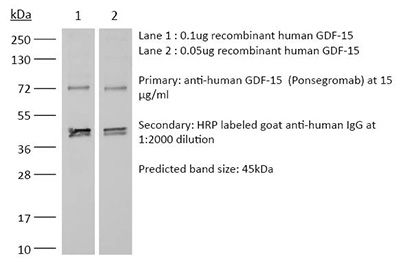
Product Description
Specifications
| Isotype | Human IgG1, κ |
|---|---|
| Recommended Isotype Control(s) | RecombiMAb human IgG1 (K214R/L234F/L235E/P331S) isotype control, anti-hen egg lysozyme |
| Recommended Dilution Buffer | InVivoPure pH 7.0 Dilution Buffer |
| Mutations | L234A/L235A/G237A/KDel |
| Immunogen | Human GDF15 |
| Reported Applications |
in vitro neutralization of GDF15 in vivo neutralization of GDF15 Functional assays Flow cytometry ELISA |
| Formulation |
PBS, pH 7.0 Contains no stabilizers or preservatives |
| Endotoxin |
≤0.5EU/mg (≤0.0005EU/μg) Determined by LAL assay |
| Aggregation |
<5% Determined by SEC |
| Purity |
≥95% Determined by SDS-PAGE |
| Sterility | 0.2 µm filtration |
| Production | Purified from cell culture supernatant in an animal-free facility |
| Purification | Protein A |
| RRID | AB_3696398 |
| Molecular Weight | 150 kDa |
| Murine Pathogen Tests |
Ectromelia/Mousepox Virus: Negative Hantavirus: Negative K Virus: Negative Lactate Dehydrogenase-Elevating Virus: Negative Lymphocytic Choriomeningitis virus: Negative Mouse Adenovirus: Negative Mouse Cytomegalovirus: Negative Mouse Hepatitis Virus: Negative Mouse Minute Virus: Negative Mouse Norovirus: Negative Mouse Parvovirus: Negative Mouse Rotavirus: Negative Mycoplasma Pulmonis: Negative Pneumonia Virus of Mice: Negative Polyoma Virus: Negative Reovirus Screen: Negative Sendai Virus: Negative Theiler’s Murine Encephalomyelitis: Negative |
| Storage | The antibody solution should be stored at the stock concentration at 4°C. Do not freeze. |
| Need a Custom Formulation? | See All Antibody Customization Options |
Application References
-
Huang Y, Wang J, Wei X, Zhang H, Shang W, Zhang X, Zhai L, Chen X, Li H, Qin S (2024). "GB18-06, a nanobody targeting GDF15, effectively alleviates weight loss and restores physical function in cachexia models" MAbs 16(1):2416453.
PubMed
Cachexia is a complicated metabolic syndrome mainly associated with cancers, characterized by extreme weight loss and muscle wasting. It is a debilitating condition that negatively affects prognosis and survival. However, there is currently no effective pharmacological intervention that can reverse body weight loss and improve physical performance in patients with cachexia. Growth differentiation factor 15 (GDF15) can suppress appetite and regulate energy balance through binding to glial cell-derived neurotrophic factor receptor alpha-like (GFRAL). In order to develop a novel, effective treatment for cachexia, we generated a GDF15-targeting VHH nanobody, GB18-06, that was able to bind GDF15 with high affinity. In vitro, GB18-06 potently inhibited the GDF15-GFRAL signaling pathway, leading to a reduction of downstream ERK and AKT phosphorylation levels; in vivo, GB18-06 alleviated weight loss (>20%) in cancer and chemotherapy-induced cachexia models in mice. Compared with the control (phosphate-buffered saline) group, the ambulatory activity of mice in the GB18-06-treated group also increased 77%. Furthermore, GB18-06 exhibited desirable pharmacokinetic properties and an excellent developability profile. Our study has demonstrated a means of developing targeted treatment for cachexia with high efficacy, potentially leading to improved clinical outcomes and quality of life for patients with cachexia.
-
Xiong J, Wu G, Ning J, Yan J, Yang J, Kang J (2024). "Neutralizing antibody against GDF15 for treatment of cancer-associated cachexia" PLoS One 19(8):e0309394.
PubMed
GDF15 (growth differentiation factor 15), also known as macrophage inhibitory cytokine 1 (MIC-1), is a circulating protein involved in the regulation of energy balance and weight control. Elevated levels of GDF15 have been associated with cachexia and reduced survival rates in cancer patients. Through the activation of the GFRAL (GDNF-family receptor α-like)-RET (Rearranged during Transfection) signaling pathway, GDF15 can induce weight loss, making it a potential target for treating cachexia. Currently, there are no approved antibody drugs specifically targeting GDF15 for cancer cachexia treatment. However, efforts have been made to develop antibody-based therapeutics against this emerging target. In this study, we generated a monoclonal antibody KY-NAb-GDF15 against GDF15 that effectively blocks downstream signaling mediated by GFRAL upon stimulation by GDF15. This antibody demonstrates robust neutralizing activity and exhibits high binding specificity. Importantly, our findings indicate that this antibody holds promise in alleviating cancer-induced cachexia and mitigating chemotherapy-induced weight loss, thereby offering significant therapeutic potential for managing cancer cachexia.
-
Breen DM, Kim H, Bennett D, Calle RA, Collins S, Esquejo RM, He T, Joaquim S, Joyce A, Lambert M, Lin L, Pettersen B, Qiao S, Rossulek M, Weber G, Wu Z, Zhang BB, Birnbaum MJ (2020). "GDF-15 Neutralization Alleviates Platinum-Based Chemotherapy-Induc
PubMed
Platinum-based cancer therapy is restricted by dose-limiting side effects and is associated with elevation of growth differentiation factor 15 (GDF-15). But whether this elevation contributes to such side effects has been unclear. Here, we explored the effects of GDF-15 blockade on platinum-based chemotherapy-induced emesis, anorexia, and weight loss in mice and/or nonhuman primate models. We found that circulating GDF-15 is higher in subjects with cancer receiving platinum-based chemotherapy and is positively associated with weight loss in colorectal cancer (NCT00609622). Further, chemotherapy agents associated with high clinical emetic score induce circulating GDF-15 and weight loss in mice. Platinum-based treatment-induced anorexia and weight loss are attenuated in GDF-15 knockout mice, while GDF-15 neutralization with the monoclonal antibody mAB1 improves survival. In nonhuman primates, mAB1 treatment attenuates anorexia and emesis. These results suggest that GDF-15 neutralization is a potential therapeutic approach to alleviate chemotherapy-induced side effects and improve the quality of life.